
James Webb Tracks Real-Time Weather on Brown Dwarf 7.5 Light-Years Away
For the first time, scientists watched clouds shift and thicken on a freezing world just 7.5 light-years from Earth. The James Webb Space Telescope spent 11 hours tracking actual weather patterns on a brown dwarf colder than Antarctica.
Astronomers just watched weather happen on another world in real time, and it's closer than you might think.
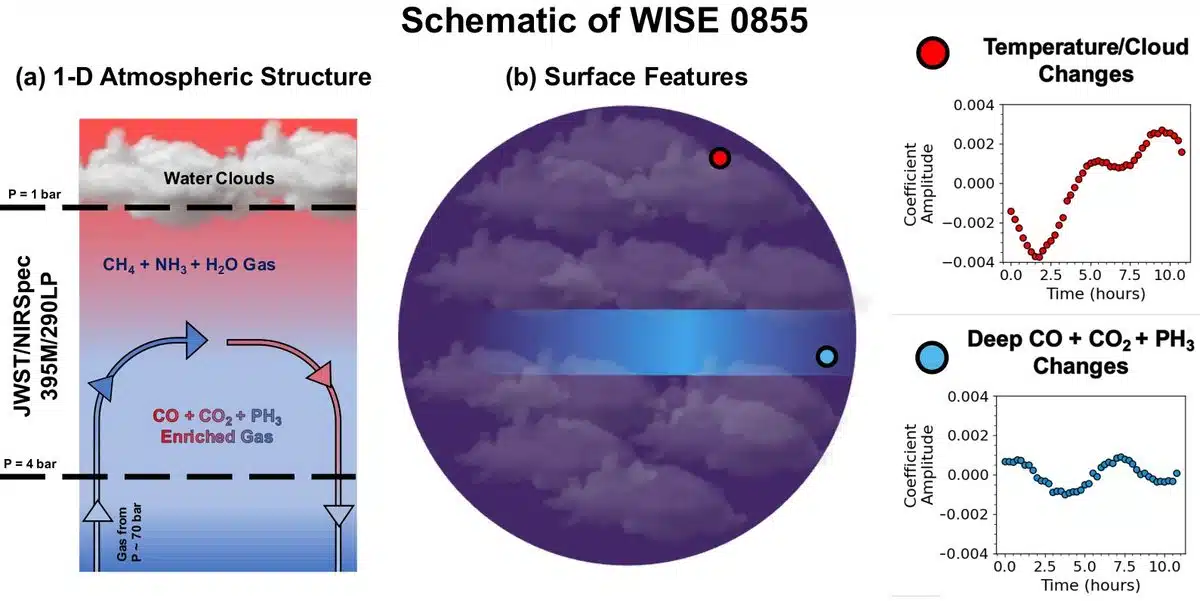
NASA's James Webb Space Telescope spent 11 hours monitoring WISE 0855, a strange brown dwarf only 7.5 light-years from Earth. The telescope captured something scientists had never directly confirmed before: water clouds actually thickening and thinning as the object rotated.
WISE 0855 sits at around 17°F, making it the coldest brown dwarf ever discovered. It's roughly the size of Jupiter but twice as massive, existing in that mysterious zone between giant planet and failed star.
Brittany Miles from the University of Arizona led the research team, taking measurements every 15 minutes throughout the observation period. What they saw was remarkable: different atmospheric regions rotating into view, each with varying cloud thickness and slightly different temperatures.
"This is the first time we've been able to confirm that water clouds are becoming thinner and thicker on a nearby world," Miles said. Before Webb, astronomers could spot brightness changes but couldn't figure out what caused them.
The telescope also detected something deeper. Wave-like signals from carbon monoxide and phosphine revealed convection currents moving through the atmosphere, carrying gases upward from hotter layers below.
Think of soup heating on a stove, with warm liquid rising from the bottom and circulating. Something similar happens inside WISE 0855, where heat moves gases between atmospheric layers just like on Jupiter.
The difference now is that researchers can follow these chemical signals over time and track individual molecules. "We're seeing water clouds getting thicker and thinner, and deep gases rising and falling, and we can actually watch them change in real time," Miles explained.
Why This Inspires
This discovery does more than reveal weather on a distant brown dwarf. It shows we've reached a point where scientists can study atmospheric processes on worlds light-years away with the same detail they use for Jupiter.
Mark Marley from the University of Arizona's Lunar and Planetary Laboratory compared studying atmospheres to looking through a screen door: some light passes through while the rest gets filtered out. Webb's precision finally lets researchers separate those different effects.
The findings, accepted for publication in The Astrophysical Journal, prove we can now distinguish between cloud activity and deeper chemical processes in distant atmospheres. What once looked like simple brightness changes now reveals a dynamic, weather-driven world.
WISE 0855 may be a brown dwarf rather than a planet, but it behaves enough like Jupiter to help scientists understand atmospheric physics across different types of objects. The same forces shaping clouds and circulation in our solar system operate on worlds we're only beginning to explore.
We've gone from wondering what happens on nearby worlds to actually watching their weather unfold.
More Images


Based on reporting by Innovation Desk
This story was written by BrightWire based on verified news reports.
Building Something New? Try the BrightWire Tech Stack Advisor
Compare modern frameworks, cloud hosting, and AI tools tailored to your project budget and scale.
Spread the positivity!
Share this good news with someone who needs it


