Japan AI Decodes Thoughts at 90% Accuracy for Paralysis Aid
Japanese researchers created an AI system that reads brain signals when people imagine moving their limbs, achieving 90% accuracy. The breakthrough could let paralyzed individuals control wheelchairs and robotic limbs with their thoughts alone.
Scientists at Chiba University in Japan just solved one of the toughest puzzles in brain technology: teaching computers to read our thoughts accurately enough to help paralyzed people move again.
The team developed a new AI system that decodes the electrical signals our brains create when we imagine moving our arms or legs. Even though no actual movement happens, the brain produces distinctive patterns that the AI learned to recognize with 90% accuracy.
Brain-computer interfaces have promised for years to help people with paralysis control wheelchairs, prosthetic limbs, and rehabilitation robots using only their thoughts. The challenge has always been reading brain signals reliably enough to make these devices actually work in real life.
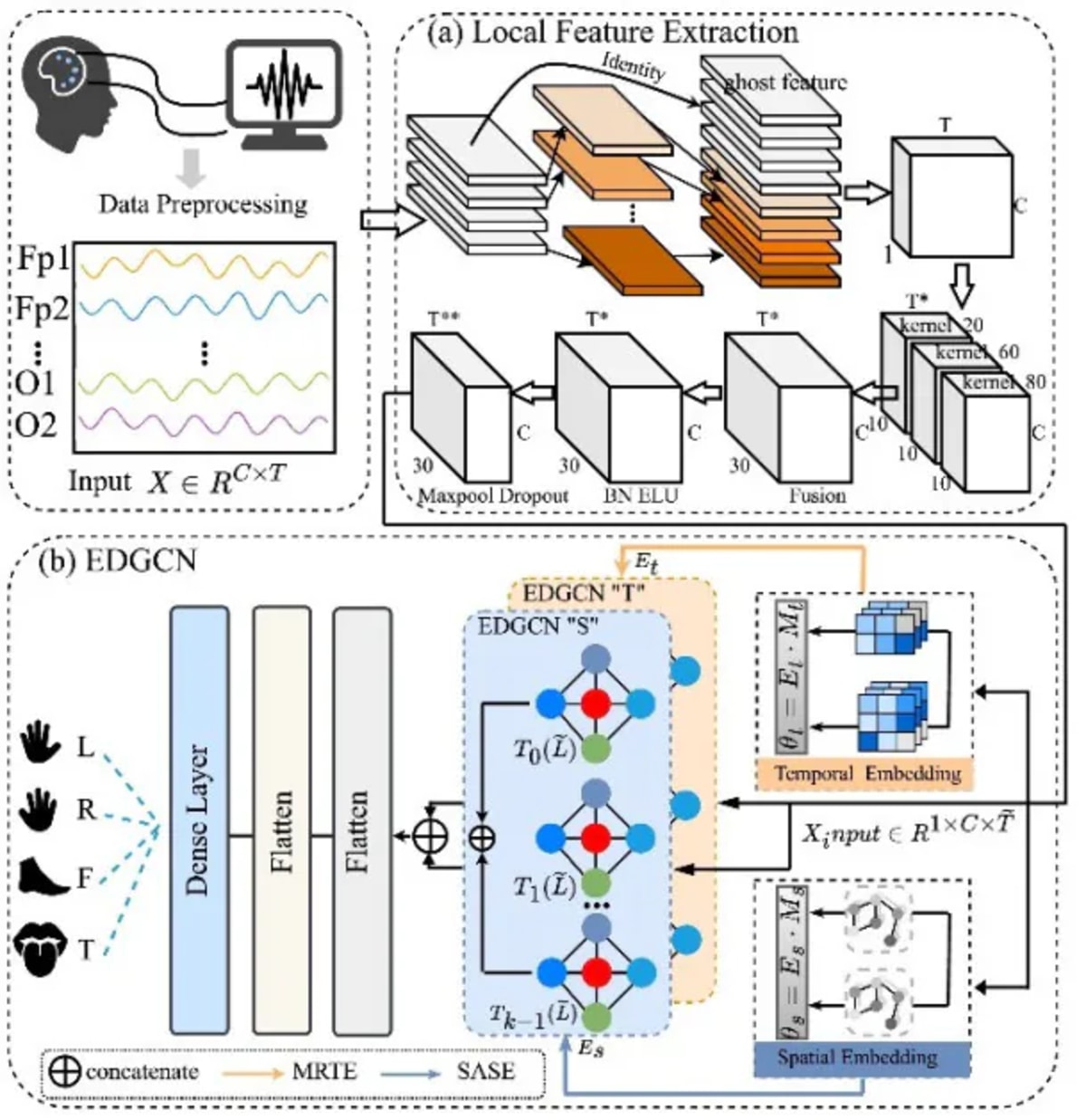
Ph.D. student Chaowen Shen and Professor Akio Namiki created something called an Embedding-Driven Graph Convolutional Network, or EDGCN for short. Their system does something earlier technology couldn't: it adapts to how each person's brain works uniquely.
The researchers explained that brain signals are notoriously messy. They vary wildly between different people and even change within the same person from day to day. Traditional AI systems tried to force these signals into rigid patterns, which is why they kept failing.
EDGCN takes a smarter approach. It analyzes brain activity at multiple time scales simultaneously, catching important patterns that happen at different speeds. It also treats the brain like the network it actually is, tracking how different regions communicate with each other rather than treating each area as isolated.
The system tested itself against standard benchmark datasets used across the brain-computer interface field. It didn't just work; it outperformed every previous method researchers threw at it.
Why This Inspires
This breakthrough matters because millions of people living with paralysis from spinal cord injuries, strokes, or conditions like ALS could regain independence. Imagine controlling a robotic arm to feed yourself, or steering your wheelchair through a park, all by simply thinking about the movement.
The technology is non-invasive, using electrodes placed on the scalp rather than requiring brain surgery. That makes it accessible and safer for widespread use once it moves from lab to real-world applications.
What makes this particularly exciting is that the AI adapts to individual brain patterns instead of forcing users through extensive training sessions. Earlier systems required hours of calibration before they worked at all. EDGCN's flexibility could make brain-controlled devices practical for everyday life.
The research opens doors not just for paralysis patients but for anyone with severe motor impairments who struggles to interact with technology or control their environment.
Science keeps finding new ways to give people back what disease or injury took away, and this AI breakthrough just made that future significantly closer.
More Images

Based on reporting by Google News - AI Breakthrough
This story was written by BrightWire based on verified news reports.
Spread the positivity!
Share this good news with someone who needs it