Japan Solar Cell Hits Record 12.28% Efficiency
Japanese researchers just set a world record for a new type of solar cell that could make future solar panels cheaper and more powerful. The breakthrough brings us closer to next-generation solar technology that captures more sunlight.
Scientists in Japan have cracked a world record for solar cell efficiency using a material that could transform how we power our homes and cities.
Researchers at Japan's National Institute of Advanced Industrial Science and Technology achieved 12.28% efficiency in a solar cell made from copper gallium selenide. That might not sound huge, but it's the highest ever recorded for this type of wide-bandgap solar cell, and it opens doors to exciting possibilities.
What makes this material special? Copper gallium selenide has a sweet spot for capturing sunlight. Its 1.68 electron volt bandgap means it absorbs visible light exceptionally well, and it needs only thin films to capture solar radiation. Even better, the material tolerates tiny imperfections in its structure, so it keeps performing well without needing perfect manufacturing conditions.
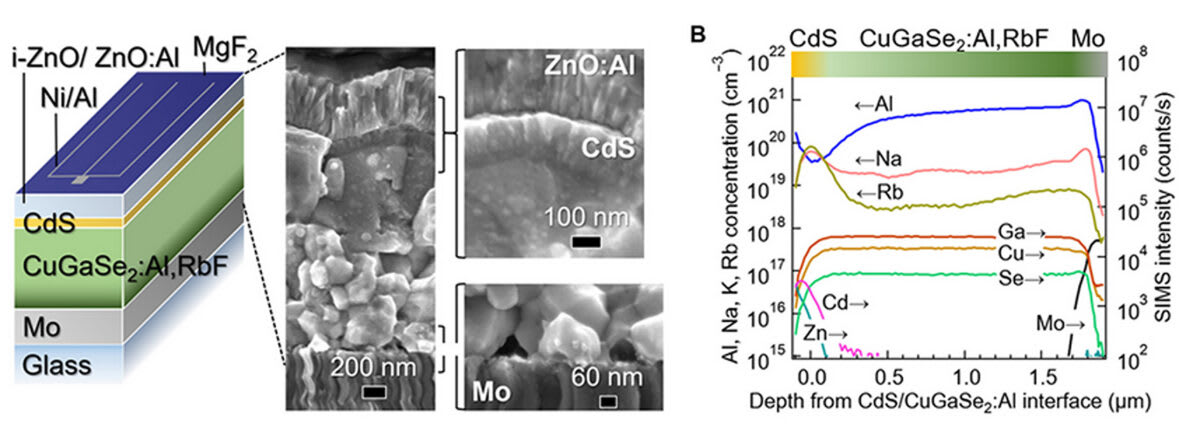
The team built on their own 2024 design by carefully incorporating aluminum into the back layer of the cell. This created what scientists call a back-surface field, which helps the cell collect more electrical charge from sunlight. They also added rubidium fluoride at precise moments during manufacturing to boost performance.
The cell achieved an open-circuit voltage of nearly one volt, with a short-circuit current of 17.90 milliamps per square centimeter. An independent testing lab certified the results, confirming this as a genuine breakthrough.
The Ripple Effect
This advance matters beyond the lab because these cells are designed to become the top layer in tandem solar cells. Tandem technology stacks different materials to capture more of the sun's spectrum, potentially doubling the efficiency of rooftop solar panels. While mass production is still years away, this research proves the concept works.
The breakthrough also points toward solar cells without indium, a relatively scarce element. Moving away from rare materials could make solar power more affordable and accessible worldwide as demand grows.
Lead researcher Shogo Ishizuka says the team is focused on fundamental research for now, with prototype development and cost analysis still ahead. But each efficiency gain brings us closer to solar panels that generate more power from the same roof space.
The sun delivers more energy to Earth in one hour than humanity uses in a year, and breakthroughs like this help us capture more of it.
More Images
Based on reporting by PV Magazine
This story was written by BrightWire based on verified news reports.
Spread the positivity!
Share this good news with someone who needs it