Japan Unlocks Clean Hydrogen Tech With New Ceramic Material
Scientists in Japan have created a ceramic material that solves a decades-old problem blocking efficient hydrogen energy, potentially accelerating the shift to carbon-free power. The breakthrough material conducts hydrogen protons at record speeds while staying stable in real-world conditions.
A team of Japanese researchers just cracked a puzzle that's been frustrating clean energy scientists for decades, and it could help hydrogen power become practical for millions of homes and businesses.
Scientists at the Institute of Science Tokyo developed a new ceramic material that moves hydrogen protons faster than any previous material at moderate temperatures. More importantly, it stays chemically stable in the harsh conditions of actual fuel cells and electrolyzers.
The challenge they solved has a name: the "Norby gap." For years, ceramic materials could either conduct protons efficiently or remain stable over time, but never both at once. Professor Masatomo Yashima and his team found a solution by trying something different.
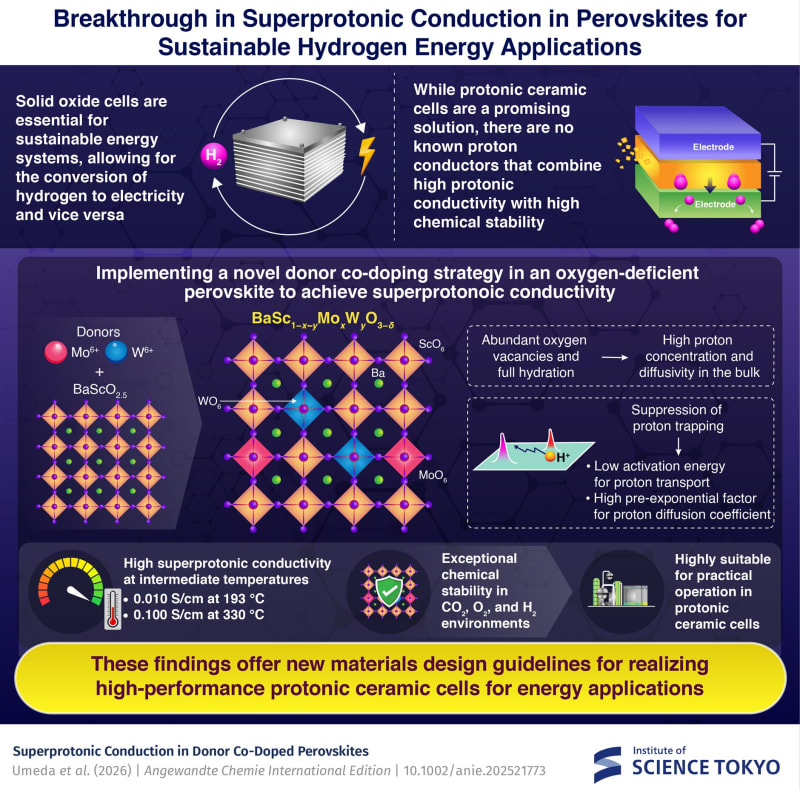
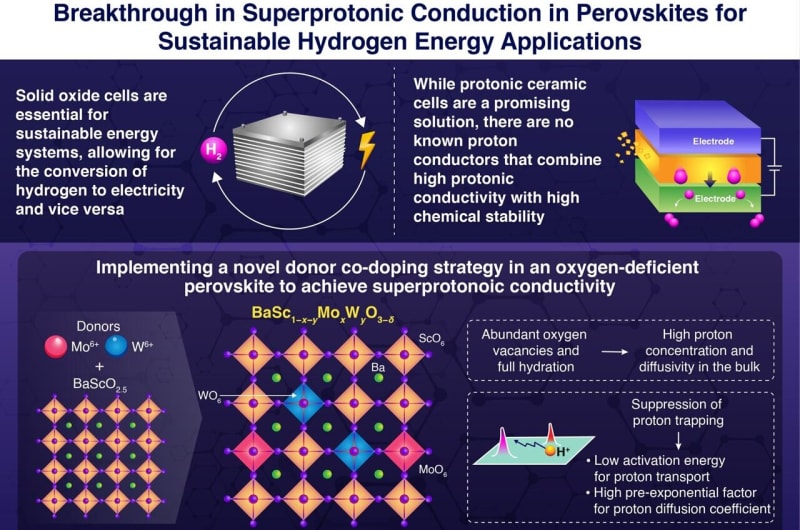
Instead of the standard approach of creating oxygen gaps in the ceramic, they added two elements called molybdenum and tungsten to a base material. This "donor co-doping" strategy sounds technical, but the result is beautifully simple: protons can zoom through the material without getting trapped.
The new material hit 0.01 siemens per centimeter of conductivity at just 193 degrees Celsius. That's a temperature low enough to make hydrogen fuel cells cheaper and more practical for everyday use. By 330 degrees, conductivity jumped to 0.10 siemens per centimeter, far exceeding conventional materials.
Why does this matter for anyone outside a chemistry lab? Hydrogen is one of our best hopes for storing clean energy and generating electricity without carbon emissions. But the technology has been too expensive and inefficient for widespread use.
Protonic ceramic fuel cells need materials that work at intermediate temperatures, stay stable when exposed to carbon dioxide and oxygen, and don't break down over time. Until now, no material checked all those boxes.
The Ripple Effect
This discovery opens doors across the entire hydrogen economy. Next-generation fuel cells could power vehicles, homes, and industries more efficiently. Steam electrolysis cells, which split water into hydrogen fuel, could operate at lower costs. Both technologies edge closer to commercial reality.
The research team tested their material extensively using neutron diffraction and computer simulations. They confirmed it remains stable in carbon dioxide, oxygen, and hydrogen environments, proving it can handle real-world applications.
Yashima believes this "powerful new design principle" will accelerate practical development of hydrogen technologies aimed at achieving carbon-neutral societies. Other researchers can now use the same donor co-doping approach to create similar materials.
The study was published January 19, 2026, in the journal Angewandte Chemie International Edition after peer review. The findings represent years of systematic research combining chemistry, physics, and materials science.
Hydrogen energy has promised a clean future for decades, but delivering on that promise required solving problems exactly like the Norby gap, and today that future moved closer to reality.
More Images

Based on reporting by Phys.org - Technology
This story was written by BrightWire based on verified news reports.
Spread the positivity!
Share this good news with someone who needs it