
Jefferson's Giant Sloth Discovery Came From West Virginia
In 1796, cave workers in what's now West Virginia unearthed mysterious giant bones that sparked America's first major fossil discovery. Thomas Jefferson's study of these massive claws launched vertebrate paleontology in the United States.
Workers digging for saltpeter in a West Virginia cave stumbled upon bones so large they thought they'd found a lion the size of an elephant. What they actually discovered was far more extraordinary: an extinct giant ground sloth that would help launch American paleontology.
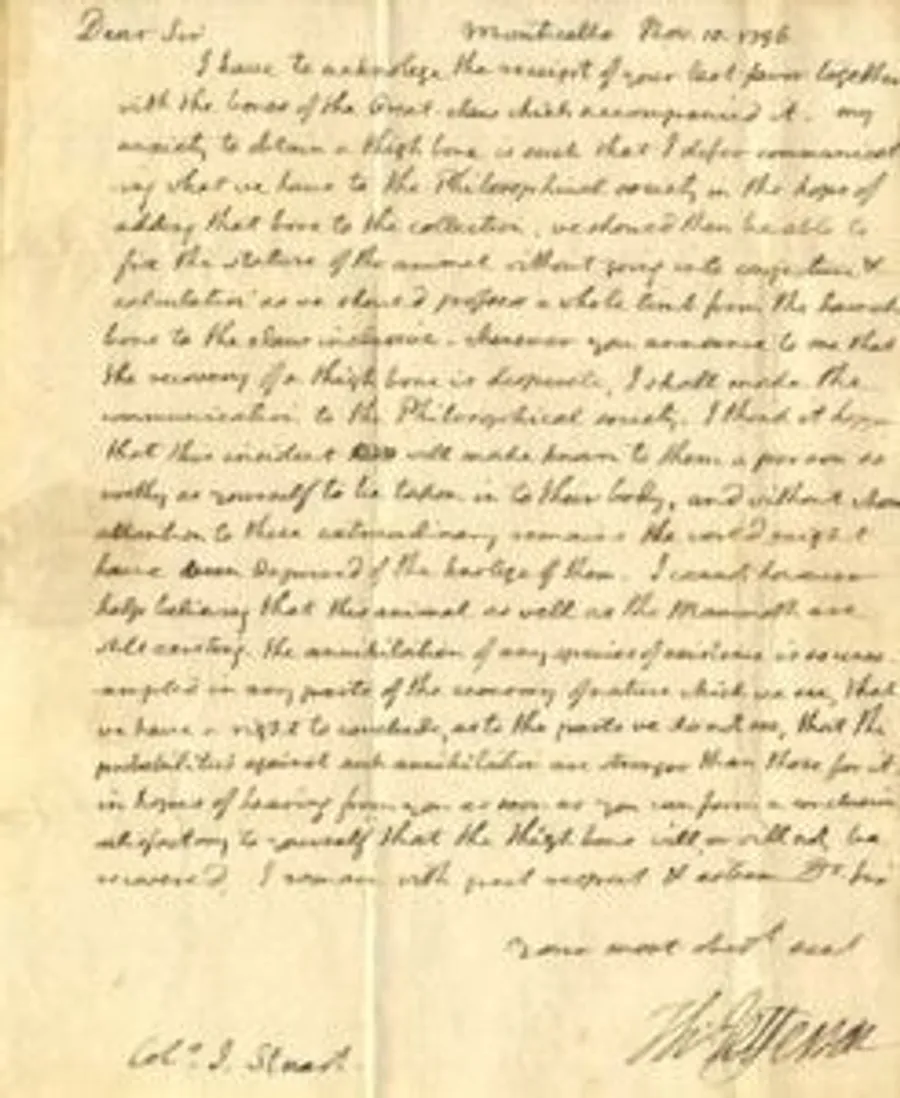
In 1796, Colonel John Stuart sent the mysterious fossils to Thomas Jefferson, who was captivated by natural history. Stuart described remains from a "Tremendous animal of the Clawed kind" with unusually large claws. Jefferson initially agreed, naming the creature Megalonyx, meaning "great claw" in Greek.
But Jefferson reconsidered before presenting his findings to the American Philosophical Society in Philadelphia in March 1797. He'd just learned about Megatherium, a giant fossil sloth from South America. The similarities were too striking to ignore.
Philadelphia physician Caspar Wistar accompanied Jefferson's 1799 paper with detailed anatomical descriptions and illustrations. By comparing the bones with modern sloths, Wistar confirmed that Megalonyx was indeed a ground sloth, not a massive cat. The American Philosophical Society now recognizes Jefferson's presentation as the beginning of vertebrate paleontology in the United States.
For nearly a century, historians believed the fossils came from Organ Cave in Greenbrier County. Local tradition dating to 1928 linked Jefferson to the site, though records showed inconsistencies. Jefferson placed the cave west of the Greenbrier River, while Organ Cave sits east of it.
Paleontologist Frederick Grady solved the mystery by examining land records and historical correspondence. His research revealed that Frederic Cromer, who owned the land where the bones were found, never owned Organ Cave. Instead, Grady identified Haynes Cave in present-day Monroe County as the likely source.
Researchers discovered two fragments of a Megalonyx shoulder blade in Haynes Cave during the early 1990s. This find confirmed the presence of giant sloth remains there, supporting Grady's conclusion.
Why This Inspires
Jefferson's careful study of these mysterious bones shows how curiosity and scientific humility can lead to breakthrough discoveries. Rather than stubbornly defending his initial lion theory, he changed his mind when new evidence emerged. His willingness to collaborate with anatomist Wistar created a foundation for American paleontology that continues today.
The original hand bones Jefferson studied are now preserved at the Academy of Natural Sciences of Drexel University in Philadelphia, where they continue inspiring new generations of scientists.
From cave workers seeking saltpeter to a Founding Father piecing together clues about ancient life, this West Virginia discovery reminds us that scientific breakthroughs can start anywhere.
More Images



Based on reporting by Innovation Desk
This story was written by BrightWire based on verified news reports.
Building Something New? Try the BrightWire Tech Stack Advisor
Compare modern frameworks, cloud hosting, and AI tools tailored to your project budget and scale.
Spread the positivity!
Share this good news with someone who needs it


