JWST Captures Stunning "Brain Nebula" 5,000 Light-Years Away
The James Webb Space Telescope just revealed images of a dying star that looks exactly like a glowing brain floating in space. Scientists captured the "Exposed Cranium" Nebula shedding beautiful clouds of gas and dust as it reaches the end of its life.
A dying star 5,000 light-years away is putting on one of the most beautiful shows the universe has to offer.
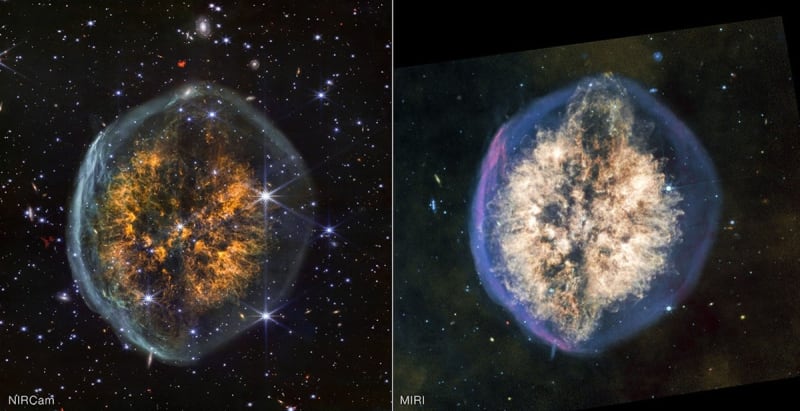
The James Webb Space Telescope captured stunning new images of Nebula PMR 1, nicknamed the "Exposed Cranium" Nebula. Located in the constellation Vela, the massive star is running out of fuel and shedding layers of its outer material into space.
The result looks uncannily like a human brain inside a translucent skull. A dark channel runs through the middle of the glowing gas clouds, mirroring the groove that separates our brain's two hemispheres.
Scientists believe jets shooting from the dying star are pushing the inner gas outward, creating this remarkable brain-like structure. The outer layers consist mainly of simple hydrogen, while the inner clouds contain more complex elements.
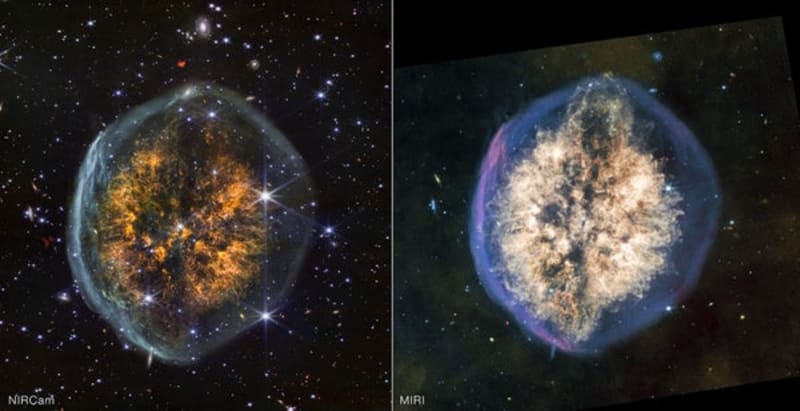
The telescope captured the nebula in both near and mid-infrared light, revealing details invisible to previous instruments. These billowing clouds of gas and dust showcase the star's dramatic transformation as it approaches its final chapter.
Why This Inspires
This cosmic spectacle reminds us that even endings can be breathtakingly beautiful. The dying star isn't just fading away but creating something extraordinary that scientists can study and the rest of us can marvel at.
The nebula also gives astronomers a front-row seat to stellar evolution. By observing PMR 1, researchers are learning more about how stars live, die, and recycle their materials back into space.
What happens next depends on the star's mass. If it's heavy enough, it will explode in a spectacular supernova. If not, it will gradually shed its outer layers until only its dense core remains, becoming a white dwarf that will cool over billions of years.
Either way, the elements this star releases will eventually become part of new stars, planets, and potentially even life. The carbon, oxygen, and other materials floating in those brain-like clouds might one day help form worlds we can't yet imagine.
The James Webb Space Telescope continues proving its worth just years after launch. Its powerful infrared instruments reveal cosmic wonders that previous telescopes could only dream of capturing, turning distant dying stars into works of art we can all appreciate.
Beauty exists everywhere in the universe, even in a star's final act.
More Images



Based on reporting by Scientific American
This story was written by BrightWire based on verified news reports.
Spread the positivity!
Share this good news with someone who needs it