Kangaroos Evolved Twice as Australia Dried Out 9M Years Ago
Scientists discovered why kangaroos became Australia's hopping icons. Climate change millions of years ago gave them an evolutionary advantage that changed the continent forever.
Australian researchers just solved a mystery that's been hopping around evolutionary biology for decades: why kangaroos and wallabies became the continent's dominant plant eaters.
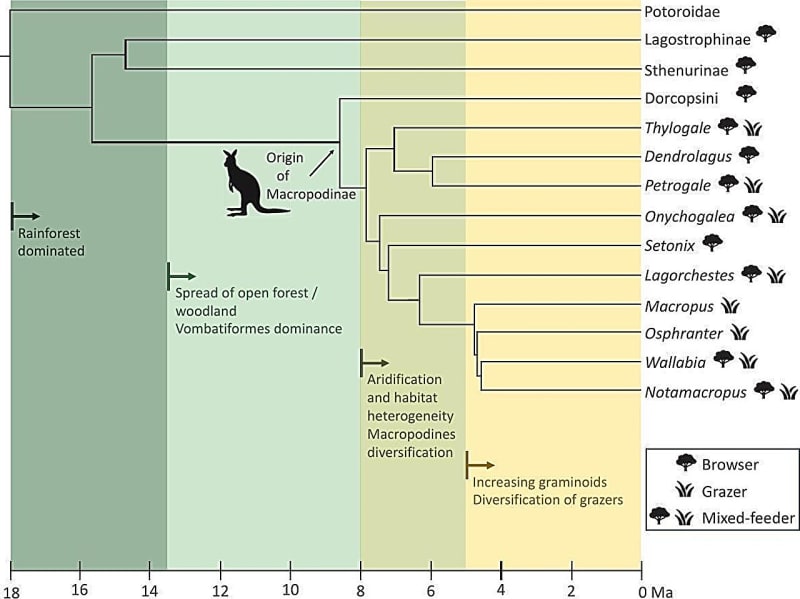
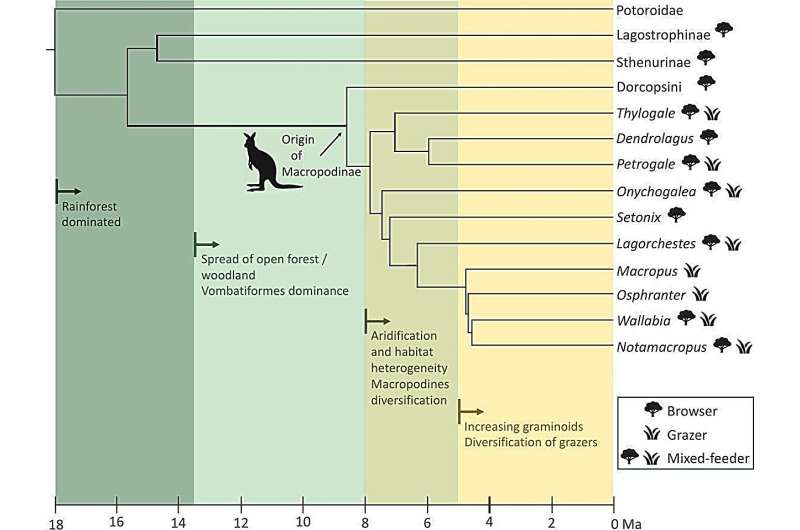
A team from Queensland University of Technology found that modern kangaroos didn't evolve gradually over time. Instead, they exploded onto the scene in two dramatic bursts, both triggered by Australia's transformation from lush rainforest to dry grassland.
The first evolutionary leap happened 7 to 9 million years ago when Australia began drying out. As habitats became more varied and water sources spread further apart, kangaroos' unique hopping ability suddenly became a superpower.
"More arid and variable habitats likely shifted the balance of evolutionary competition in favor of kangaroos and wallabies," said Professor Matthew Phillips, who led the study. Their energy-efficient hopping meant they could travel farther for water and food than their competitors.
The second burst came 4.5 to 5 million years ago when grasslands emerged across the continent. This time, kangaroos that could graze on the new grasses diversified rapidly, creating most of the species we recognize today including the iconic red and grey kangaroos.
Ph.D. researcher Clelia Gauthier and her team built the most comprehensive genetic dataset ever assembled for these marsupials. They combined complete mitochondrial genomes with 11 nuclear genes across all living kangaroo and wallaby groups, then matched their findings with Australia's fossil record.
The timing tells a remarkable story of survival. As kangaroos thrived, many other large herbivores went extinct, including the ancestors of today's wombats who once dominated the landscape.
Why This Inspires
This research shows how understanding the past helps us protect the future. Kangaroos succeeded because they adapted to environmental change, but that change happened over millions of years.
Today's kangaroos face rapid human-driven climate shifts. Knowing exactly which environmental pressures shaped their evolution gives conservationists crucial insights into protecting these iconic animals as Australia's climate continues changing.
The study also demonstrates the power of combining cutting-edge genetic science with traditional fossil records. What seemed like random evolutionary luck turns out to be a clear story of adaptation written in both genes and ancient bones.
Sometimes the best way forward is understanding how we got here in the first place.
More Images
Based on reporting by Phys.org
This story was written by BrightWire based on verified news reports.
Spread the positivity!
Share this good news with someone who needs it