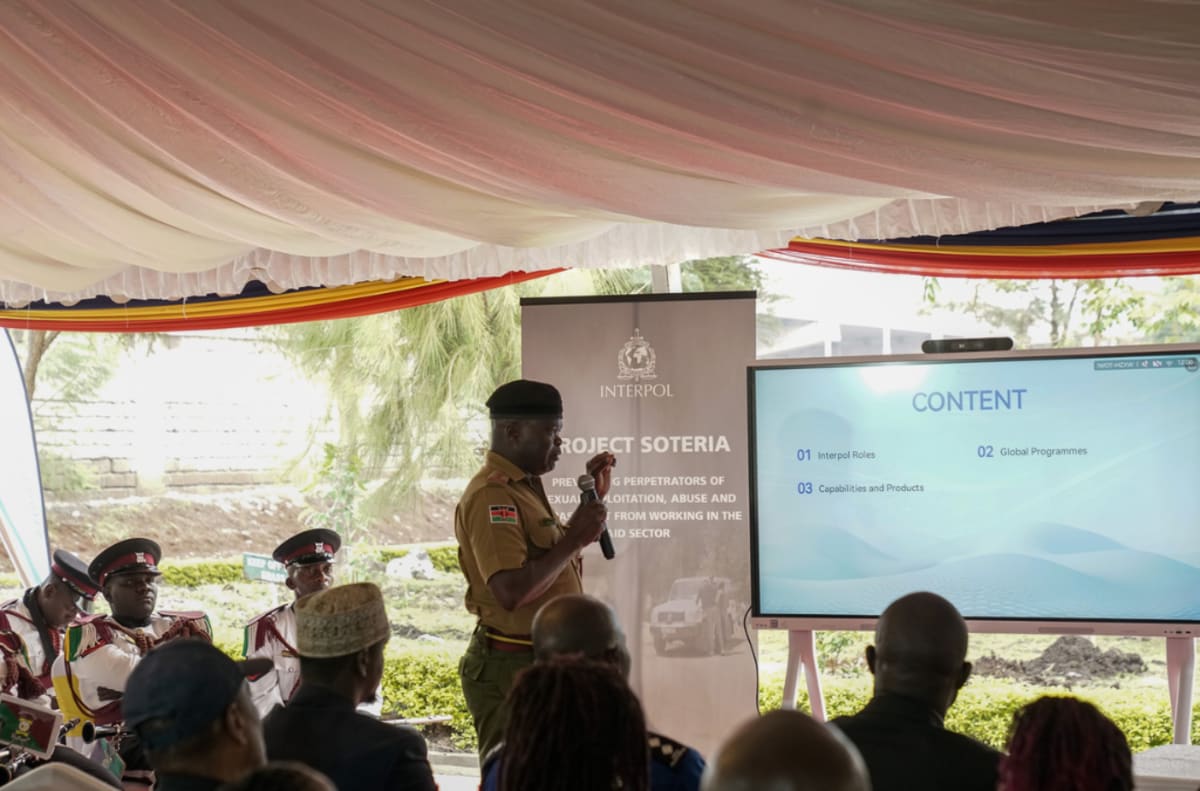
Kenya Launches INTERPOL Training to Fight Cross-Border Crime
Kenya just became the first in its region to integrate INTERPOL's global crime-fighting tools into national police training. Officers now learn to use international databases and secure communication systems to catch criminals who cross borders.
Kenyan police officers are getting powerful new training that connects them directly to the world's largest law enforcement network.
The country launched a groundbreaking course in March 2026 that teaches officers how to use INTERPOL's global databases, secure communication platforms, and investigative tools. It's the first program of its kind in the region to make international policing capabilities part of standard training.
Inspector-General Douglas Kanja Kirocho explained why this matters now more than ever. "Criminals exploit the gaps between law enforcement agencies, the gaps between national crime databases, and the gaps in our knowledge of how to use international policing tools," he said.
The training addresses a critical challenge: criminal networks don't respect borders, but cooperation between countries can be slow and complicated. When a crime crosses from Kenya to Tanzania or beyond, investigators need instant access to shared information and trusted partners who know how to work together.
The course uses real-world case studies, group analysis, and hands-on simulations to prepare officers for actual transnational investigations. Officers learn to identify, investigate, and respond to crimes including human trafficking and gender-based violence that span multiple countries.
Mohamed I. Amin, Director of Kenya's Directorate of Criminal Investigations, emphasized the long-term vision. "By institutionalizing this training, we are investing in lasting capability, strengthening trust among our partners, and reinforcing Kenya's leadership in advancing security across the region."
The Ripple Effect
Kenya's initiative creates a model other countries can follow. When more nations train their officers in the same international systems, the entire network becomes faster and more effective at stopping criminals who cross borders.
The stronger connections also build trust between law enforcement agencies in different countries. Officers who understand the same tools and protocols can collaborate confidently, turning what used to be slow diplomatic processes into quick operational responses.
INTERPOL developed the course through Project Soteria, with funding from the UK's Foreign, Commonwealth and Development Office. David Caunter, INTERPOL's Director of Organized and Emerging Crime, noted that the program "enables officers to operate even more efficiently within international networks, ensuring their local expertise is fully connected to global responses."
Kenya is showing that investing in training today creates safer communities tomorrow, across borders and beyond.
Based on reporting by Google: cooperation international
This story was written by BrightWire based on verified news reports.
Spread the positivity!
Share this good news with someone who needs it