Korean Scientists Solve Solar Panel Efficiency Problem
Researchers just cracked a puzzle that has held back solar energy for years: how to make panels more efficient without shortening their lifespan. South Korean scientists achieved both goals at once, bringing cheaper renewable energy closer to reality.
Scientists in South Korea just solved a problem that has frustrated the solar industry for decades: making panels both powerful and long-lasting at the same time.
A team at the Korea Advanced Institute of Science and Technology (KAIST) developed a new way to build perovskite solar cells that are more efficient and more durable. These next-generation panels could help make clean energy cheaper and more reliable for millions of homes.
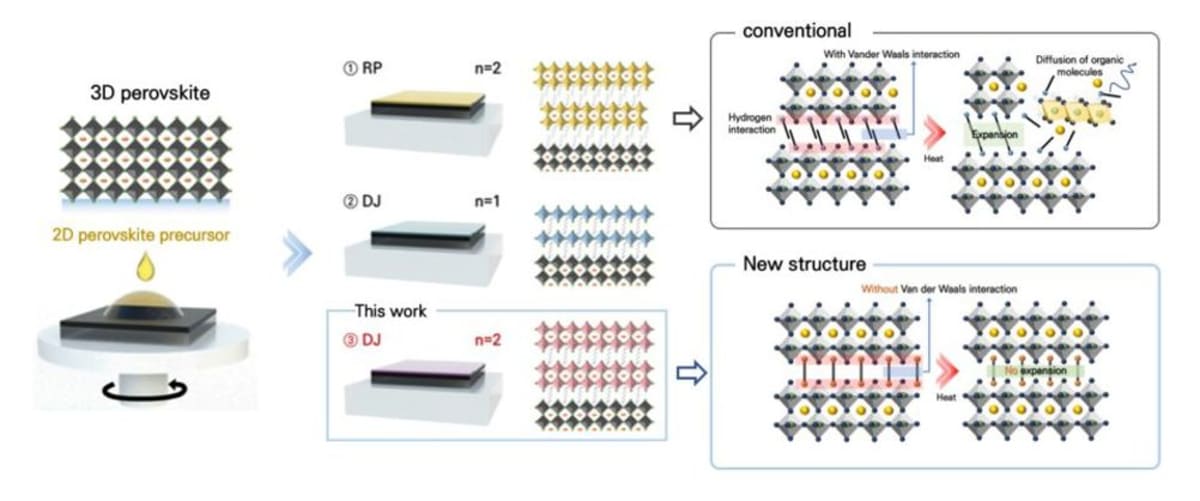
The breakthrough centers on a thin protective layer that sits on top of the solar cell. By carefully controlling how this layer forms during manufacturing, the researchers created panels that convert over 25 percent of sunlight into electricity while staying stable under harsh conditions.
Previous attempts to boost efficiency came with a costly tradeoff. Make the panels more powerful, and they degraded faster in heat and humidity. Make them last longer, and performance suffered. It seemed impossible to win at both.
Professor Jangwon Seo's team used a special structure called Dion-Jacobson perovskite, which holds layers together more firmly than older designs. They discovered they could control exactly how these layers stack by adjusting the temperature during manufacturing.
The results speak for themselves. The new solar cells maintained high performance even after prolonged exposure to 85-degree heat, 85 percent humidity, and continuous sunlight. That's exactly the kind of real-world punishment that destroys typical perovskite panels.
The team didn't stop at lab samples. They successfully built larger modules using the same technique, proving the technology can scale up for commercial production.
The Ripple Effect
This advance matters beyond laboratory bragging rights. Perovskite solar cells are lighter, cheaper to manufacture, and easier to install than traditional silicon panels. But their tendency to degrade quickly has kept them from reaching rooftops and solar farms.
By solving the durability problem without sacrificing efficiency, KAIST researchers cleared a major roadblock for the technology. Countries racing to reduce carbon emissions need solar panels that generate more power and last longer, making renewable energy competitive with fossil fuels.
The team's method also works reliably even when manufacturing conditions vary slightly, a crucial advantage for mass production. That means companies could adopt this technique without requiring perfect laboratory conditions every time.
Scientists worldwide have been chasing stable, efficient perovskite cells for years, and this design brings the technology significantly closer to real-world deployment.
Clean energy just got a little more powerful and a lot more practical.
Based on reporting by Google: solar power breakthrough
This story was written by BrightWire based on verified news reports.
Spread the positivity!
Share this good news with someone who needs it