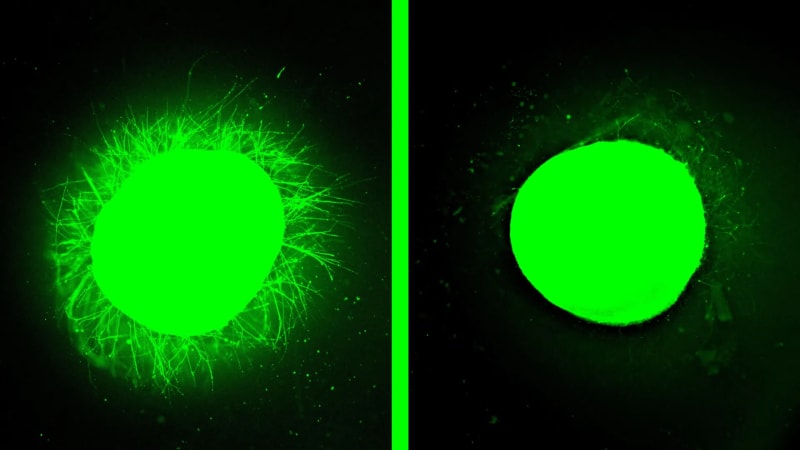
Lab-Grown Spinal Cord Heals After Injury at Northwestern
Scientists created a mini human spinal cord in the lab and successfully treated it with a groundbreaking therapy that regrew nerve fibers and erased scar tissue. This breakthrough brings real hope to millions living with spinal cord injuries.
A tiny lab-grown spinal cord just proved that reversing paralysis might be closer than we think.
Researchers at Northwestern University built the most realistic human spinal cord model ever created, then deliberately injured it to test a revolutionary therapy called "dancing molecules." The results were stunning: nerve fibers that had stopped growing began extending again, and the thick scar tissue that normally blocks healing nearly disappeared.
The miniature spinal cords, called organoids, are grown from stem cells and measure just a few millimeters across. But they contain all the same components as real spinal cords, including neurons, support cells, and immune cells that respond to injury.
Lead scientist Samuel Stupp and his team became the first researchers to include microglia, specialized immune cells, in their lab-grown spinal cords. This addition made the model react to injury just like human tissue does, with inflammation and devastating scar formation that prevents healing.
Then came the treatment. The dancing molecules therapy works by forming a web of nanofibers that mimics the spinal cord's natural structure. These molecules move dynamically to better interact with cells, essentially telling them to start repairing themselves.
The organoids responded just as real tissue might. Dead and damaged areas began producing new neurites, the long extensions that let nerve cells communicate. The glial scar, normally an impenetrable barrier to healing, shrank dramatically.
Why This Inspires
This discovery matters because spinal cord injuries have long been considered permanent. More than 300,000 Americans currently live with these devastating injuries, facing paralysis and life-altering challenges every day.
The dancing molecules therapy already showed promise in animal studies, restoring movement to paralyzed mice. Now, seeing it work in human tissue brings the possibility of clinical trials much closer.
The U.S. Food and Drug Administration recently granted the therapy Orphan Drug Designation, a status that speeds development for treatments addressing serious conditions. The Northwestern team published their findings in Nature Biomedical Engineering on February 11.
Stupp emphasizes that organoids let researchers test new therapies in actual human tissue without waiting for clinical trials. The fact that this human model responded the same way animals did strengthens confidence that the treatment could work in people.
The research also opens doors beyond spinal cord injuries. The same organoid technology could help scientists develop treatments for other nervous system conditions, from traumatic brain injuries to degenerative diseases.
For now, the breakthrough offers something precious to people facing paralysis: validated scientific hope that repair might truly be possible.
Based on reporting by Science Daily
This story was written by BrightWire based on verified news reports.
Spread the positivity!
Share this good news with someone who needs it