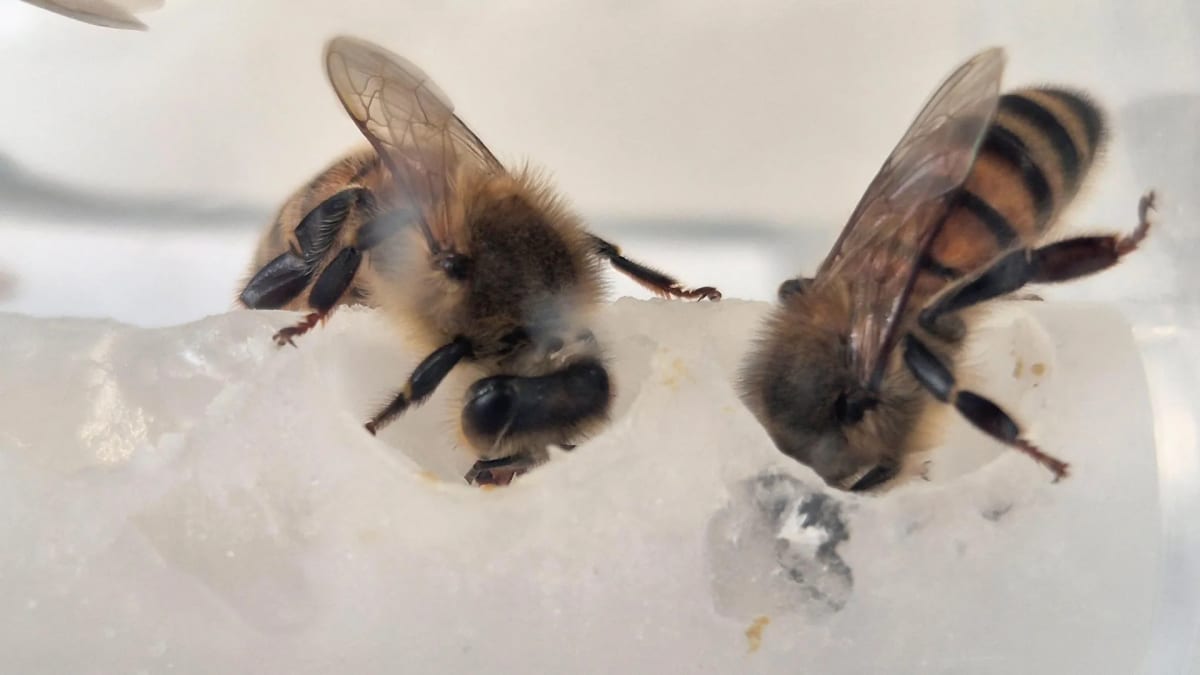
Lab-Made Bee Food Boosts Colony Growth 15-Fold
Scientists created a superfood for honeybees using engineered yeast, and colonies exploded with 15 times more young. The breakthrough could help save struggling bee populations and protect our food supply.
Honeybees just got a lifeline that could change everything about how we protect our food supply.
Researchers at the University of Oxford engineered a revolutionary bee superfood that mimics the essential nutrients found in pollen. When they tested it, colonies produced up to 15 times more young compared to bees on standard diets.
The secret ingredient? Six essential sterols that bees desperately need but increasingly can't find in nature.
Climate change and modern farming have reduced the variety of wildflowers bees depend on for food. The pollen they do find often lacks critical nutrients, leaving entire colonies slowly starving despite eating every day.
Scientists compared it to humans eating meals with plenty of calories but missing essential fatty acids. You'd feel full but slowly decline.
To solve this, researchers used CRISPR gene editing to program yeast called Yarrowia lipolytica to produce the exact sterol mix bees need. They added this engineered yeast to bee feed and watched what happened over three months in controlled glasshouse experiments.
The transformation was stunning. Colonies eating the enriched diet kept producing baby bees for the entire study period. Colonies without the sterols stopped reproducing after just 90 days.
Even better, the nutrient profile of larvae matched bees feeding on natural pollen, proving the supplement truly replicates what nature provides.
The Ripple Effect
This discovery matters far beyond beehives. Honeybees pollinate more than 70 percent of major global crops, including almonds, apples, and cherries. But colony losses in the U.S. have hit 40 to 50 percent annually in recent years, with predictions reaching 70 percent in 2025.
The new supplement can be produced in industrial bioreactors and dried into powder, making it scalable for commercial beekeepers worldwide. Unlike harvesting natural pollen, which can't meet demand, this lab-grown solution is sustainable and unlimited.
Wild bees benefit too. When commercial honeybee colonies are stronger and better fed, they put less pressure on limited wildflowers, leaving more food for native bee species.
Professor Geraldine Wright from Oxford explained that most pollen sterols aren't available in quantities that could be harvested commercially, making this synthetic biology approach the only viable path to nutritionally complete bee feed.
Danielle Downey from honeybee research nonprofit Project Apis m. called it a potential game changer for landscapes with dwindling natural forage.
The breakthrough shows how precision science can solve ecological crises while supporting both managed and wild pollinators that our entire food system depends on.
Based on reporting by Science Daily
This story was written by BrightWire based on verified news reports.
Spread the positivity!
Share this good news with someone who needs it