Light-Powered Nanorobots Herd Bacteria Like Tiny Janitors
Scientists built microscopic robots smaller than a human hair that use light beams to hunt down bacteria, collect them, and move them to specific locations. These breakthrough "microbial cleaners" could transform how we handle cells and fight disease at the tiniest scales.
Imagine robots so small they can work directly with individual bacteria, moving them around like a microscopic cleanup crew. Scientists at the University of Würzburg just made that reality.
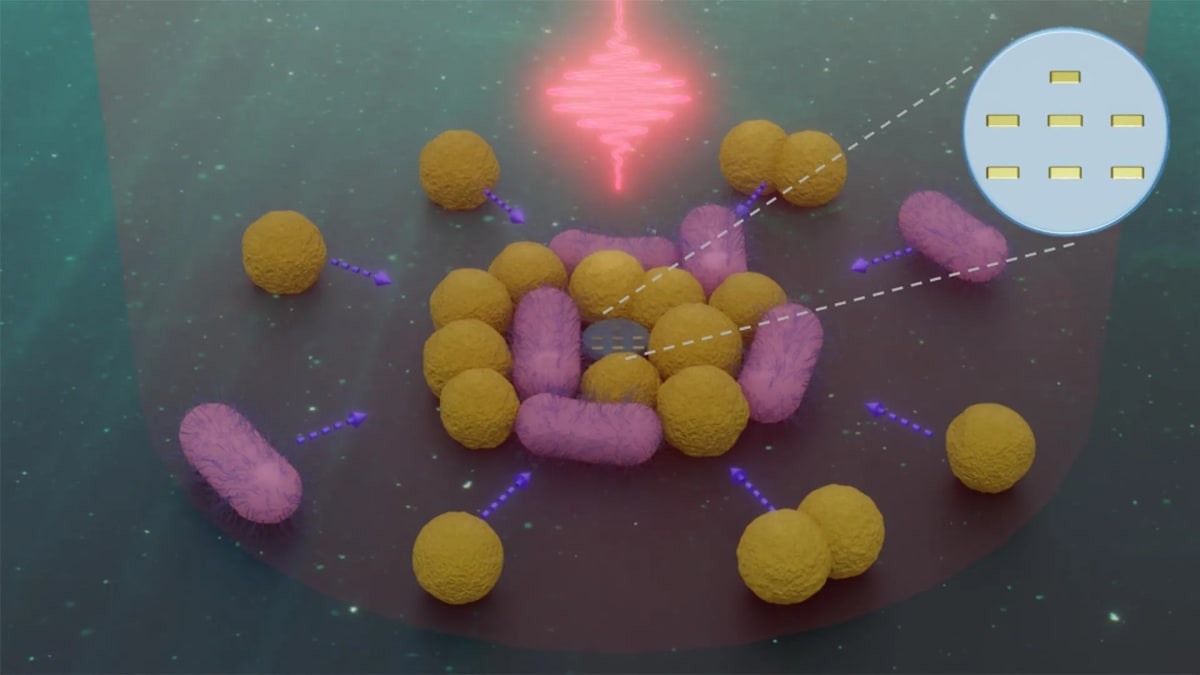
The team created nanorobots about 50 times smaller than a human hair that can navigate through liquid, gather bacteria, and deposit them wherever researchers choose. These tiny machines represent a major breakthrough in our ability to interact directly with the microscopic world.
The robots solve one of the biggest challenges in nanotechnology: how to power and steer something impossibly small. Lead researcher Professor Bert Hecht's team uses light itself as both the engine and steering wheel.
Here's how it works. The nanorobots contain special wire antennas that absorb light and shoot it back out in a specific direction. Each photon bouncing off creates a tiny recoil force, like the kickback from a fired bullet. Because these robots weigh almost nothing, those minuscule forces create enough speed to zip through water.
Steering is equally clever. The antenna wires naturally align with the direction of incoming light waves. By changing the light's orientation, researchers can point the robot in any direction while photon recoil keeps pushing it forward.
The result is a remarkably nimble machine. These nanorobots can make sharp 90-degree turns, scan areas in organized patterns, and even make fast work of bacterial cleanup. Under lab conditions, they successfully collected bacteria from one location and transported them to chosen destinations.
"In essence, we have built a light-driven nanorobot that can track down and collect bacteria," says Jin Qin, the study's lead scientist. The robots remain fully maneuverable even while carrying clusters of bacteria, though they slow down slightly under the extra load.
The Ripple Effect
This breakthrough opens doors far beyond laboratory curiosity. The ability to precisely manipulate individual bacteria and cells could transform biomedical research, helping scientists study infections, test treatments, and understand cellular behavior in entirely new ways.
The technology might eventually help develop targeted medical treatments, improve how we study disease at the cellular level, or create new approaches to handling biological materials. The robots demonstrate that we're no longer limited to just observing the microscopic world.
"The idea of tiny robotic cleaners may sound futuristic, but we are already demonstrating the physical principles that make it possible," Hecht notes. His team published their findings in Nature Communications, showing that science fiction's vision of molecular machines is becoming science fact.
For now, these nanorobots work in controlled laboratory settings, but they prove the concept works. As the technology develops, researchers imagine applications in medicine, environmental cleanup, and materials science.
The future of fighting disease might just be measured in nanometers.
Based on reporting by Science Daily
This story was written by BrightWire based on verified news reports.
Spread the positivity!
Share this good news with someone who needs it