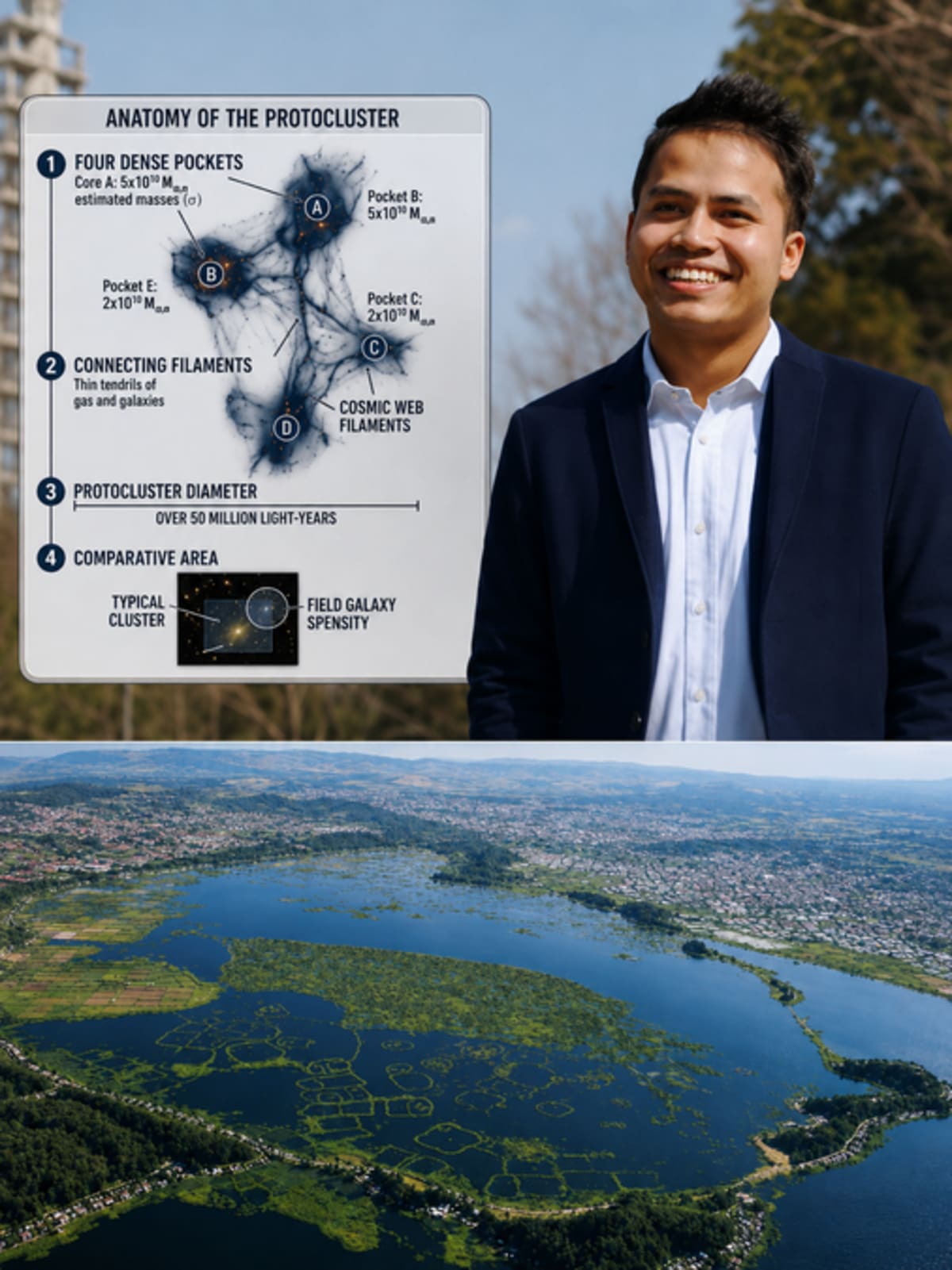
Manipur Scientist Names Ancient Galaxy City After Home Lake
A 29-year-old researcher from India discovered a 12.6-billion-year-old galaxy supercluster and named it after Loktak Lake in his home state of Manipur. The cosmic structure offers new insights into how galaxies formed in the early universe.
A young scientist from Manipur just put his home on the cosmic map by naming one of the oldest structures in the universe after a local lake.
Dr. Ronaldo Laishram, a 29-year-old researcher at Japan's National Astronomical Observatory, discovered a massive galaxy supercluster that existed when the universe was only about a billion years old. He named it the Loktak Protocluster after Loktak Lake in Manipur, where floating islands called phumdis create an interconnected ecosystem similar to the cosmic web he found in space.
The protocluster contains four distinct regions of galaxies all connected as part of one enormous evolving system. Using data from the Subaru Telescope and the James Webb Space Telescope, Dr. Laishram and his team studied this ancient cosmic neighborhood located 12.6 billion light-years away.
What makes this discovery particularly exciting is what it reveals about how galaxies grow. Scientists found that galaxies inside the protocluster were nearly 40% larger than isolated galaxies of the same age. The dense cosmic neighborhood appears to have accelerated their growth.
These early galaxies drew in vast clouds of cold gas, rapidly forming new stars and shining brighter than their isolated counterparts. Over billions of years, gravity will slowly pull all these galaxy groups together into one enormous galaxy cluster.
The Ripple Effect
Dr. Laishram deliberately chose to honor his home state with the name. He wanted Manipur's identity to echo through the story of the universe, ensuring that a small state in Northeast India would be remembered in astronomical records forever.
The discovery is already inspiring students and young people across Manipur and Northeast India. From a freshwater lake's floating islands to a giant structure in deep space, the name Loktak now bridges Earth and cosmos in modern astronomy.
The research demonstrates how powerful modern space telescopes have become at peering into the universe's distant past. Scientists can now study how the earliest cosmic neighborhoods formed and influenced galaxy evolution in ways never before possible.
Young minds from Manipur now have a homegrown role model who took a question about the early universe and found an answer written in starlight.
Based on reporting by The Better India
This story was written by BrightWire based on verified news reports.
Spread the positivity!
Share this good news with someone who needs it
%2Fhttps%3A%2F%2Ftf-cmsv2-smithsonianmag-media.s3.amazonaws.com%2Ffiler_public%2Ff0%2Ffe%2Ff0fe19e4-e68b-474d-b0a4-19c5beb9d19d%2Fspeedy-star.webp)