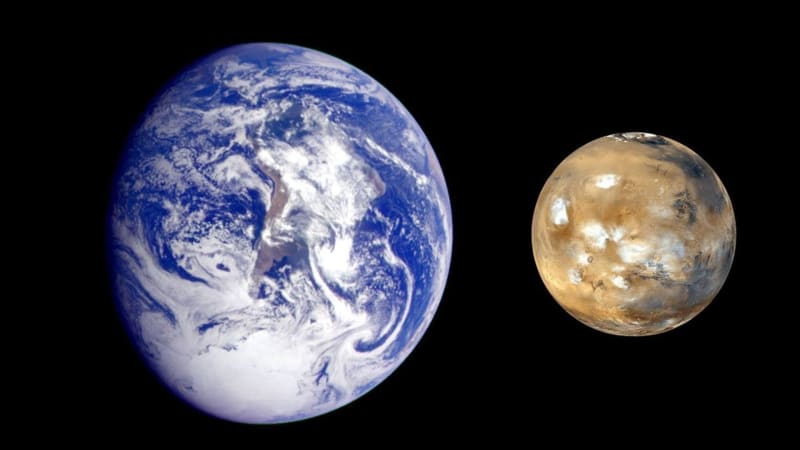
Mars Helps Keep Earth's Climate Stable, Scientists Find
Scientists discovered that Mars plays a surprising role in keeping Earth's climate balanced over millions of years. The Red Planet's gravity helps stabilize our planet's tilt and orbit, potentially making Earth-like worlds more common throughout the universe.
Mars might be our smaller neighbor, but it's doing big things for Earth's long-term survival.
New simulations from scientists at UC Riverside, the University of Birmingham, and the University of Southern Queensland show that Mars' gravity significantly influences Earth's climate over hundreds of thousands of years. The Red Planet helps control the cycles that keep our world from tipping into permanent ice ages or losing the stable tilt that makes life possible.
"I knew Mars had some effect on Earth, but I assumed it was tiny," said Stephen Kane, the lead researcher from UC Riverside. He set out to test his own assumptions and found something remarkable instead.
The team ran detailed computer simulations of the solar system, testing what would happen if Mars disappeared or changed size. They focused on the Milankovitch cycles, natural variations in Earth's orbit and tilt caused by gravitational pulls from other planets over geological timescales.
When Mars vanished from the simulations, two important climate cycles lasting 100,000 years and 2.4 million years completely disappeared. These cycles help ensure that ice ages don't last forever by gradually changing Earth's position and angle relative to the sun.
Mars also helps keep Earth's tilt stable between 21.5 and 24.5 degrees every 41,000 years. By comparison, Mars itself wobbles wildly, with tilt variations up to 90 degrees throughout its history.
Scientists previously thought Earth's large moon deserved all the credit for our stable tilt. Now they know Mars plays a supporting role too.
Why This Inspires
This discovery changes how we think about finding habitable planets beyond our solar system. Earth might not need a large moon to stay stable after all.
Astronomers searching for life-friendly worlds now have a new item on their checklist. Finding an Earth-like planet in the habitable zone is great, but spotting a modest outer planet like Mars nearby makes the prospects even brighter.
Mars punches above its weight because it sits farther from the sun, where the sun's gravity is weaker and planetary influences matter more. This small world has been quietly helping maintain the conditions that allowed life to flourish on Earth for billions of years.
Understanding these cosmic partnerships helps scientists identify which distant solar systems might harbor stable, life-friendly planets. Every new Earth we find might have its own silent guardian keeping conditions just right.
More Images


Based on reporting by Space.com
This story was written by BrightWire based on verified news reports.
Spread the positivity! 🌟
Share this good news with someone who needs it

