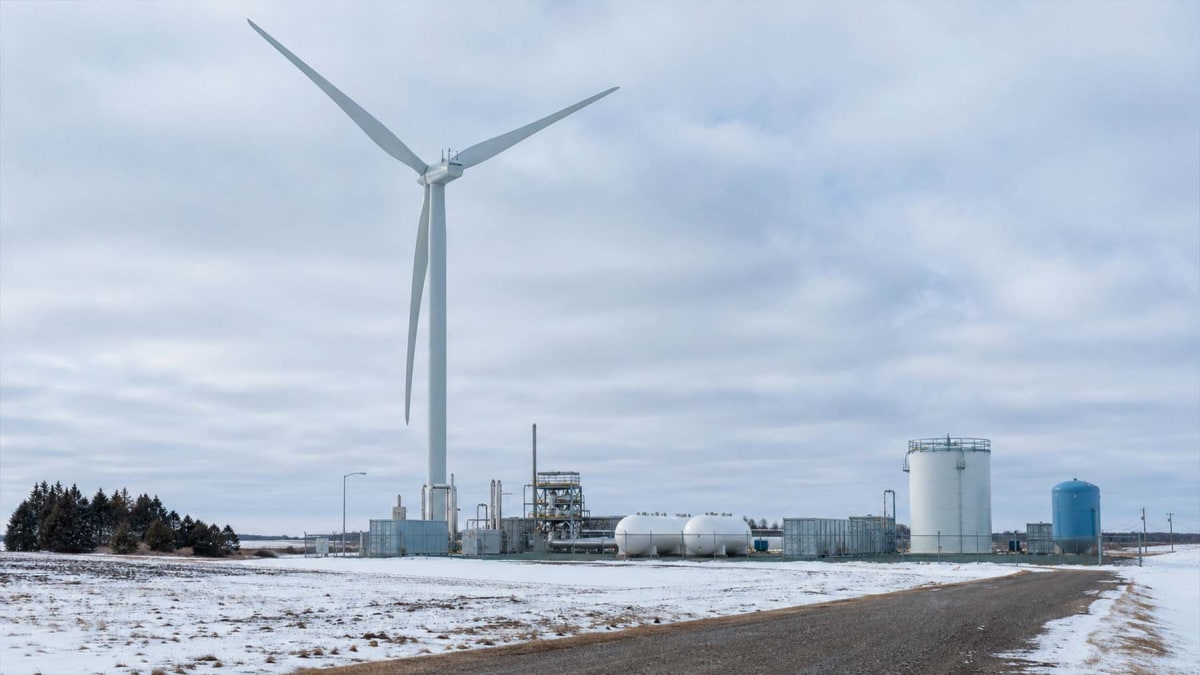
Minnesota Wind Turbine Now Makes Fertilizer From Thin Air
A wind turbine in Morris, Minnesota is producing carbon-free fertilizer using only electricity, water, and air. The breakthrough could save American farmers nearly $1 billion annually while slashing agricultural emissions.
A single wind turbine in rural Minnesota just proved that clean energy can do more than keep the lights on.
The 1.65-megawatt turbine at the University of Minnesota's West Central Research and Outreach Center in Morris doesn't just generate electricity anymore. It powers an on-site plant that produces liquid ammonia fertilizer using nothing but wind energy, water, and nitrogen pulled straight from the atmosphere.
Here's how it works: electrolyzers use the turbine's electricity to split water into hydrogen and oxygen. An air-separation unit captures nitrogen from the surrounding air. Those gases combine under pressure to create completely carbon-free ammonia fertilizer, about one metric ton every day.
The innovation tackles one of agriculture's dirtiest secrets. For over a century, the world's food supply has depended on the Haber-Bosch process, which creates synthetic fertilizer by combining atmospheric nitrogen with natural gas or coal. That single chemical reaction accounts for up to 2% of all global greenhouse gas emissions, yet it still feeds nearly half the world's population.
American farmers have been stuck in an impossible position. Agriculture produces roughly 10% of U.S. greenhouse gas emissions, but decarbonizing has seemed nearly impossible. Meanwhile, extreme weather driven by climate change continues devastating crops and cutting yields.
The financial pressure has mounted too. Minnesota farmers alone spend nearly $1 billion each year on carbon-heavy imported fertilizer. Global supply chain shocks and geopolitical tensions send prices soaring unpredictably. Now, premium buyers and federal export standards increasingly demand low-carbon products, threatening market access for farmers who can't clean up their operations.
The Ripple Effect
This Morris pilot plant offers farmers something they haven't had in generations: control. The fertilizer gets stored on-site and transferred directly into local farm tanks, cutting out volatile international markets entirely.
The project shows that wind energy can serve dual purposes in rural communities. The same turbine generating clean power for the grid now produces the exact agricultural input that local farmers desperately need, created from resources that will never run out.
The University of Minnesota Twin Cities designed the complex control systems that keep production steady even as wind speeds fluctuate throughout the day. That technological achievement means intermittent renewable energy can reliably power industrial chemical processes once thought to require constant fossil fuel input.
If the model scales, it could reshape American agriculture. Farmers could achieve true resilience while protecting both their bottom lines and the climate that determines their harvests.
One turbine in Morris just proved the future of farming might blow in on the wind.
More Images

Based on reporting by Google News - Wind Energy
This story was written by BrightWire based on verified news reports.
Spread the positivity!
Share this good news with someone who needs it


