MIT and Mexico City Partner to Solve Urban Challenges
MIT researchers are collaborating with Mexican universities and local leaders to tackle complex urban problems, from transforming a massive landfill into clean energy space to decarbonizing neighborhoods. The project's secret weapon isn't just innovative solutions—it's the lasting friendships and networks being built across borders.
Students and professors from MIT and Mexico's National Autonomous University are proving that the best solutions to urban challenges come from working together across borders.
Through the MIT Leventhal Center's Mexico City Initiative, teams have designed ambitious projects addressing some of the megacity's toughest problems. One project proposes converting nearly 990 acres of what was once Latin America's largest landfill into a model of ecological restoration and clean energy production. Another reimagines an industrial zone as an engine for renewable power, water resilience, and sustainable housing.
The collaboration has even sparked a sustainable construction startup contributing to local economies in both Mexico and the United States. MIT's Digital Structures team developed 3D printed clay blocks that build on existing concrete systems, cutting environmental impact by 50 percent through optimized brick shapes that use less material.
But ask the leaders what matters most, and they'll tell you it's not just the innovative designs. It's the relationships.
"To really create change in cities, we need to build relationships, friendships, and new networks," says Sarah Williams, director of MIT's Leventhal Center for Advanced Urbanism. "Through building them together, we can go so much further."
The Ripple Effect
The connections formed over the past three years are already generating new research collaborations and opportunities. Mexican students working alongside MIT faculty gain exposure to cutting edge urban planning approaches, while MIT researchers tackle challenges that could apply to cities worldwide.
"If you can find urban solutions for a city as complex as Mexico City, you can probably figure it out for any city in the world, particularly in the Global South," says Onésimo Flores, a 2013 MIT PhD graduate now directing the initiative's corporate partner, Mota-Engil Mexico.
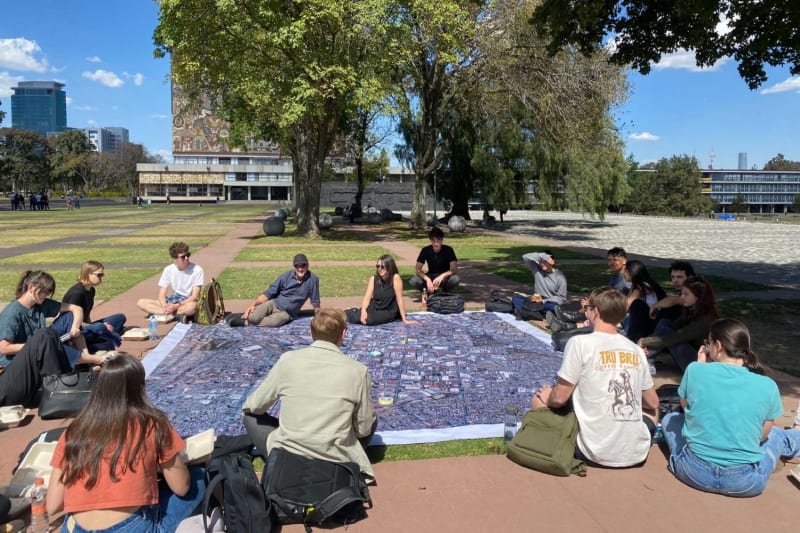
The initiative brings together MIT, UNAM, Mexico City government officials, and private sector leaders for symposiums and workshops focused on energy transition. Recent projects have included decarbonizing municipal neighborhoods and repurposing a vintage roller coaster as public meeting space.
For Elena Tudela, a UNAM architecture professor collaborating on the initiative, the impact on students stands out. "It built bonds that transcend the workshop's objectives, contributing to a deeper understanding of design as a collaborative, multidisciplinary practice," she says.
The team recently gathered in Mexico City for an "Energy Transitions" symposium showcasing their progress, with presentations from MIT faculty and discussions about reimagining urban infrastructure for sustainability. Former Mexico City leader Claudia Sheinbaum, now Mexico's president, attended earlier events supporting the initiative.
These cross-border friendships are proving that the best innovation happens when brilliant minds work together on problems that matter.
Based on reporting by MIT News
This story was written by BrightWire based on verified news reports.
Spread the positivity! 🌟
Share this good news with someone who needs it