MIT Breakthrough Turns Concrete Into Giant Batteries to Power Our Homes
Scientists at MIT have made an exciting leap forward in transforming ordinary concrete into energy-storing supercapacitors. The innovative material could one day allow our walls, bridges, and sidewalks to power our lives while supporting the structures we depend on.
Imagine if the walls of your home could power your lights, charge your devices, and store renewable energy—all while holding up your roof. Thanks to groundbreaking work at MIT, this remarkable vision is becoming increasingly real.
Researchers at the Massachusetts Institute of Technology have achieved a major breakthrough with their innovative electron-conducting carbon concrete, affectionately known as ec3 (pronounced "e c cubed"). This incredible material combines ordinary cement and water with ultra-fine carbon black and electrolytes to create a conductive "nanonetwork" that transforms structural concrete into functioning energy storage systems.
The latest advancement is particularly thrilling: the MIT team has increased the energy storage capacity of ec3 by tenfold. To put this in perspective, just five cubic meters of this special concrete—roughly the volume of a typical basement wall—could store enough electricity to meet an average home's daily energy needs. It's a game-changing development that could revolutionize how we think about both construction and energy storage.
"We found that there is a wide range of electrolytes that could be viable candidates for ec3," shares Damian Stefaniuk, a research scientist at MIT's Electron-Conducting Carbon-Cement-Based Materials Hub. Even more exciting? Seawater works as an electrolyte, opening up fascinating possibilities for coastal and marine applications, including support structures for offshore wind farms that could store the clean energy they help generate.
The researchers achieved this impressive progress through meticulous scientific detective work. Using high-resolution 3D imaging, they gained unprecedented insights into how the conductive carbon network functions and interacts with electrolytes. Armed with this deeper understanding, the team experimented with various electrolyte combinations and concentrations, ultimately discovering formulas that dramatically improved performance.
The team also refined their manufacturing process, making it possible to cast thicker electrodes that pack in more energy storage capacity. While ec3 doesn't yet match conventional batteries in energy density, it offers something uniquely valuable: the ability to be incorporated directly into buildings, roads, and bridges, lasting as long as the structures themselves with no need for replacement.
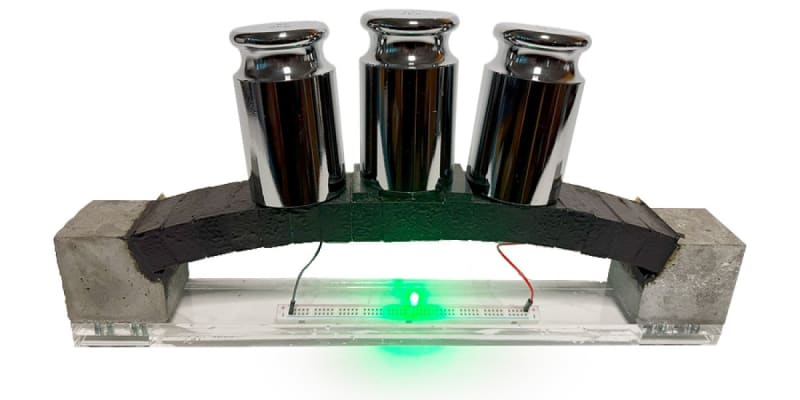
To demonstrate the dual functionality of their creation, the MIT researchers constructed a charming miniature arch that not only supported its own weight plus additional load but simultaneously powered an LED light—a proof of concept that structural integrity and energy storage can work hand in hand.
This innovation arrives at a perfect moment, as communities worldwide seek ways to integrate renewable energy sources and reduce reliance on fossil fuels. Structural energy storage could help smooth out the intermittent nature of solar and wind power, storing excess energy when it's abundant and releasing it when needed.
The possibilities stretch far beyond homes. Imagine electric vehicle charging stations built into parking structures, sidewalks that power streetlights, or bridge supports that store solar energy collected during the day. As the technology continues to mature, ec3 could help create a future where our built environment actively contributes to a cleaner, more sustainable energy grid.
The MIT team's work represents more than just a technical achievement—it's a glimpse into a future where the very foundations of our world help power our lives in harmonious, sustainable ways.
Based on reporting by MIT Technology Review
This story was written by BrightWire based on verified news reports.
Spread the positivity! 🌟
Share this good news with someone who needs it
More Good News
 🚀 Innovation
Norway's Flying Kite Technology Shows Exciting Future for Clean Energy Innovation
 🚀 Innovation
JinkoSolar's AI-Powered Partnership Heralds Exciting Solar Energy Breakthrough
 🚀 Innovation
Clean Energy Breakthrough: Fusion Power Plant Takes Major Step Toward Reality
Joke of the Day
Why did the librarian get kicked out of class?
Explore Categories
Quote of the Day
"Do not go where the path may lead, go instead where there is no path and leave a trail."
— Ralph Waldo Emerson