MIT Creates Chip That Computes Using Waste Heat, Not Power
Engineers at MIT have designed tiny silicon structures that perform calculations using excess heat instead of electricity, achieving 99% accuracy. This breakthrough could lead to more energy-efficient computers that turn waste into useful work.
Instead of fighting against heat, MIT researchers decided to put it to work.
A team at the Massachusetts Institute of Technology has created dust-sized silicon structures that perform complex calculations using the waste heat already present in electronic devices. The breakthrough turns a problem into a solution, achieving over 99% accuracy on key computational tasks.
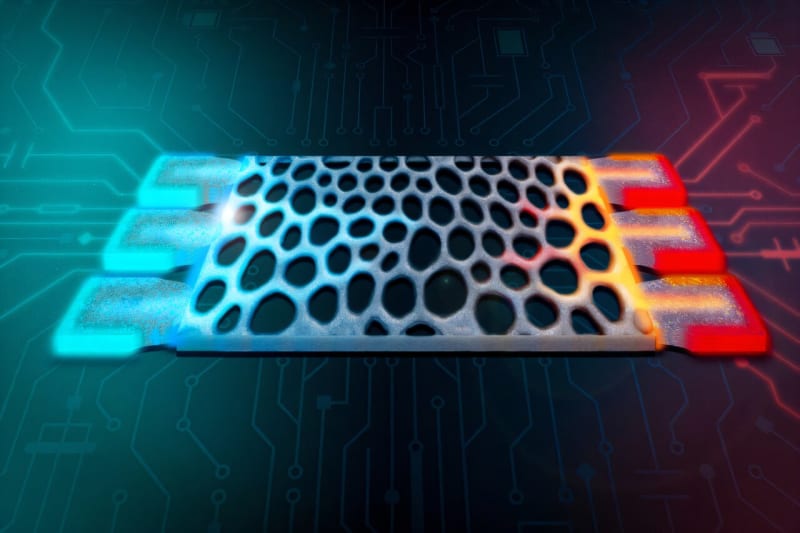
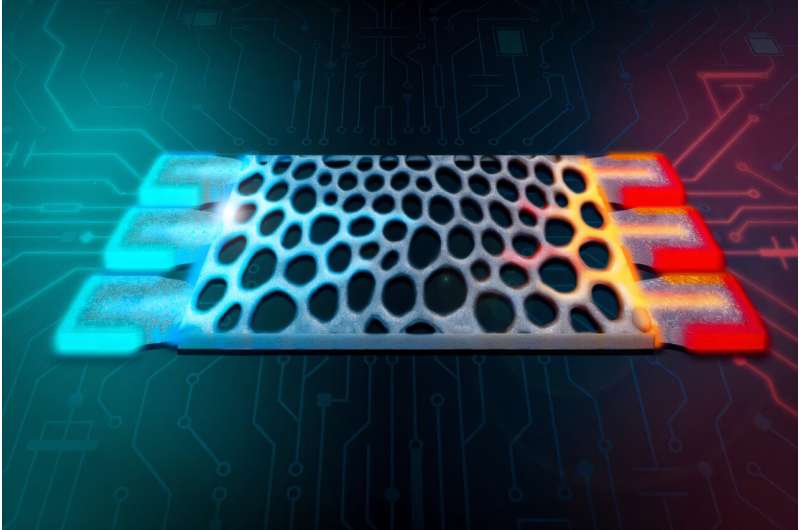
The tiny structures work by encoding data as temperatures using heat that electronics naturally produce. As heat flows through specially designed silicon patterns filled with microscopic pores, it performs mathematical operations. The result comes out as power collected at the other end, measured by a thermostat at a fixed temperature.
This approach flips traditional computing on its head. Most electronic devices fight to eliminate heat because it wastes energy and damages components. These new structures embrace heat as a form of information itself.
The team used software they developed to automatically design the optimal shape for each structure. The system starts with the mathematical function needed, then uses powerful algorithms to figure out the best geometry to make it happen. It continuously adjusts tiny pixels in a grid until the perfect design emerges, creating patterns far too complex for humans to design manually.
The researchers demonstrated their method by performing matrix multiplication, the fundamental math behind machine learning models and large language models. Each silicon structure encodes different numbers through its unique geometry, with thicker areas conducting more heat to represent larger values.
One challenge emerged from physics itself. Heat naturally flows from hot to cold, meaning the structures could only handle positive numbers. The team solved this by splitting calculations into positive and negative parts, running them through separate structures, then combining the results.
Lead author Caio Silva, an undergraduate physics student, worked with senior researcher Giuseppe Romano from MIT's Institute for Soldier Nanotechnologies. Their findings appear in the journal Physical Review Applied.
The Ripple Effect
While the technology still needs scaling up for modern deep learning models, the applications extend beyond just computation. These structures could detect heat sources and measure temperature changes in electronics without consuming any extra energy. That would eliminate the need for multiple temperature sensors that currently take up valuable space on computer chips.
The approach represents a broader shift in how engineers think about efficiency. Rather than viewing waste as something to eliminate, these structures show how it can become a resource. Every electronic device produces heat during operation. Capturing even a fraction of that energy for useful work could reduce power consumption across billions of devices.
For now, the team has tested their structures on simple calculations relevant for sensor fusion and diagnostics in microelectronics. But the principle opens doors for future innovations in energy-efficient computing.
This breakthrough shows that sometimes the best solution comes from working with nature instead of against it.
More Images

Based on reporting by Phys.org - Technology
This story was written by BrightWire based on verified news reports.
Spread the positivity!
Share this good news with someone who needs it