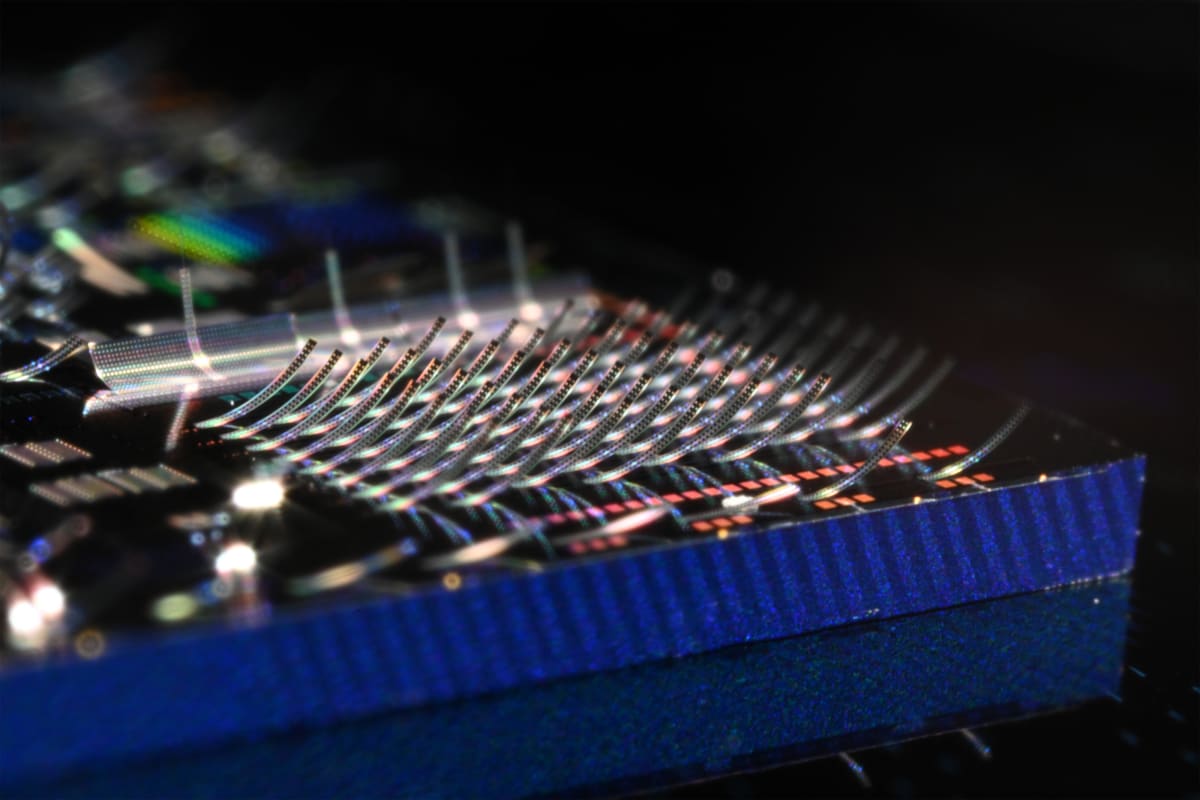
MIT Creates Tiny "Ski Jumps" That Beam Light Off Chips
Scientists at MIT invented microscopic structures that curve upward like ski jumps to shoot light off computer chips into the air. This breakthrough could lead to lightweight AR glasses, better quantum computers, and displays smaller than a grain of salt.
Scientists just solved a problem that's been holding back the future of light-based computing, and the solution looks like thousands of tiny, glowing ski jumps.
Researchers at MIT and partner institutions created a new type of photonic chip that uses microscopic curved structures to precisely beam light into free space. These chips process data using light instead of electricity, making them much faster, but until now, most of that light stayed trapped inside the chip's wiring.
The breakthrough came from a clever fabrication trick. The team layered two different materials that expand at different rates when cooling down from manufacturing temperatures. The strain difference causes the structures to curl upward naturally, like an old thermostat coil responding to temperature changes.
"On a chip, light travels in wires, but in our normal, free-space world, light travels wherever it wants," explains Henry Wen, a visiting research scientist at MIT. "Interfacing between these two worlds has long been a challenge."
The team can now control thousands of these tiny light emitters simultaneously. They've already used the platform to project detailed, full-color images roughly half the size of a grain of table salt.
The project started as part of the Quantum Moonshot Program, a collaboration between MIT, the University of Colorado at Boulder, MITRE Corporation, and Sandia National Laboratories. They needed a way to control millions of quantum bits at once using laser beams.
"We can't control a million laser beams, but we may need to control a million qubits," Wen notes. The ski jump design solves this scaling problem elegantly.
Why This Inspires
This technology opens doors to innovations that seemed impossible just months ago. Imagine augmented reality glasses as light as regular sunglasses, or 3D printers with precision we've never seen before.
The breakthrough also matters for quantum computing, where controlling millions of qubits simultaneously could unlock processing power far beyond today's supercomputers. The team demonstrated how their photonic ski jumps can precisely control these quantum bits in real systems.
Smaller Lidar systems could make self-driving cars safer and more affordable. Compact displays could transform everything from medical devices to smartphones.
What makes this especially exciting is how the team combined existing materials in a new way. Silicon nitride and aluminum nitride were separate technologies until this fabrication innovation brought them together. Sometimes progress happens not by inventing something entirely new, but by seeing fresh possibilities in what already exists.
The research appears in Nature, marking a significant milestone in photonics. The technology is scalable and ready for further development across multiple industries.
This tiny curved structure might just be the bridge between the chip-based world and our everyday reality, lighting the way to technologies we're only beginning to imagine.
Based on reporting by MIT News
This story was written by BrightWire based on verified news reports.
Spread the positivity!
Share this good news with someone who needs it


%2Ffile%2Fattachments%2F2997%2FGettyImages-2211967510_856600.jpg)