MIT Engineers Turn Waste Heat Into Computing Power
MIT researchers built microscopic silicon structures that perform calculations using excess heat instead of electricity. The breakthrough could make our devices far more energy efficient while turning waste into useful work.
What if the heat your laptop generates could actually help it run instead of draining the battery? MIT engineers just made that possible.
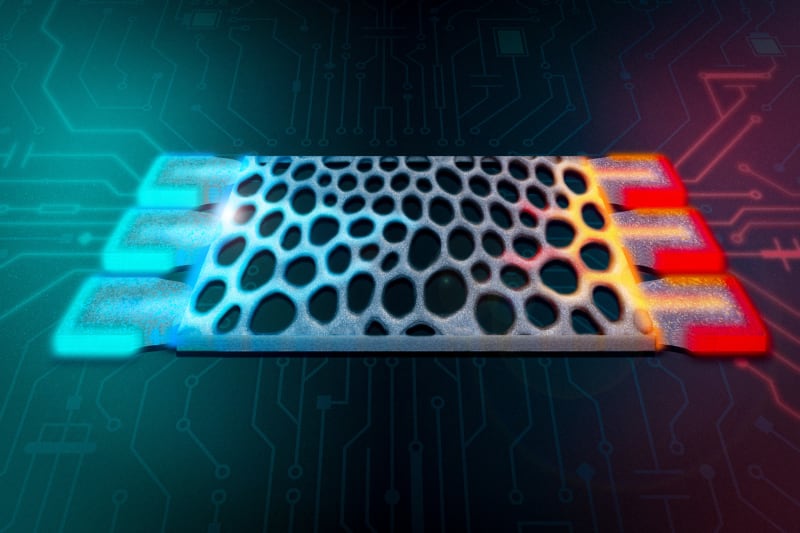
Researchers at MIT have designed tiny silicon structures, each about the size of a dust particle, that perform calculations using the waste heat already present in electronic devices. Instead of viewing heat as something to eliminate, they turned it into useful information.
Here's how it works. The team encodes data as a set of temperatures using the excess heat in a device. As that heat flows through specially designed silicon structures filled with microscopic pores, it performs mathematical calculations. The result comes out as power collected at the other end.
The structures achieved more than 99 percent accuracy when performing matrix multiplication. That's the fundamental math technique that powers artificial intelligence models like ChatGPT.
"Most of the time, when you are performing computations in an electronic device, heat is the waste product," says Caio Silva, an undergraduate physics student who led the research. "But here, we've taken the opposite approach by using heat as a form of information itself."
The team used sophisticated software to design these structures. They told the computer what function they wanted, and powerful algorithms figured out the best geometry to achieve it. The final designs were far too complex for humans to create through intuition alone.
The Ripple Effect
The technology could first help our devices monitor themselves without consuming extra energy. Electronics could detect heat sources and measure temperature changes without needing multiple sensors that take up valuable chip space.
Looking further ahead, the approach opens a new frontier in computing. Every data center, smartphone, and computer generates massive amounts of heat. If even a fraction of that waste could perform useful calculations, it would dramatically reduce global energy consumption.
The researchers acknowledge they have challenges to overcome before scaling this up for modern deep learning models. But the proof of concept works, turning a fundamental problem into an opportunity.
Senior researcher Giuseppe Romano, from MIT's Institute for Soldier Nanotechnologies, sees the bigger picture. By teaching computers to design these heat computing structures, the team has created a blueprint others can follow and improve.
The future of computing might not just be smaller or faster. It could be one where our devices waste less and work smarter with what they already produce.
Based on reporting by MIT News
This story was written by BrightWire based on verified news reports.
Spread the positivity!
Share this good news with someone who needs it