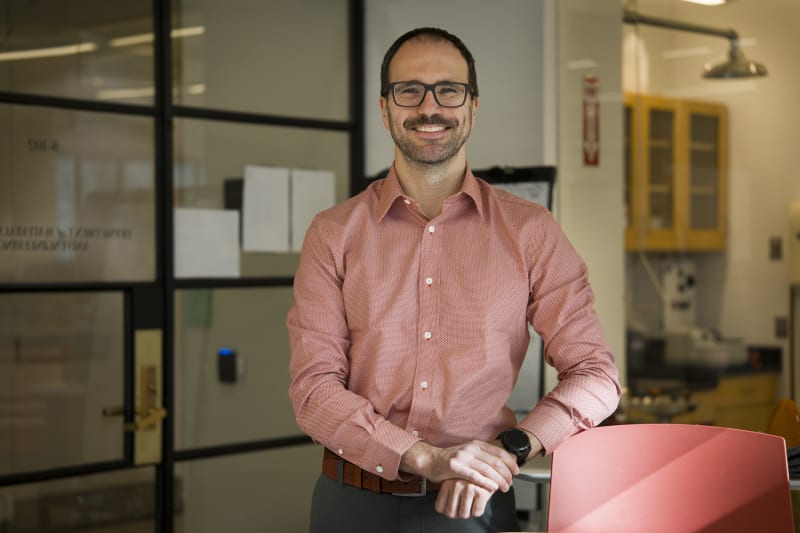
MIT Professor Uses AI to Fast-Track Scientific Breakthroughs
Rafael Gómez-Bombarelli has spent over a decade using artificial intelligence to discover new materials, and he believes we're entering a transformative era for science. His AI-powered approach has already created breakthrough materials for batteries, displays, and more.
What if we could speed up scientific discovery by years, bringing life-saving innovations to people faster than ever before?
MIT Professor Rafael Gómez-Bombarelli is making that vision real. For more than a decade, he's combined artificial intelligence with physics simulations to discover new materials that would take traditional researchers years to find.
His work has already produced tangible results. The associate professor in materials science and engineering has created new materials for batteries, catalysts, plastics, and organic light-emitting diodes. Each discovery moves us closer to better technology and cleaner energy.
Gómez-Bombarelli believes we're at a pivotal moment. After the first wave of AI-assisted science around 2015, he says we're now entering a second revolution where AI can reason across multiple types of scientific data at once.
His journey started in Spain, where he won a Chemistry Olympics competition in 2001. He began his career doing hands-on lab experiments but fell in love with computer simulations halfway through his PhD. Programming felt like a natural way to organize his thinking, and it opened up possibilities that physical experiments couldn't match.
By 2016, working at Harvard, Gómez-Bombarelli became one of the first scientists to use generative AI for chemistry. He and his team ran hundreds of thousands of calculations simultaneously, discovering hundreds of promising new materials ready for testing.
The experience taught him that AI could eliminate tedious manual work and let scientists focus on creativity and analysis. He even cofounded a startup to bring these discoveries to market, making actual products people could use.
Now at MIT since 2018, he's expanded his vision. His latest company, Lila Sciences, is building what he calls a "scientific superintelligence platform" for life sciences, chemistry, and materials research.
The Ripple Effect
Gómez-Bombarelli's work extends far beyond his own lab. He serves on scientific advisory boards for multiple startups applying AI to drug discovery and robotics, helping spread these powerful tools across industries.
The implications touch everyone's lives. Faster battery innovation means better electric vehicles and renewable energy storage. Accelerated drug discovery means new treatments reaching patients years sooner. Better materials mean more efficient technology at lower costs.
"AI for science is about bringing a better future forward in time," Gómez-Bombarelli says. Unlike other AI applications that raise ethical concerns, using AI to accelerate scientific discovery offers pure upside.
His students and collaborators are now carrying these techniques into their own research, multiplying the impact across fields and institutions.
The future of science is getting brighter, and it's arriving faster than we thought possible.
Based on reporting by MIT News
This story was written by BrightWire based on verified news reports.
Spread the positivity!
Share this good news with someone who needs it