MIT Roboticist Wins Germany's Top Engineering Prize
Daniela Rus just received Germany's most prestigious technology award for creating robots that work in the messy, unpredictable real world. Her 30-year journey shows how machines and humans can solve problems together that neither could tackle alone.
A robot small enough to swallow just earned its creator one of Europe's highest honors.
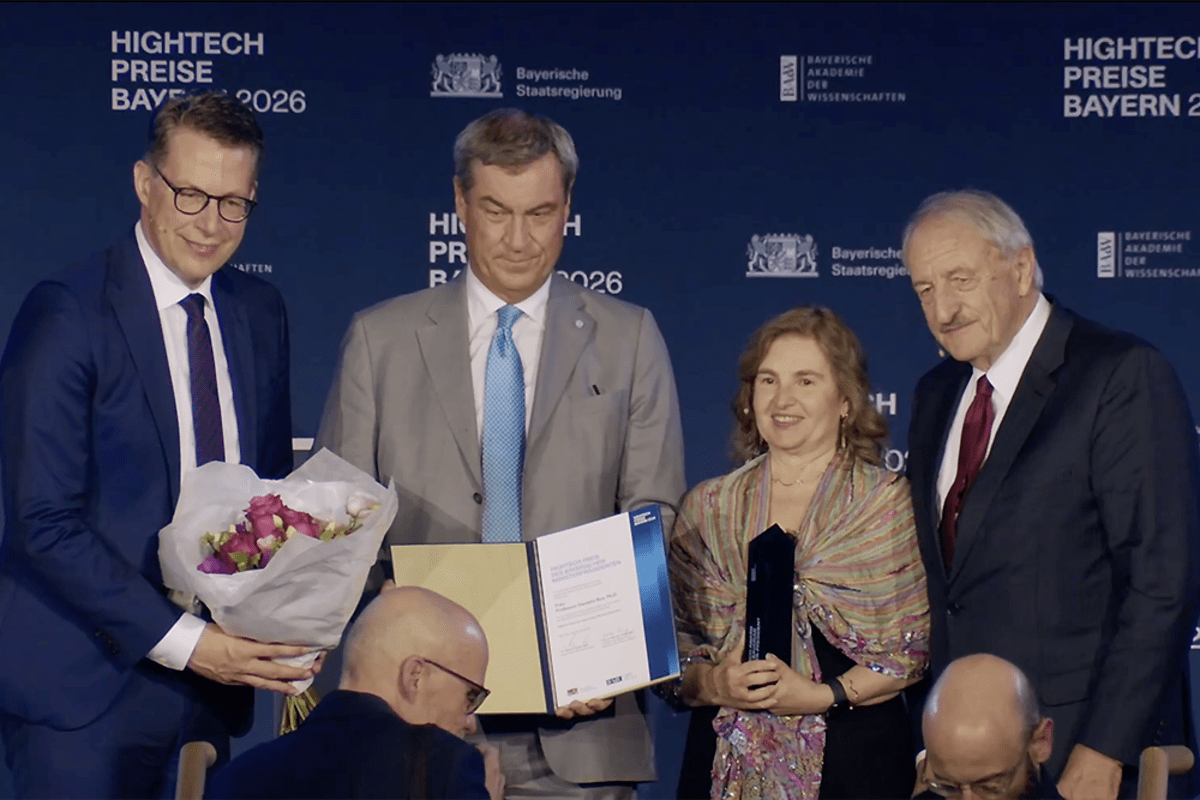
Daniela Rus, director of MIT's Computer Science and Artificial Intelligence Laboratory, received the 2026 Bavarian High-Tech Prize on July 23. The award recognizes her three decades of building robots that don't just work in sterile labs, but out in the chaos of everyday life.
The prize celebrates four major breakthroughs. Rus developed self-organizing robot teams that coordinate without human oversight. She pioneered soft robotics, where flexible machines can safely work alongside people. Her autonomous systems now operate in hospitals, farms, homes, and waterways. And her brain-inspired AI uses remarkably few resources to make smart decisions.
One invention perfectly captures her approach to solving real problems. Her team created a tiny origami robot that can be swallowed like a pill. Once inside a child's stomach, it unfolds and retrieves dangerous button batteries that kids accidentally swallow. The robot does delicate work that would otherwise require surgery.
Another project turns waterways into flexible infrastructure. Rus built fleets of small autonomous boats that assemble themselves into bridges and platforms. Cities could reconfigure their canals on demand, creating new pathways exactly when and where people need them.
Her liquid neural networks might be the most elegant solution yet. Inspired by a millimeter-long worm's compact nervous system, these networks can steer a vehicle through unfamiliar terrain using just 19 control neurons. Traditional AI systems need thousands. The efficiency breakthrough led Rus and her colleagues to found Liquid AI, a company building models designed for real-world devices from day one.
The Ripple Effect
Rus's work arrives as industries worldwide grapple with how humans and robots can truly collaborate. While others focus on household chores or factory tasks, she's thinking several steps ahead. Her algorithms put autonomous systems into agriculture fields, operating rooms, environmental monitoring stations, and city infrastructure.
The Bavarian prize, Germany's most generous technology award, comes from both the state government and the Bavarian Academy of Sciences. Lorenzo Masia, a robotics professor at the Technical University of Munich, says the recognition will push physical AI from research labs into mainstream attention.
Rus frames the relationship simply. "AI gives machines the ability to do work that humans don't want to do," she explains. "It's not a battle between humans and machines. Both form a system that solves problems that neither humans nor machines can solve alone."
Her trophy shelf already holds the 2025 IEEE Edison Medal, the 2024 John Scott Award, and a MacArthur Fellowship. She's been elected to the National Academy of Engineering, the American Academy of Arts and Sciences, and France's National Academy of Medicine.
Thirty years of patient work is finally meeting the moment when the world needs it most.
Based on reporting by MIT News
This story was written by BrightWire based on verified news reports.
Spread the positivity!
Share this good news with someone who needs it