MIT Scientist Launches Business Selling Roman Self-Healing Concrete
A scientist who cracked the 2,000-year-old secret of Rome's indestructible concrete is now selling the ancient recipe to modern builders. The material can repair its own cracks and has survived earthquakes, volcanoes, and millennia of wear.
Ancient Roman concrete has outlasted modern materials by nearly two thousand years, and now one scientist is bringing that lost technology back to life.
MIT Professor Admir Masic spent years studying why Roman structures like the Pantheon and Colosseum still stand strong while modern concrete crumbles within decades. In 2023, he discovered the secret: Romans used a "hot-mixing" process that trapped reactive lime fragments inside the concrete. When cracks formed, these lime pieces dissolved and naturally filled the gaps, making the material self-healing.
But Masic hit a problem. His findings contradicted Vitruvius, the legendary Roman architect who literally wrote the first book on architecture in the 1st century BCE. Vitruvius described a different mixing process, and questioning his writings felt like contradicting history itself.
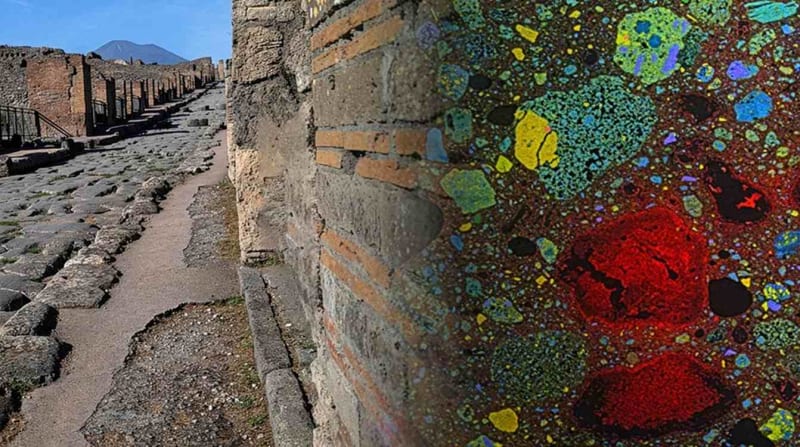
Then came the breakthrough. Archaeologists discovered a perfectly preserved construction site in Pompeii, frozen in time by Mount Vesuvius in 79 CE. The site contained piles of pre-mixed materials, half-built walls, and ancient tools still waiting for workers who never returned.
Masic and his team analyzed everything they found. The evidence was undeniable: intact quicklime fragments mixed with volcanic ash, exactly as his theory predicted. The Romans really did use hot-mixing, and Vitruvius may have been misunderstood for two millennia.
The team also discovered that volcanic pumice in the concrete reacted chemically over centuries, creating new minerals that made the structures even stronger with age. This wasn't just durable concrete—it was concrete that improved itself over time.
The Ripple Effect
Masic didn't just want to write papers about ancient materials. He wanted to fix modern construction's massive concrete problem.
Today's concrete accounts for 8% of global carbon emissions and typically lasts only 50 to 100 years. Roman concrete has survived 2,000 years of earthquakes, saltwater, and extreme weather without reinforcement. That's not just impressive history—it's a blueprint for sustainable building.
So Masic launched DMAT, a company that applies Roman concrete principles to modern construction. His goal is to create materials that regenerate themselves rather than slowly crumbling. If buildings could heal their own cracks and strengthen over time, we'd need less concrete overall and produce far less waste.
The ancient Romans built their empire on concrete that lasted forever. Now, thanks to a scientist willing to challenge conventional wisdom, modern builders might finally have access to the same recipe—and a chance to build structures our great-great-grandchildren will still be using.
More Images

Based on reporting by Good News Network
This story was written by BrightWire based on verified news reports.
Spread the positivity!
Share this good news with someone who needs it