MIT's "Pencil Beam" Laser Speeds Up Brain Drug Discovery
MIT scientists discovered that cranking up laser power creates a self-organizing beam that captures brain images 25 times faster than current methods. This breakthrough could help researchers quickly test whether Alzheimer's and ALS drugs actually reach brain cells.
Scientists just found a way to watch medicine reach the brain in real time, and it happened by accident when they did the exact opposite of what textbooks said to do.
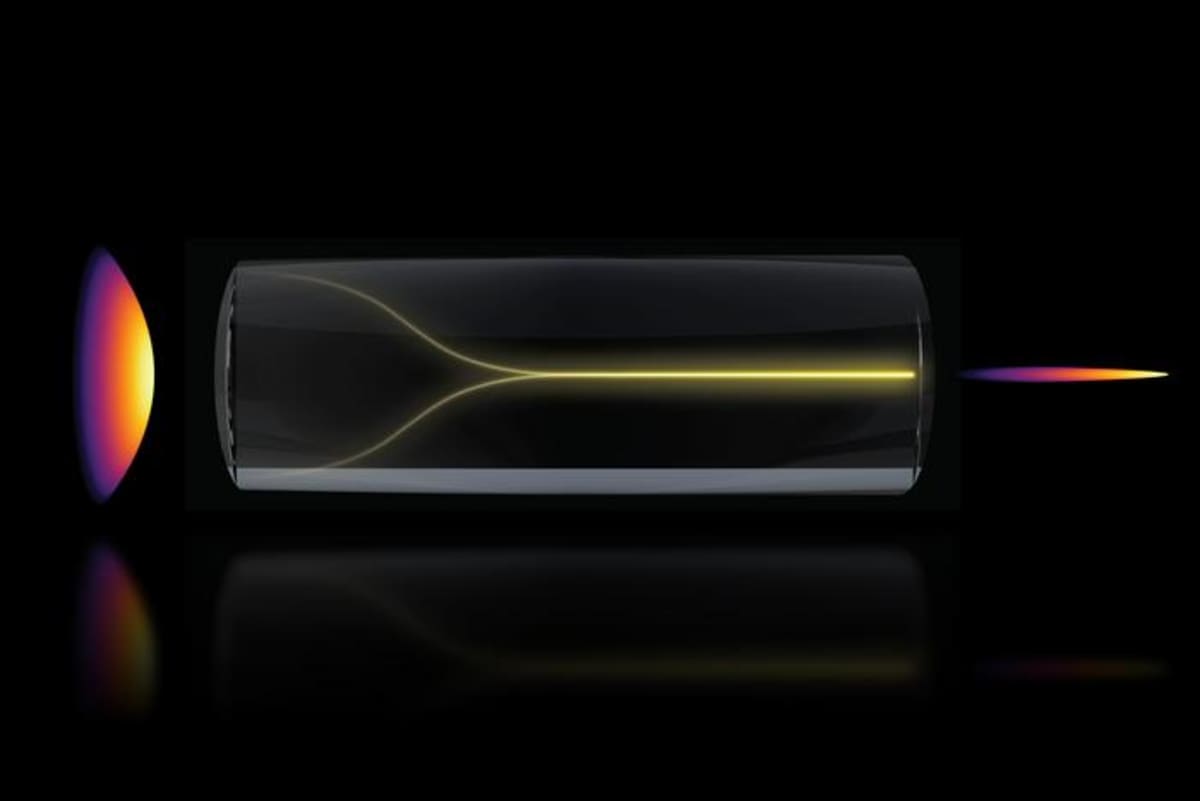
MIT researchers were testing how much power an optical fiber could handle when they noticed something strange. Instead of scattering into chaos like predicted, the laser light suddenly organized itself into a sharp, focused beam when pushed to its limit.
Assistant Professor Sixian You and her team discovered this "pencil beam" by breaking two rules. They aligned the laser at a perfect zero-degree angle and cranked the power almost high enough to burn the fiber. Those two precise conditions triggered the light to self-organize without any fancy equipment or complex engineering.
The discovery solves a problem that's been frustrating scientists for years. Testing new brain drugs is painfully slow because researchers can only capture one flat slice of the blood-brain barrier at a time, then repeat the process over and over to build a complete picture.
Using their new pencil beam technique, the MIT team captured 3D images of the human blood-brain barrier 25 times faster than the gold standard method. The beam stayed stable and crystal clear without the blurry halos that typically distort images.
The Ripple Effect
This speed boost matters enormously for drug development. The blood-brain barrier protects our brains from toxins, but it also blocks most medicines trying to treat diseases like Alzheimer's and ALS. Pharmaceutical companies desperately need faster ways to test whether their experimental drugs can actually cross this barrier and reach brain cells.
The technology works with normal human cell models, not just animal models that often fail to predict human responses. For the first time, researchers can watch in real time as different cell types absorb drugs and measure exactly how quickly they work.
Roger Kamm, who collaborated on the project, points out another game-changing benefit. The method doesn't require cells to have fluorescent tags, making it simpler and more accurate for testing diverse compounds across different tissue models.
Graduate student Honghao Cao, who first observed the phenomenon, explains the beauty of their approach. "At this critical power, the nonlinearity can counter the intrinsic disorder, creating a balance that transforms the input beam into a self-organized pencil beam."
The team published their findings in Nature Methods, showing that sometimes the best discoveries come from following unexpected results rather than conventional wisdom. Their willingness to push past normal safety limits and embrace uncertainty led to a tool that could accelerate breakthrough treatments for millions of people waiting for better brain disease therapies.
More Images
Based on reporting by Google News - Researchers Find
This story was written by BrightWire based on verified news reports.
Spread the positivity!
Share this good news with someone who needs it