Modified Bacteria Delivers Cancer-Killing Toxin to Tumors
Baylor University researchers have turned a common food-borne bacteria into a precision weapon against colorectal cancer, the nation's second-deadliest cancer. The breakthrough could one day be delivered as a simple oral medication.
Scientists just transformed one of nature's most notorious bacteria into a cancer-fighting hero. Researchers at Baylor University have successfully modified Listeria monocytogenes to carry a potent toxin directly into colorectal cancer cells, opening a promising new front in the battle against the disease.
Colorectal cancer caused the second-most cancer deaths in 2025, making new treatment approaches desperately needed. This breakthrough offers genuine hope for patients who have run out of options.
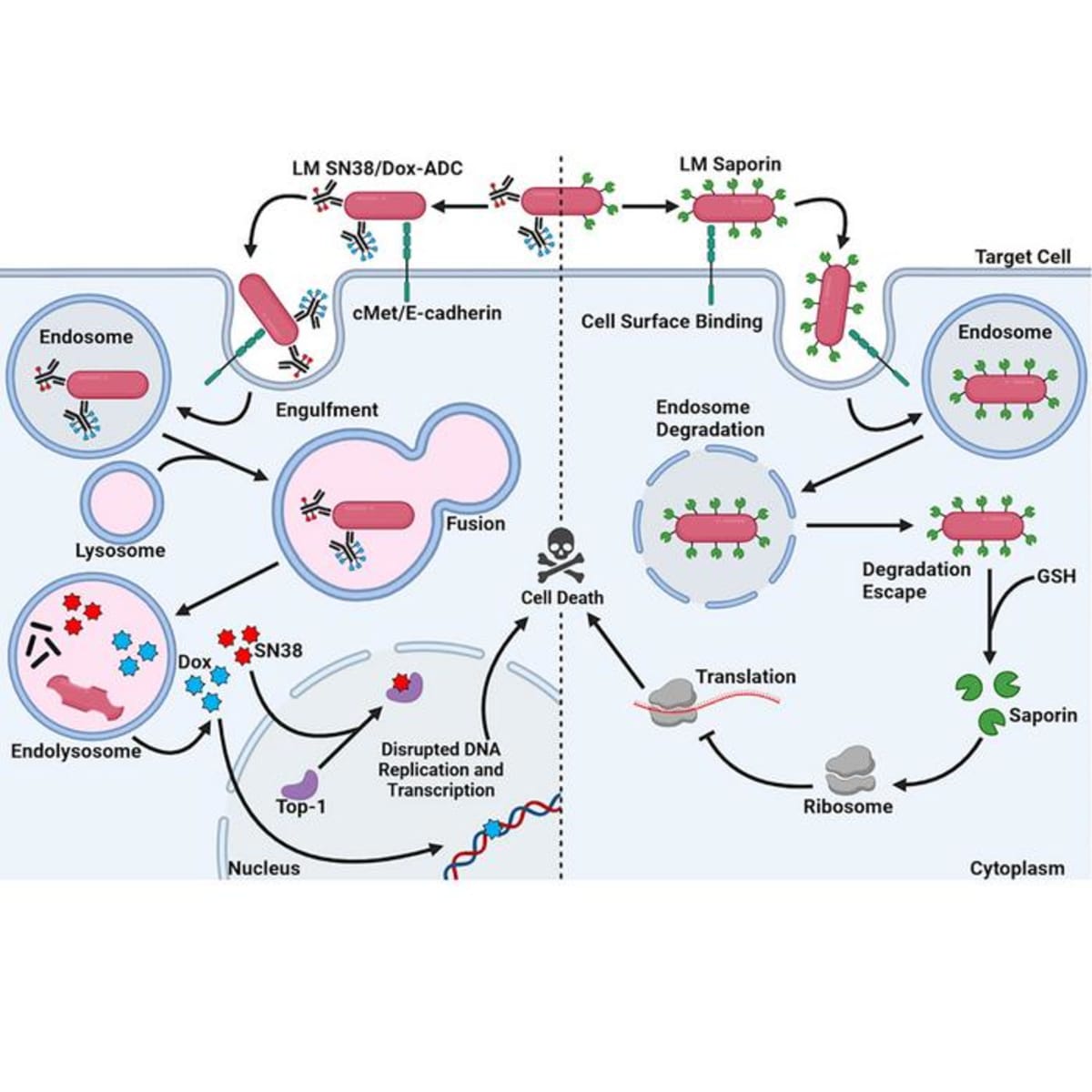
Dr. Michael VanNieuwenhze and his team attached saporin, a powerful cancer-killing protein, to the surface of modified Listeria bacteria. The bacteria acts like a microscopic delivery truck, carrying its toxic cargo through the cancer cell's defenses and releasing it exactly where it needs to work.
The approach works because Listeria naturally invades human cells. By genetically modifying the bacteria to make it safer while preserving this cell-penetrating ability, researchers created the perfect vehicle for delivering treatments that couldn't otherwise reach their targets.
"What if we could hook saporin on the surface of a bug and let the bug get delivered into the cell as it normally would?" VanNieuwenhze explained. "We could then take advantage of chemistry inside the cell to release saporin to kill the cancer cell."
That's exactly what happened. Tests in both lab dishes and mice showed the bacteria successfully delivered the toxin and significantly increased cancer cell death.
Doctoral student Jianan Lyu used fluorescent imaging to track the journey. "It turns out we see a significant increase of toxicity with this approach," she said.
The Bright Side
What makes this discovery especially exciting is its potential for real-world use. Unlike many cancer treatments that require complex intravenous delivery, this therapy could eventually be taken as a pill. The modified bacteria would travel through the digestive system and target colorectal tumors directly where they grow.
Listeria has been studied as a cancer therapy since 1994, but this chemical attachment approach represents a significant leap forward. The bacteria offers unique advantages as a living organism that can be continuously improved through genetic modification.
"As a living bug, we can modify it to make it safer and more effective," said doctoral student Wyatt Paulishak. "It further has a significant immunotherapy component to it and is naturally anti-cancer."
The team is already planning next steps to make the process safer and more scalable. Their goal is moving this from laboratory success to actual therapeutic treatment that could help patients.
The research, published in Cell Chemical Biology, represents years of collaborative work between Baylor and Texas Tech University Health Sciences Center researchers. With colorectal cancer affecting thousands of families each year, breakthroughs like this remind us that science keeps pushing forward, turning yesterday's problems into tomorrow's solutions.
More Images
Based on reporting by Google News - New Treatment
This story was written by BrightWire based on verified news reports.
Spread the positivity!
Share this good news with someone who needs it