Monks' Brains Show Meditation Boosts Mental Power
New brain scans of Buddhist monks reveal meditation doesn't quiet the mind, it supercharges it. Scientists found meditation increases brain complexity and pushes neural networks toward their most efficient state.
Scientists just proved what monks have known for centuries: meditation doesn't put your brain to sleep. It wakes it up.
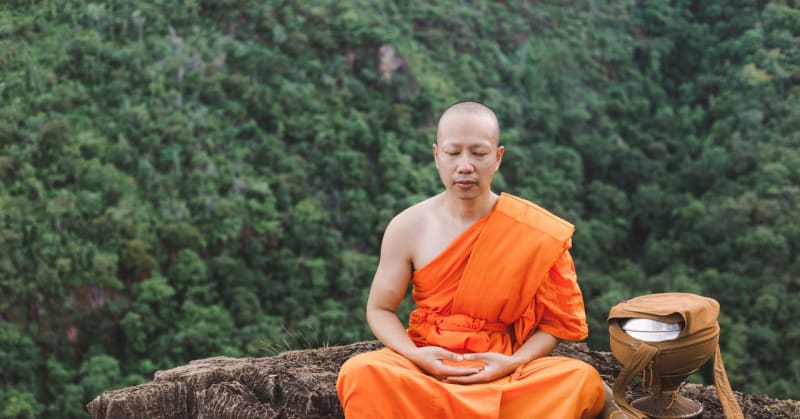
Researchers in Italy used cutting-edge brain scanning technology to study 12 Buddhist monks from the Thai Forest Tradition. What they discovered challenges everything beginners think about meditation.
The team recorded the monks' brain activity using magnetoencephalography, a tool that captures the brain's electrical signals with remarkable precision. They tested two classical meditation styles: Samatha, which focuses attention on breathing to build concentration, and Vipassana, which expands awareness to observe thoughts and sensations as they arise.
"With Samatha, you narrow your field of attention, somewhat like narrowing the beam of a flashlight. With Vipassana, on the contrary, you widen the beam," explains Karim Jerbi, professor of psychology at the University of Montreal.
Both techniques actively engage the brain's attention systems. While the monks meditated, their brains didn't relax into a restful state.
Instead, brain complexity increased dramatically compared to rest periods. The scans revealed meditation pushes the brain toward what scientists call "criticality," a sweet spot between order and chaos where neural networks work most efficiently.
Think of it like Goldilocks finding the perfect porridge. Too much rigidity and the brain can't adapt. Too much chaos leads to problems like epilepsy.
At the critical point, neural networks stay stable enough to transmit information reliably while remaining flexible enough to adapt quickly. This balance optimizes how the brain processes information, learns, and responds to new situations.
The study found fascinating differences between the two meditation styles. Vipassana brought practitioners closer to that ideal critical state of balance. Samatha produced a more stable, focused brain pattern.
Why This Inspires
This research gives us hard evidence for benefits people have felt for thousands of years. The monks showed measurable improvements in their brain's ability to switch tasks and store information.
These findings help explain why meditation reduces stress and eases symptoms of anxiety and depression. The practice isn't passive relaxation. It's active training that reshapes how your brain functions.
The research team combined ancient wisdom with modern neuroscience tools, documenting "with unprecedented precision what happens in the meditating brain." Their work opens doors for anyone seeking better mental health through meditation.
Your brain might be more trainable than you ever imagined.
More Images




Based on reporting by Wired
This story was written by BrightWire based on verified news reports.
Spread the positivity!
Share this good news with someone who needs it