Moon Observations Reveal Earth's Climate 'Fingerprint
Scientists in China have discovered a revolutionary way to track Earth's climate by observing our planet's radiation patterns from the moon. This breakthrough offers a clearer picture of global climate change than ever before.
Imagine looking at Earth from 240,000 miles away and seeing something satellites have been missing all along. That's exactly what Chinese scientists just accomplished from the moon's surface.
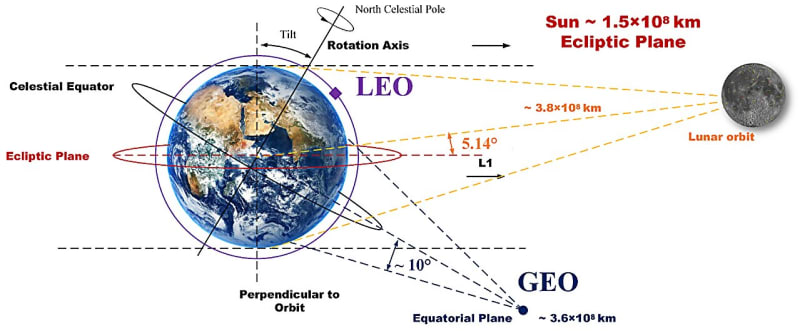
Researchers from the Chinese Academy of Sciences have confirmed that moon-based observations can capture Earth's complete "radiation fingerprint." This breakthrough provides a whole-planet view that traditional satellites simply can't match.
Earth constantly emits radiation into space, and tracking these patterns is crucial for understanding climate change. The challenge has always been getting a consistent, complete picture. Low-orbit satellites zip around too quickly, while geostationary satellites can only see one side of our planet at a time.
Dr. Ye Hanlin and his team found an elegant solution. From the moon, Earth appears as a complete disk, revealing patterns that account for 90% of our planet's radiation changes. Local weather events that confuse satellite data get filtered out naturally, leaving behind clear global signals.
The team discovered that Earth's radiation changes follow predictable mathematical patterns, like unique fingerprints. These patterns sync with the moon's orbit around Earth and our planet's daily rotation. It's like finding a rhythm in what previously seemed like random noise.
The Ripple Effect
This discovery could transform how we monitor climate change. Current satellite networks cost billions to maintain and still leave gaps in coverage. A moon-based observatory would provide continuous, whole-planet monitoring that never misses a beat.
Professor Guo Huadong, who led the research, emphasized the platform's lasting value. Unlike satellites that need constant replacement, a lunar observatory could operate for decades. The holistic view it provides is something no Earth-based system can replicate.
The findings, published in the Journal of Geophysical Research: Atmospheres, represent years of analyzing how Earth's radiation appears from lunar distances. The researchers confirmed their mathematical models match real observations, validating the approach.
This isn't just about better data collection. Understanding Earth's radiation budget helps scientists predict how our planet will respond to increasing greenhouse gases. It's the difference between educated guesses and precise measurements when planning our climate future.
The research opens doors for future lunar-based Earth observation systems. As space agencies worldwide plan moon bases, climate monitoring could become a major scientific mission alongside exploration.
From our cosmic neighbor, humanity might finally see Earth clearly enough to protect it better.
More Images

Based on reporting by Phys.org
This story was written by BrightWire based on verified news reports.
Spread the positivity!
Share this good news with someone who needs it