Moon Rocks from China's Mission Reveal Ancient Impact Mystery
Rare lunar samples from China's Chang'e-6 mission just solved a 4-billion-year mystery about how a massive asteroid collision changed the Moon from the inside out. The discovery explains why one side of the Moon looks so different from the other.
Scientists just discovered that an ancient asteroid strike didn't just dent the Moon's surface. It reached deep enough to reshape everything beneath it, forever changing how our celestial neighbor evolved.
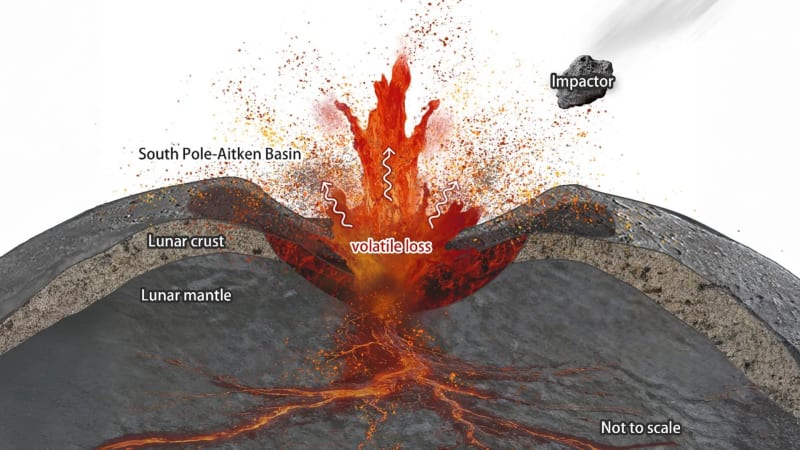
China's Chang'e-6 mission made history by collecting rocks from the South Pole-Aitken Basin, the largest crater on the Moon. When researchers analyzed these rare samples, they found something no one had seen before: a chemical fingerprint left by unimaginable heat and violence.
The team from the Chinese Academy of Sciences measured potassium isotopes in the lunar rocks and found them unlike any samples brought back by Apollo astronauts. The potassium was heavier, suggesting extreme temperatures had caused lighter isotopes to evaporate into space during the impact.
Think of it like boiling water. When the asteroid slammed into the Moon billions of years ago, it generated enough heat to vaporize certain elements. The lighter particles escaped, leaving behind a heavier chemical signature that scientists can still detect today.
This discovery solves a longstanding puzzle about the Moon. Scientists have always wondered why the near side has so much more volcanic activity than the far side. The massive impact apparently stripped away volatile elements needed for magma production, cooling volcanic activity on the far side where the crater formed.
Computer simulations backed up the findings. They showed the collision dug deep into the lunar crust and mantle, releasing enough heat to create convection currents inside the Moon. The impact literally stirred the Moon's interior like a cosmic mixer.
Why This Inspires
This breakthrough shows how far human curiosity can reach. By studying rocks from a crater formed billions of years ago, scientists from multiple countries are piecing together the violent yet beautiful story of how our Moon became what it is today.
The research also opens doors to understanding other rocky planets and moons throughout our solar system. Every world with impact craters might carry similar hidden stories beneath its surface, waiting for the right technology and determination to reveal them.
Understanding these ancient collisions helps scientists predict how planets evolve and what makes them capable of supporting life. Each lunar sample is a time capsule, preserving secrets about forces that shaped our corner of the universe.
The Chang'e-6 mission represents a new era of international space exploration, where collaboration and advanced technology unlock answers to questions humanity has pondered since we first looked up at the night sky.
Based on reporting by Science Daily
This story was written by BrightWire based on verified news reports.
Spread the positivity!
Share this good news with someone who needs it