MSU's Tiny Cancer Robots Could Replace Surgery
Scientists created microscopic robots smaller than a hair that swim through the body to kill tumors without surgery. These biodegradable "TriMag" robots could make cancer treatment, brain surgery, and eye procedures safer and less painful.
📺 Watch the full story above
Imagine swallowing a pill filled with microscopic robots that swim straight to your tumor and destroy it without touching healthy tissue.
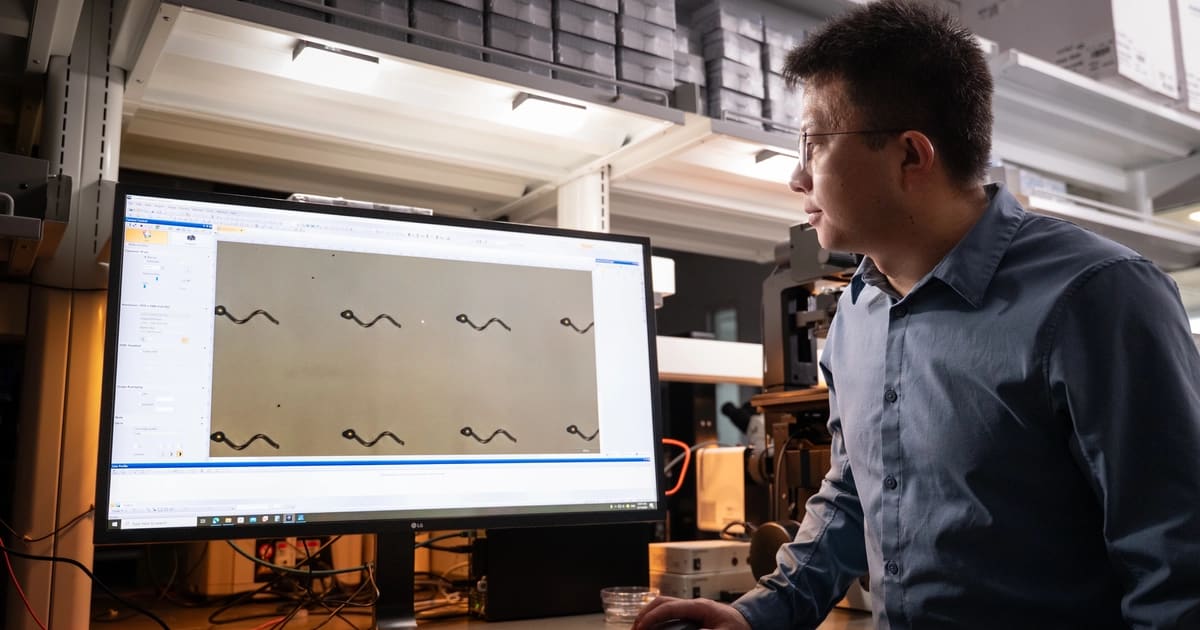
That future just moved closer to reality. Researchers at Michigan State University unveiled a breakthrough microrobot called TriMag that combines three powerful abilities in one device smaller than a human hair.
The tiny robots can be guided through the body using magnetic fields, tracked in real time with advanced imaging, and gently heated to destroy cancer cells. No incisions needed.
"Now, with advanced microrobotic design and imaging tools, we can reliably build, track and activate microrobots deep inside the human body," said Jinxing Li, lead researcher at MSU's College of Engineering.
Here's how they work. Doctors could inject, apply to skin, or have patients swallow the microrobots. Magnets outside the body steer them to exact targets, like guiding a tiny ship through bloodstreams and organs.
The robots' shape mimics sperm cells, helping them move easily through the body's thick fluids. Once they reach a tumor, they heat up to kill cancer cells while protecting surrounding healthy tissue.
When their job is done, the robots safely biodegrade. They're made from edible polymers similar to dissolvable drug capsules and tiny iron oxide particles. The body breaks them down naturally, using the iron for hemoglobin or removing it through normal processes.
The Ripple Effect
Beyond cancer treatment, these microrobots could transform multiple areas of medicine. Eye treatments could become less invasive because doctors could guide robots to exact spots instead of injecting needles directly into eyeballs.
Brain surgeries could require smaller incisions and shorter recovery times. "They offer a less invasive way to navigate delicate brain structures in humans," said Ian Lee, neurosurgeon at Henry Ford Health and study co-author. "Less invasiveness means faster recovery for patients."
The research, published in Advanced Materials, solved a major problem with current microrobots. Previous designs couldn't deliver accurate real-time images through tissue or organs, making them unreliable for medical use.
The TriMag design uses magnetic particle imaging that clearly tracks the robots in deep tissues and produces three-dimensional images with no radiation. Unlike X-rays or CT scans, this imaging isn't blocked by organs or bones.
Researchers tested the microrobots in biological fluids and animal models. Human trials are still years away, but scientists say this breakthrough provides one of the strongest platforms yet for developing microrobots that could reach clinical use.
The research received support from the National Science Foundation, National Institutes of Health, and Henry Ford Health partnerships.
Cancer treatment that targets only tumors, brain surgery without major incisions, and pain-free eye procedures could soon move from science fiction to medical reality.
Based on reporting by Google News - Medical Breakthrough
This story was written by BrightWire based on verified news reports.
Spread the positivity!
Share this good news with someone who needs it