NASA Finds Ammonia on Europa, Hints at Alien Life
Scientists discovered ammonia compounds on Jupiter's moon Europa by reanalyzing 1997 spacecraft data, suggesting the icy moon's hidden ocean could support life. The compounds appeared near surface cracks where ocean water likely pushed through from below.
A 29-year-old spacecraft flyby just gave us fresh reasons to believe we might not be alone in our solar system.
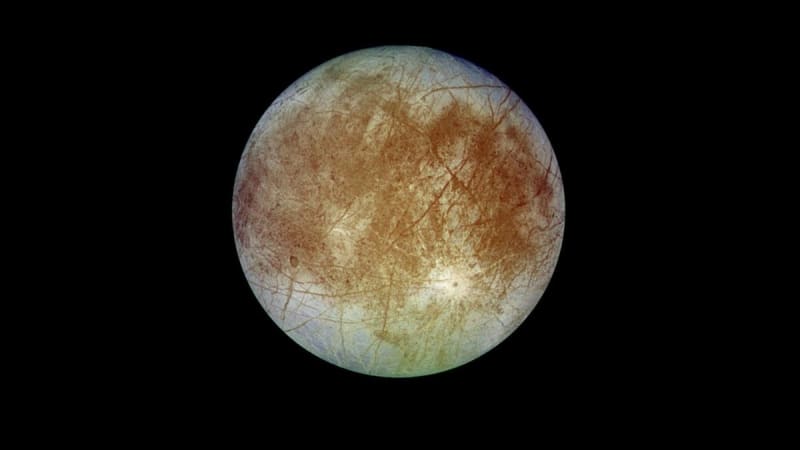
NASA scientists announced in late January 2026 that they've found ammonia-bearing compounds on Europa, Jupiter's ice-covered moon, by taking a new look at data collected way back in 1997. The discovery came from advanced processing of images captured by the Galileo spacecraft, which orbited Jupiter for eight years before its mission ended in 2003.
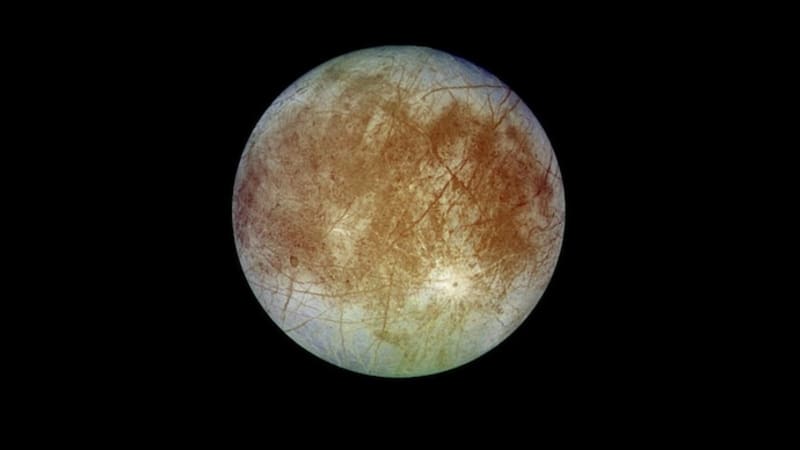
Europa has always fascinated scientists because beneath its cracked ice shell lies a global ocean that likely holds twice as much water as all of Earth's oceans combined. The moon's surface is crisscrossed with dark, linear fractures called lineae that look like giant roadways carved into the ice.
The ammonia showed up as bright red pixels in the new composite images, clustered around these fracture zones. That pattern tells an exciting story: material from the subsurface ocean was pushed up through the cracks and deposited on the surface, bringing deep-ocean chemistry into view for the first time.
Ammonia matters because it acts as a natural antifreeze in space. When dissolved in water, it keeps liquids from freezing at temperatures far below zero degrees Celsius, creating more stable environments where the building blocks of life could potentially form and persist.
The findings support the idea that Europa experiences cryovolcanism, essentially ice volcanoes that erupt freezing-cold liquids instead of hot magma. Similar activity has been observed on Saturn's moon Enceladus, where water vapor plumes shoot dramatically into space.
Why This Inspires
This discovery reminds us that patience and curiosity pay off in unexpected ways. The Galileo spacecraft has been gone for over two decades, yet its carefully archived data continues revealing new secrets with modern analysis techniques.
Europa was already considered one of the most promising places in our solar system to search for extraterrestrial life. Adding ammonia to the equation strengthens that case by introducing compounds that could fuel the energy-rich chemical reactions essential for biology.
The timing couldn't be better. NASA's Europa Clipper spacecraft is already on its way to the Jupiter system, carrying advanced instruments designed to study the moon up close during multiple flybys in the coming years. Scientists are eager to confirm these ammonia hints and search for other signs of habitability.
The discovery also highlights how much we still don't know about worlds we thought were well understood. Europa has been photographed, mapped, and studied for decades, yet it can still surprise us with major findings hiding in plain sight.
Even data from a mission that ended before many of today's scientists started their careers continues pushing the boundaries of what we know about life's potential beyond Earth.
More Images


Based on reporting by Google: NASA discovery
This story was written by BrightWire based on verified news reports.
Spread the positivity!
Share this good news with someone who needs it