NASA Finds Mars Molecules That Point to Ancient Life
Scientists discovered organic molecules on Mars that are hard to explain without biology. While not proof of life, the finding opens exciting new questions about our planetary neighbor.
NASA scientists just reported something extraordinary: organic molecules on Mars exist in concentrations that may require a biological explanation.
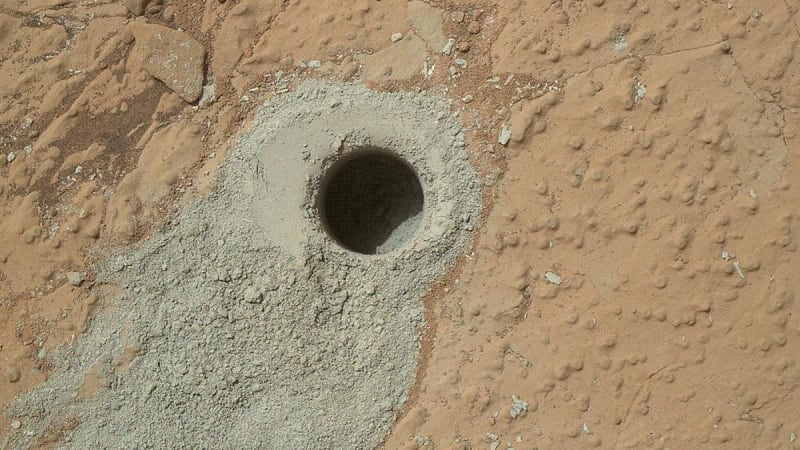
In 2025, the Curiosity rover found long-chain organic molecules called alkanes in ancient Martian mudstone. Now, a team led by Alexander Pavlov at NASA's Goddard Space Flight Center has calculated that these molecules were once far more abundant than we see today.
The mudstone sat exposed on Mars' surface for 80 million years, getting bombarded by harsh radiation. That radiation slowly broke down organic material in the rock, like sunlight fading an old photograph.
Using laboratory experiments, Pavlov's team estimated the original concentration at 120 to 7,700 parts per million. That's dramatically higher than the 30 to 50 parts per billion they detect today.
Here's where it gets interesting. These alkanes could be fragments of fatty acids, which on Earth come mostly from living organisms. The team tested every known non-biological source: meteorites, interplanetary dust, atmospheric reactions, and hydrothermal chemistry.
Even combining all these natural processes, they couldn't account for the original abundance. Something else may have created these molecules millions of years ago.
The Bright Side
The researchers are careful to say this isn't definitive proof of Martian life. There could be non-biological pathways we haven't discovered yet, or factors about Martian radiation we don't understand.
But that's exactly what makes this discovery so valuable. It gives scientists specific questions to investigate and clear targets for future Mars missions.
Mars has revealed many different organic molecules over the years. Each discovery helps us understand whether the red planet could have supported life, or perhaps still does in protected subsurface environments.
The study appears in the journal Astrobiology, inviting the global scientific community to examine the evidence and propose new explanations. Every mystery solved about Mars brings us closer to answering humanity's oldest question: are we alone?
This finding reminds us that exploration continues to surprise us, and the universe still holds secrets worth uncovering.
More Images


Based on reporting by Google News - Science
This story was written by BrightWire based on verified news reports.
Spread the positivity!
Share this good news with someone who needs it