NASA Rescues Falling Space Telescope With Robot Spacecraft
A groundbreaking mission is underway to save NASA's Swift Observatory from burning up in Earth's atmosphere. A robotic spacecraft called LINK will attempt the first-ever rescue of a satellite not designed to be grabbed, potentially giving the telescope decades more life.
When astronomer Anna Ho submitted a routine request to study a newly discovered supernova in February, she got radio silence. That's when she learned NASA's Swift Observatory had stopped taking new observations and was fighting for survival.
Swift has been falling. For more than 20 years, the pickup truck-sized telescope has circled Earth every 90 minutes, studying exploding stars and cosmic phenomena. Friction with particles in the upper atmosphere has slowly dragged it down, and intense solar activity recently accelerated its decline.
Without intervention, Swift would burn up within months. NASA needed a solution fast.
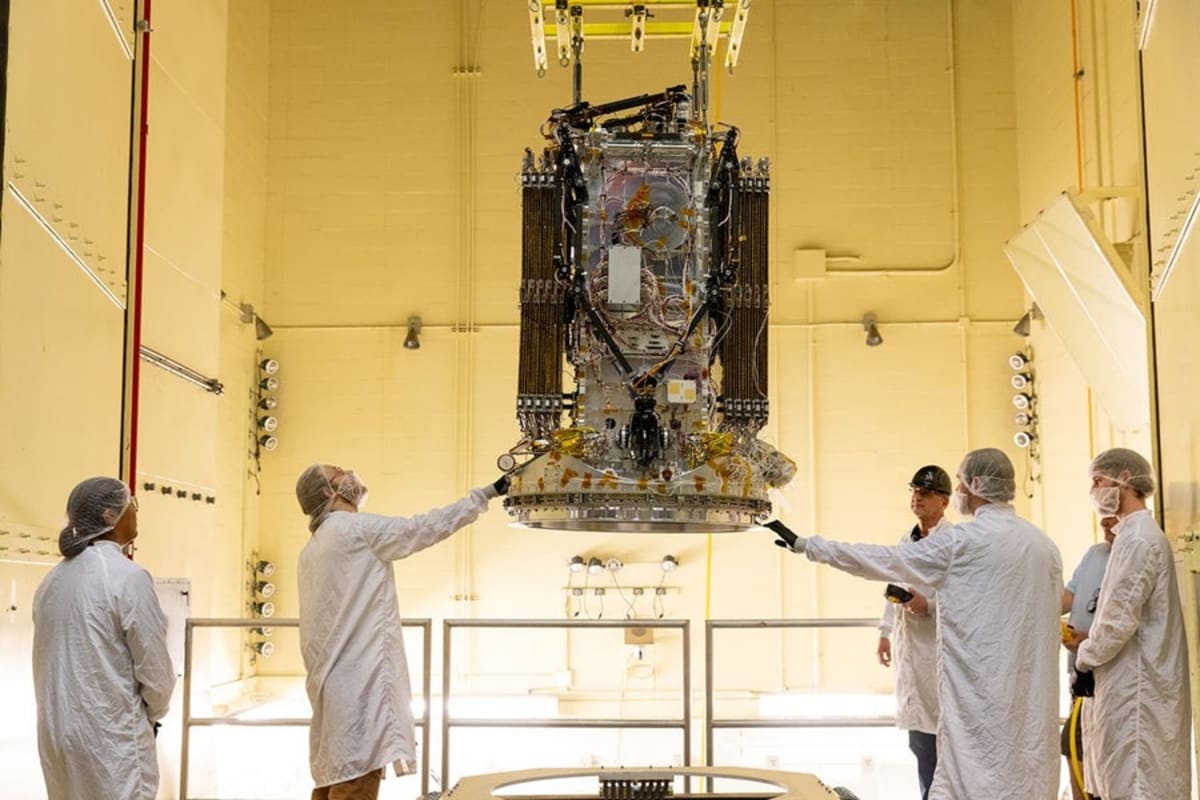
Enter Katalyst Space Technologies, an Arizona company given just nine months to build a rescue mission from scratch. On Tuesday, their spacecraft LINK launched from a plane over the Marshall Islands, heading to orbit on an unprecedented mission.
LINK's job sounds simple but has never been done before. The robotic spacecraft must catch Swift using mechanical arms, then slowly push it back to higher orbit using ion thrusters over several months. The catch is that Swift was never designed to be grabbed.
The riskiest moment comes during capture. LINK's arms need to grasp metal panels on Swift's corners, but the telescope is wrapped in aluminum foil-like insulation that's been in space for two decades. No one knows what condition it's in because no one has seen Swift up close since launch.
LINK will photograph Swift from multiple angles first, analyzing the best approach like a careful surgeon planning an operation. Once it grabs hold, LINK will spend months carefully boosting both spacecraft to higher orbit while keeping Swift's solar panels charged and its delicate mirrors protected.
The stakes extend beyond one telescope. Swift discovers cosmic explosions happening right now across the universe, responding to urgent requests from astronomers worldwide within minutes. It's found nearly 2,000 gamma ray bursts from exploding stars and helped discover entirely new types of cosmic phenomena.
In 2018, Swift revealed that a mysterious explosion nicknamed "the Cow" was actually an incredibly powerful event in a distant galaxy, not a nearby star as everyone assumed. That discovery opened up entirely new fields of research.
Building a replacement telescope would cost far more money and take years longer than this rescue mission. If successful, LINK proves that aging satellites can be saved rather than replaced, potentially transforming how we manage spacecraft.
The Ripple Effect
This mission demonstrates something bigger than saving one telescope. Dozens of valuable satellites orbit Earth with no backup plan if something goes wrong. LINK shows that rescue is possible even for spacecraft never designed to be touched.
The technology Katalyst developed in just nine months could extend the lives of weather satellites, communications systems, and scientific instruments worth billions. It's faster and cheaper than building replacements, and it keeps functional equipment out of the growing problem of space junk.
For astronomers like Ho, Swift's rescue means continuing to catch the universe's most fleeting moments. When stars explode or black holes flare, these events fade quickly. Swift gives scientists the ability to study them before they disappear forever.
Within months, if all goes well, Swift will return to its mission of revealing cosmic secrets, rescued by human ingenuity and a robot that learned to catch.
More Images



Based on reporting by Scientific American
This story was written by BrightWire based on verified news reports.
Spread the positivity!
Share this good news with someone who needs it