NASA Telescope Gets First-Ever Space Rescue Mission
A 22-year-old NASA telescope facing a fiery death will be saved by a robotic rescue craft in a historic first. The mission could change how we handle aging satellites forever.
📺 Watch the full story above
For the first time ever, a perfectly good NASA spacecraft won't have to die just because its orbit is decaying.
The Neil Gehrels Swift Observatory has been studying gamma-ray bursts since 2004, doing exactly what scientists need it to do. But after nearly 22 years in space, gravity is slowly pulling it toward Earth's atmosphere, where it would normally burn up and be lost forever.
Not this time. Northrop Grumman is launching a robotic rescue mission in late June 2026 to save Swift and give it years more life.
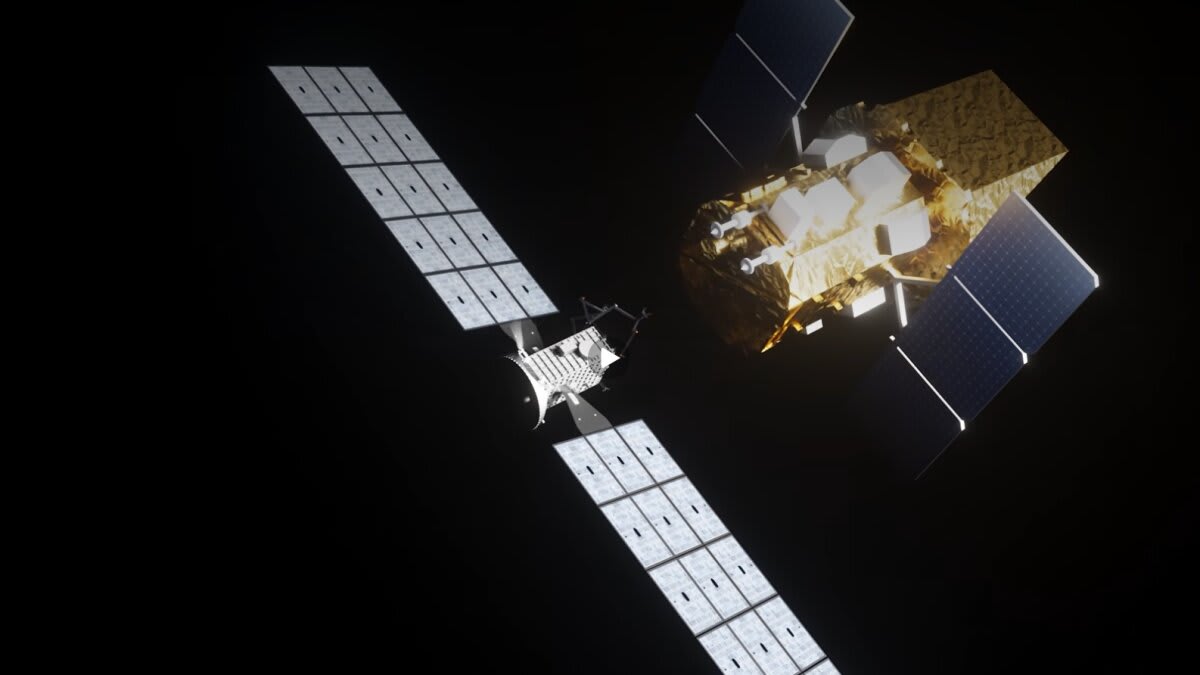
The plan sounds like science fiction. A carrier aircraft will fly over the Marshall Islands and release a Pegasus rocket carrying an 880-pound robot called LINK. The rocket will shoot LINK into the same orbital plane as Swift, matching its exact path around Earth.
Then comes the hard part. LINK will chase Swift for days or weeks until both spacecraft are traveling side by side at 17,000 miles per hour. With no human pilot and no real-time control from Earth, LINK must rely entirely on its own cameras and sensors to find Swift and figure out how to grab it.
Swift was never designed to be rescued. It has no docking rings, no magnetic capture points, no navigation beacons to help another spacecraft find it. LINK will have to scan the telescope, assess its condition after two decades in space, and locate the ground-handling fixtures workers used to move it before launch.
If everything works, LINK will extend three robotic arms and grasp those fixtures. Then it will fire its thrusters to boost Swift into a higher orbit about 373 miles up, extending the telescope's mission for years to come.
Why This Inspires
This rescue represents a fundamental shift in how we treat space technology. For decades, mission controllers could only watch helplessly as functioning satellites died from orbital decay. Now we're proving that doesn't have to be the end of the story.
The technology developed for this mission could save countless other satellites. Spacecraft that cost hundreds of millions of dollars and still work perfectly could get second lives instead of becoming expensive shooting stars.
Swift itself will continue its important work studying some of the most violent explosions in the universe. The telescope has made thousands of observations over its lifetime, helping scientists understand gamma-ray bursts and the early universe.
The mission also showcases what's possible with modern robotics and autonomous systems. LINK must make split-second decisions entirely on its own, processing images and sensor data to dock with a tumbling, unprepared spacecraft traveling at unimaginable speeds.
If successful, this will be the first capture of an unprepared US government satellite by a commercial vehicle and the first rescue of a scientific satellite never designed for such an operation.
A telescope that should have died will instead keep watching the cosmos, proving that even in the harshness of space, rescue is possible.
More Images


Based on reporting by New Atlas
This story was written by BrightWire based on verified news reports.
Spread the positivity!
Share this good news with someone who needs it