NASA Unveils Moon Base Plans to Return Humans to Lunar Surface
NASA just announced its ambitious Moon Base program, launching three unmanned missions starting in 2026 to prepare for humanity's first return to the Moon since 1969. The missions will test equipment, map landing sites, and build infrastructure for a permanent human presence on the lunar surface.
Humanity is heading back to the Moon, and this time we're planning to stay.
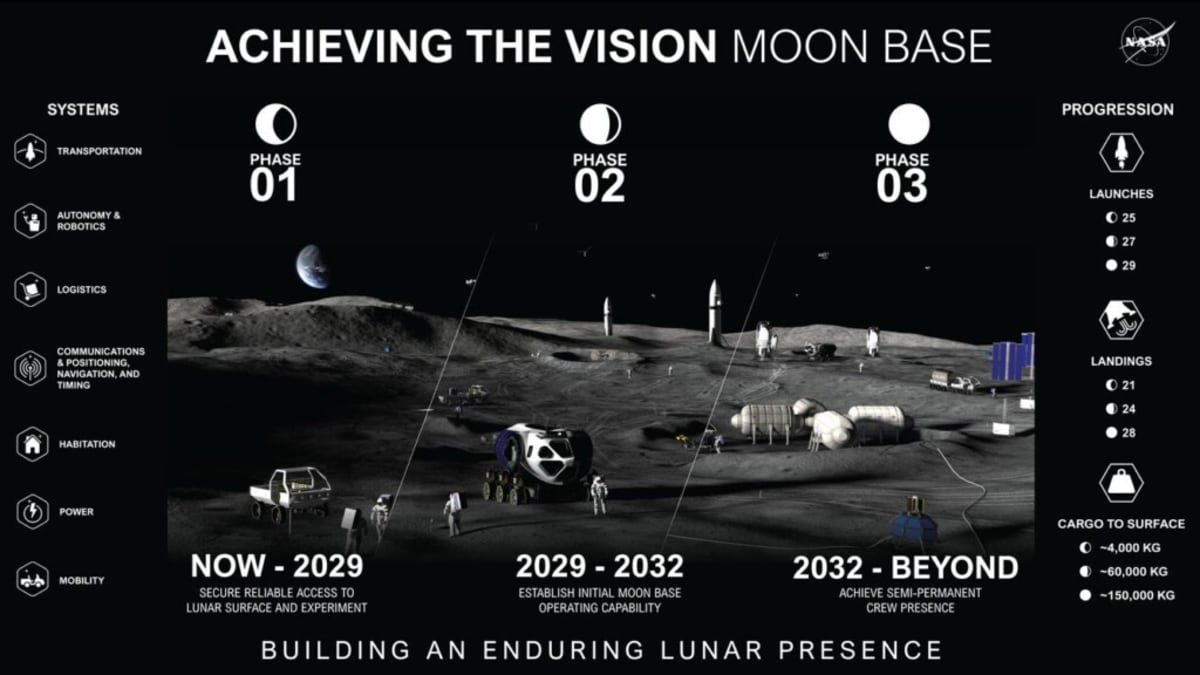
NASA revealed details this week of its Moon Base program, a series of missions designed to establish a semi-permanent human presence on the lunar south pole. The first three missions will launch starting in 2026, paving the way for astronauts to return to the Moon later this decade.
Moon Base I will kick things off with Blue Origin's Mark 1 Endurance lander delivering two critical instruments to the lunar surface. One will study how rocket thrusters affect the Moon's dusty surface, while another uses laser technology to help future spacecraft land more precisely.
Moon Base II follows with Astrobotic's Griffin lander carrying 1,100 pounds of equipment, including a lunar terrain vehicle called FLIP. This rover will gather essential data on how wheels, treads, and vehicle systems perform in the Moon's low gravity environment.
"The Moon Base will be America's and humanity's first outpost on another celestial world," said NASA Administrator Jared Isaacman at Tuesday's announcement event. Every mission will help astronauts learn to live and work safely in one of space's most challenging environments.
The third mission includes payloads from the European Space Agency and the Korea Astronomy and Space Science Institute, highlighting the international collaboration behind lunar exploration. NASA also announced MoonFall, a 2028 mission sending four drones to survey potential landing sites by hopping across the lunar surface.
The Ripple Effect
Beyond exploration, the Moon holds enormous potential for humanity's future. The lunar surface contains trillions of dollars worth of resources, including rare earth elements essential for modern technology and helium-3, a valuable isotope used in medical treatments for respiratory diseases like asthma and COPD.
Just a few tons of helium-3 could potentially power the United States for a year in nuclear fusion reactors. The Moon also contains billions of tons of common metals and rare earth elements currently difficult to source on Earth, all accessible without harming terrestrial ecosystems.
These missions represent more than technological achievement. They're building the foundation for sustainable space exploration that could solve resource challenges back on Earth while expanding humanity's presence beyond our home planet.
The journey to becoming an interplanetary species officially begins in 2026.
More Images




Based on reporting by Good News Network
This story was written by BrightWire based on verified news reports.
Spread the positivity!
Share this good news with someone who needs it
%2Fhttps%3A%2F%2Ftf-cmsv2-smithsonianmag-media.s3.amazonaws.com%2Ffiler_public%2F31%2Feb%2F31ebdfc9-0df0-4f8b-9103-77d6dfdb4483%2Fsmithsonian_feature_images_15.png)