NASA's Roman Space Telescope Nears 2026 Launch
NASA's next great space observatory has finished assembly and is heading toward a late 2026 launch. The Nancy Grace Roman Space Telescope will scan the universe at an unprecedented scale, hunting for thousands of new planets and unlocking mysteries about dark energy.
A powerful new telescope that could revolutionize our understanding of the universe is one step closer to the stars.
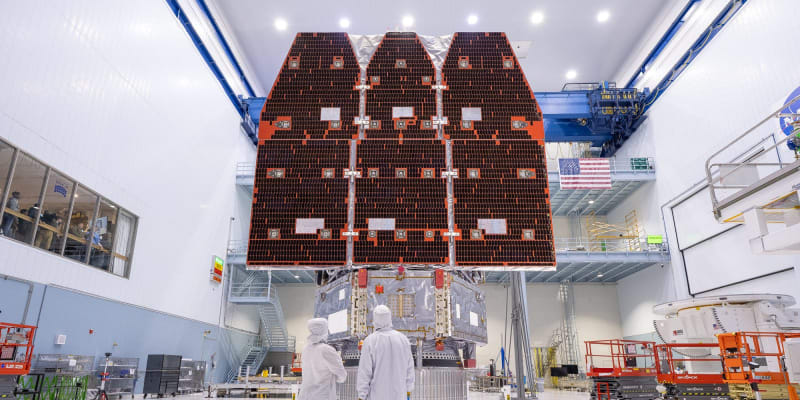
NASA's Nancy Grace Roman Space Telescope has completed assembly at the agency's facilities and is now undergoing final environmental testing before shipping to Kennedy Space Center in Florida. If all goes according to plan, the observatory will launch aboard a SpaceX Falcon Heavy rocket in late 2026.
Named after NASA's first chief of astronomy, the Roman Space Telescope represents a massive leap forward in how we survey the cosmos. While the James Webb Space Telescope peers deeply into tiny patches of sky, Roman will capture sweeping panoramic views, observing areas roughly 100 times larger with similar clarity to Hubble.
Think of it this way: if Webb is a microscope examining cosmic details, Roman is a wide-angle camera capturing the big picture. That field of view will let scientists gather statistical data at a scale no previous space telescope could achieve.
One of Roman's most exciting missions involves hunting for exoplanets using gravitational microlensing, a technique that detects planets when their gravity briefly magnifies light from distant stars. This method excels at finding cold, Earth-mass planets in wider orbits and even rogue planets floating freely through space without any star at all. NASA expects Roman to discover thousands of new worlds.
The telescope will also tackle one of astronomy's biggest puzzles: dark energy. Scientists know this mysterious force is accelerating the universe's expansion, but they don't understand why. Roman will measure tiny distortions in the shapes of distant galaxies and map how galaxies cluster across cosmic time, providing crucial clues about how the universe evolved.
The Ripple Effect
Roman's impact extends beyond its own discoveries. The telescope carries a technology demonstration coronagraph designed to block starlight and directly image planets around other stars. While experimental, this instrument paves the way for future missions that could photograph Earth-like worlds in habitable zones where liquid water might exist.
Once launched, Roman will join Webb at the L2 Lagrange point, a gravitationally stable location about 930,000 miles from Earth. The two observatories will work as partners rather than competitors, with Webb providing deep, detailed looks at specific targets while Roman delivers the broad surveys that reveal cosmic patterns and trends.
From advancing our search for worlds beyond our solar system to probing the fundamental nature of the universe itself, Roman promises to reshape multiple fields of astronomy simultaneously. The telescope stands ready to show us not just new things in the universe, but an entirely new view of how everything fits together.
The countdown to a new era of cosmic discovery has begun.
More Images

Based on reporting by Google: James Webb telescope
This story was written by BrightWire based on verified news reports.
Spread the positivity!
Share this good news with someone who needs it