NASA's Space Research Helps Perfect World Cup Soccer Balls
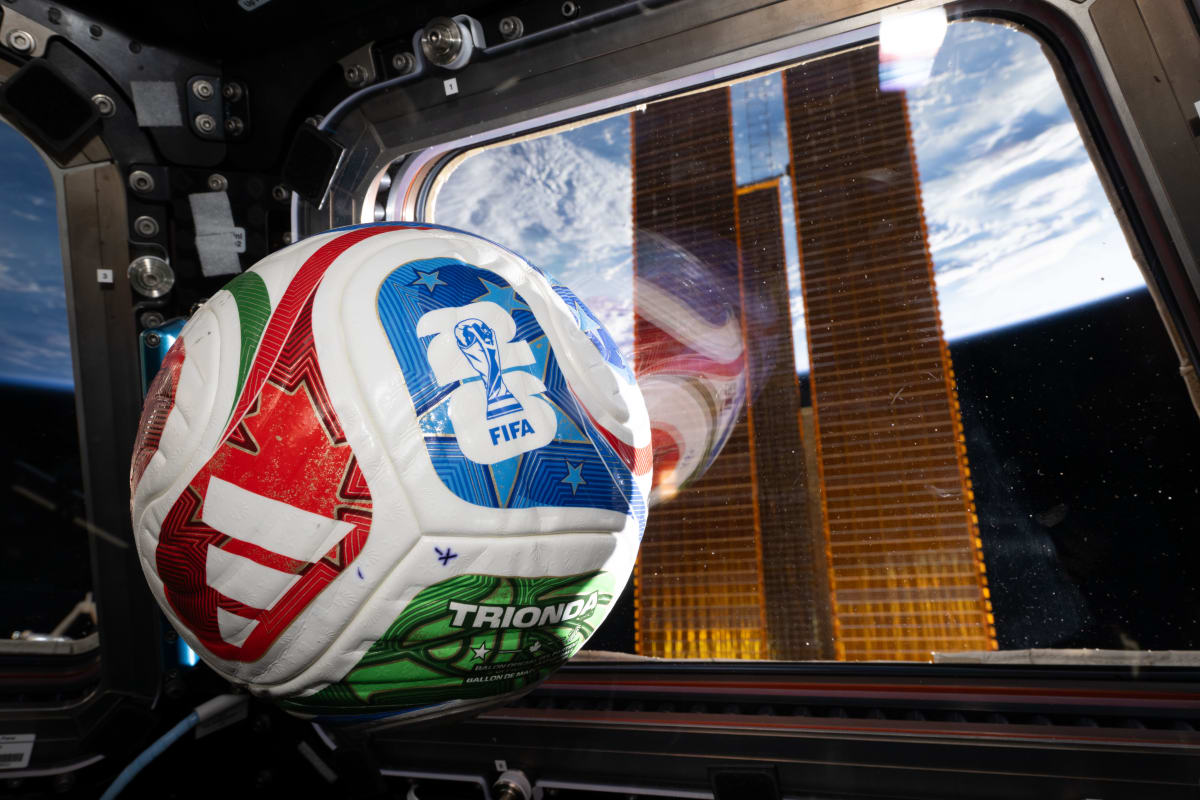
Scientists tested soccer balls on the International Space Station to understand how embedded sensors affect ball movement. The research is helping improve match balls used in major tournaments, including the 2026 FIFA World Cup.
📺 Watch the full story above
When soccer balls fly through the air during the World Cup, they're following the same physics laws that guide spacecraft orbiting Earth.
NASA scientists spent years studying soccer balls aboard the International Space Station to understand how internal sensors affect ball movement during play. The research started in 2019 when researchers partnered with the ISS National Laboratory to test how a ball's internal mass influences its motion and stability in microgravity.
The findings matter because modern match balls contain embedded electronics. Since 2022, Adidas has placed sensors inside official tournament balls to track speed, position, and contact in real time. But those sensors add mass in specific locations, and uneven weight distribution can change how a ball moves through the air.
Understanding where mass sits inside a ball helps engineers predict its flight path more accurately. The same principles apply to spacecraft, satellites, and aircraft, where knowing the relationship between an object's center of mass and its geometric center is critical.
NASA engineers at Ames Research Center in California also tested the 2014 World Cup ball in wind tunnels. They studied "knuckling," the unpredictable movement that happens during low-spin kicks when airflow becomes unstable across the ball's seams. Their measurements showed exactly which speeds and conditions produced the most dramatic effects.
Adjustments to panel shape, seam depth, and surface texture can make balls curve, dip, or hold steady during flight. These insights helped shape the development and evaluation of soccer balls for major international tournaments, including FIFA World Cup competition.
The Ripple Effect
NASA's soccer ball research shows how space science reaches far beyond rockets and astronauts. For over 25 years, experiments aboard the International Space Station have produced breakthroughs that benefit everyday life on Earth. What starts as a question about physics in microgravity ends up improving products used by millions of people.
As the 2026 FIFA World Cup kicks off, NASA is bringing this connection to fans in Houston. From June 11 to July 19, a free exhibit at FIFA Fan Festival Houston will showcase International Space Station research and the Artemis program. On June 20, Artemis II crew members fresh from their historic Moon mission will appear at the festival to share their experience with soccer fans.
NASA and Adidas created a demonstration video comparing how differently balanced soccer balls spin and move in microgravity. The experiment proves that the physics governing motion in space are the same forces at play when a ball curves into the net during the world's most watched sporting event.
More Images


Based on reporting by NASA
This story was written by BrightWire based on verified news reports.
Spread the positivity!
Share this good news with someone who needs it