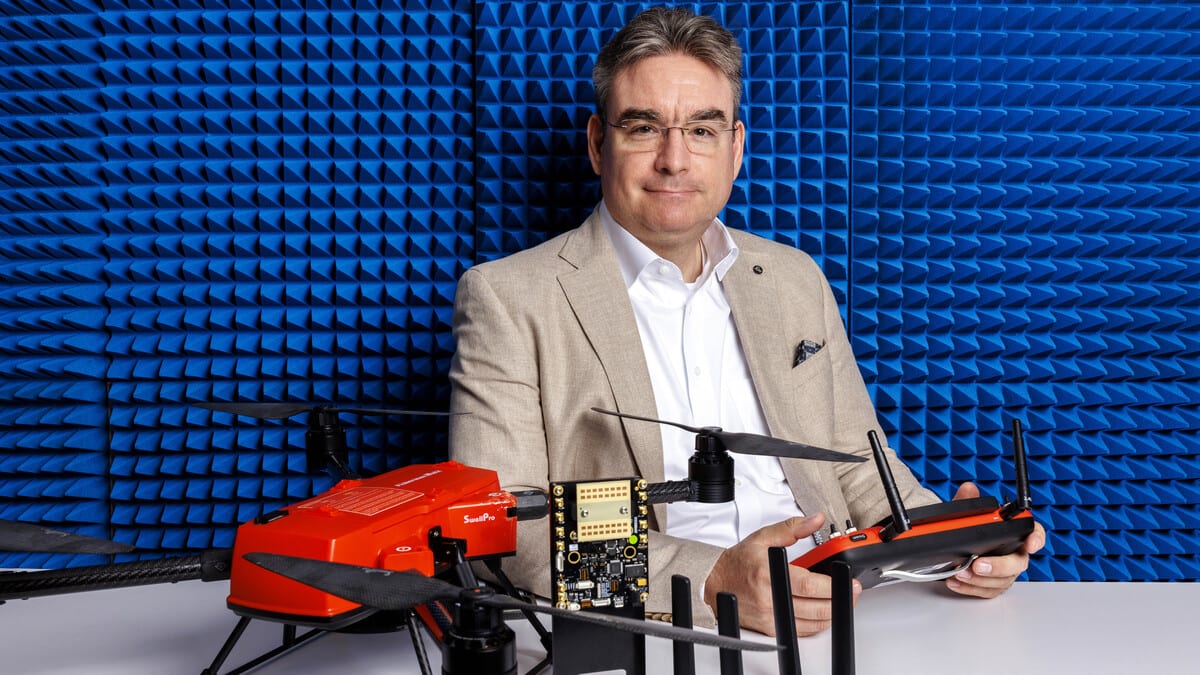
Nebraska Scientists Build AI "Autopilot" for 6G Networks
University of Nebraska researchers are creating an AI system that designs next-generation wireless networks in days instead of months, helping sensors and robots stay connected anywhere. The breakthrough could power everything from scientific missions to everyday devices when 6G launches around 2030.
Imagine wireless networks that think for themselves, automatically staying connected even in the most unpredictable places.
That's exactly what a University of Nebraska team is building as part of the U.S. Department of Energy's Genesis Mission, an ambitious project to create the world's most powerful science discovery platform. Professor Mehmet Can Vuran's team was among the first to receive funding when awards were announced in July at the Genesis Mission Summit in Washington, D.C.
The challenge they're tackling is huge. When 6G networks launch globally around 2030, they'll be at least 100 times faster than today's technology and far more complex. Traditional methods of designing these networks take weeks or months, but Vuran's team is developing an AI system that can do the job in days.
"We are building an 'autopilot' for designing the next generation of 6G wireless technology," Vuran said. The system will ensure robots and sensors stay connected even when moving through unpredictable terrain during future scientific missions.
The innovation solves another critical problem: cost. Equipping every sensor or robot with AI-capable processors would be extremely expensive, and the hardware consumes significant power while generating heat. Instead, Vuran's approach lets thousands of devices share AI computing power through intelligent 6G networks.
"We are creating a novel, AI-driven system that acts like a 'brain' for the network," Vuran explained. "It can automatically reconfigure itself and move computing power to where it's needed most, whether that's on a robot, at a local tower or in a supercomputing facility."
The project brings together an impressive team including Brookhaven National Laboratory, ALPEMI Consulting, and Hewlett-Packard. Nebraska's Santosh Pitla, professor of biological systems engineering, is also contributing expertise.
Why This Inspires
This breakthrough represents more than just faster internet. The Genesis Mission aims to double the productivity and impact of American research and innovation by harnessing AI across scientific fields. Nebraska's selection from a record pool of applicants shows how land-grant universities are solving real-world challenges with global importance.
The Department of Energy chose 278 projects total, representing the largest response to a funding opportunity in DOE history. Nebraska's leadership in AI and wireless technology positioned them perfectly for this moment.
By 2030, this work could transform how scientific instruments, robots, and sensors communicate in the field, accelerating discoveries in energy, national security, and beyond.
America's next generation of wireless technology is getting smarter, and Nebraska scientists are building its brain.
Based on reporting by Google: scientific discovery
This story was written by BrightWire based on verified news reports.
Spread the positivity!
Share this good news with someone who needs it