New AI System Spots Factory Defects Human Eyes Miss
Japanese researchers created a quality-control system that catches hidden manufacturing defects—like tiny cracks and heat problems—that traditional cameras miss, making products safer and more reliable. The technology runs fast enough to inspect items in real time on factory assembly lines.
Imagine a microscopic crack in an airplane part or a thermal flaw in your phone's circuit board slipping past quality inspectors—defects that could lead to costly failures or safety issues down the road.
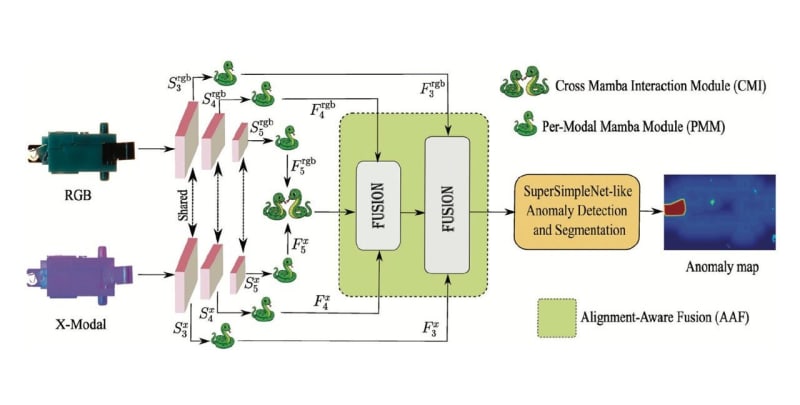
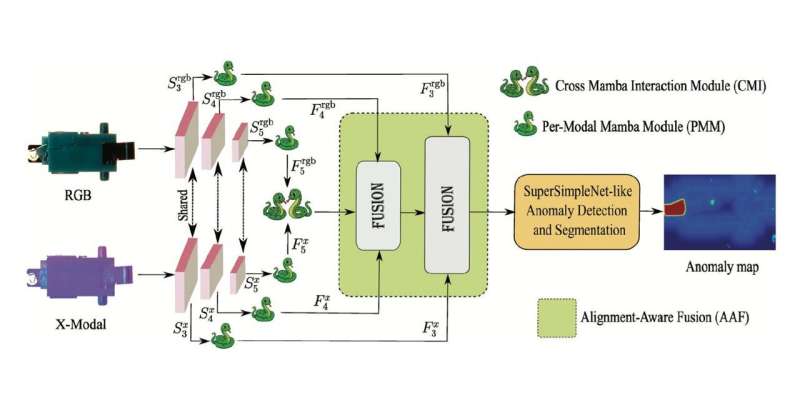
Researchers at Japan's Shibaura Institute of Technology and Vietnam's FPT University just solved this problem. They developed MambaAlign, an inspection system that combines multiple camera types to catch defects invisible to standard factory cameras.
Traditional factory inspections rely on regular RGB cameras—the same kind in your smartphone. They're fast and cheap, but they miss geometric problems like scratches, material flaws, and heat-related defects. Adding thermal cameras or depth scanners helps, but getting all those sensors to work together has been a major headache for manufacturers.
MambaAlign fixes this by smartly fusing data from different sensors while staying fast enough for real-world production lines. The system handles a common factory problem: sensors that aren't perfectly aligned. It also detects thin or angled defects like scratches and cracks that other systems often miss.
The results speak for themselves. Across three different testing scenarios, MambaAlign improved defect detection accuracy by roughly 5% compared to existing methods. More importantly, it produces clearer, less fragmented defect maps—meaning fewer false alarms and fewer real defects slipping through.
Speed matters in manufacturing, and MambaAlign delivers. The system processes nearly 30 frames per second, making it practical for inspecting items as they move down conveyor belts. It doesn't require expensive computing power either, keeping costs reasonable for factories.
The Ripple Effect
This technology could transform quality control across industries. Electronics manufacturers can spot micro-cracks or missing components on circuit boards. Aerospace companies can detect hidden delamination in composite materials that standard cameras can't see. Auto manufacturers get better detection of dents, scratches, and seam problems on vehicle bodies.
By catching more defects before products leave the factory, MambaAlign reduces waste, prevents costly recalls, and most importantly, keeps safer products in consumers' hands. Engineers get actionable information they can actually use, rather than sorting through endless false alarms.
The system addresses what Associate Professor Phan Xuan Tan calls "a long-standing bottleneck in industrial quality assurance"—combining multiple sensor types efficiently without losing precision. Fewer missed defects means fewer product failures in the field, whether that's a phone that doesn't overheat or an airplane component that performs reliably.
Real-time, multi-sensor inspection is now practical and affordable for manufacturers who want to ensure quality without slowing down production.
More Images


Based on reporting by Phys.org - Technology
This story was written by BrightWire based on verified news reports.
Spread the positivity!
Share this good news with someone who needs it