New Chip Survives 1300°F and Could Transform AI Computing
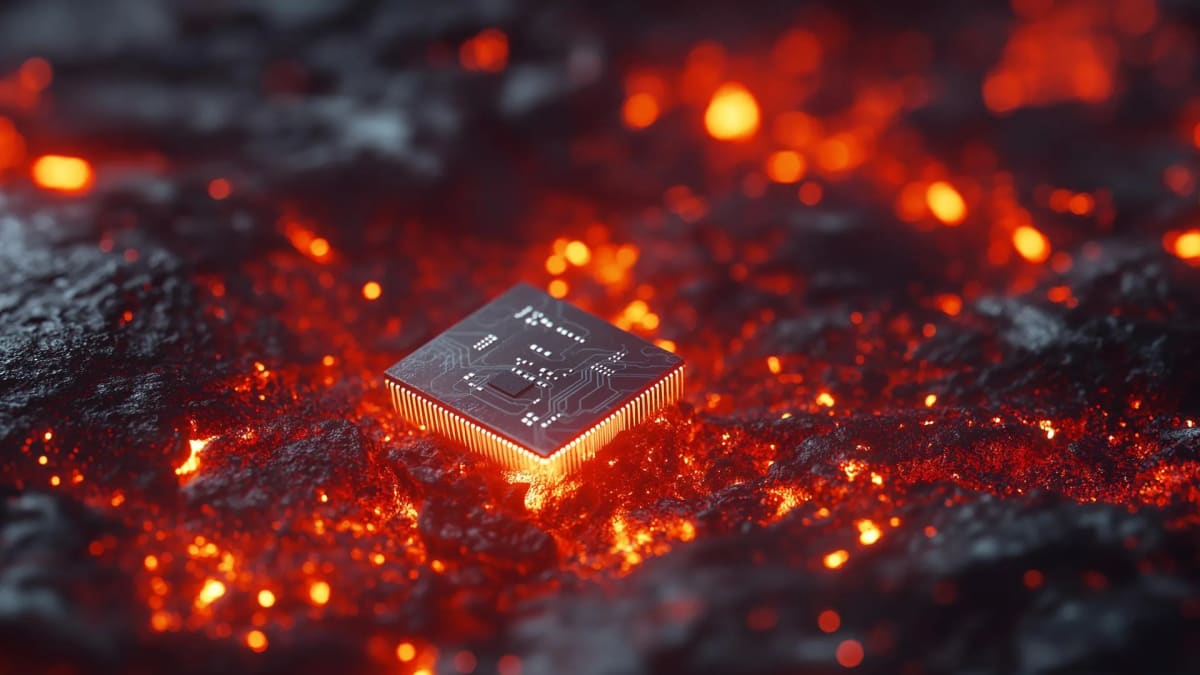
Engineers at USC created a breakthrough memory chip that works at temperatures hotter than molten lava, opening new possibilities for space exploration and dramatically faster artificial intelligence. The device operates flawlessly at 700°C, far beyond what any electronics could previously survive.
A tiny chip that refuses to die, even when heated beyond the temperature of molten lava, just shattered one of technology's most stubborn barriers.
Researchers at the University of Southern California have built a memory device that keeps working at 700 degrees Celsius (1300 degrees Fahrenheit). That's more than three times hotter than conventional electronics can handle before they melt down and fail.
The breakthrough came partly by accident. Professor Joshua Yang and his team were trying to build something completely different when they stumbled onto an unexpected discovery. "To be honest, it was by accident, as most discoveries are," Yang said.
The device is called a memristor, a nanoscale component that can both store information and perform calculations. The team built it using tungsten (which has the highest melting point of any element), a ceramic middle layer, and graphene at the bottom.
Here's what makes it revolutionary. When most electronics get hot, metal atoms slowly migrate through the device until they create a permanent connection that fuses everything together. It's like a switch getting permanently stuck in the on position.
Graphene prevents this. Tungsten atoms that try to attach to the graphene surface simply can't stick. They drift away instead, keeping the device functional no matter how hot it gets.
The chip retained data for more than 50 hours at 700 degrees without any maintenance. It also survived over one billion switching cycles at that extreme temperature, operating faster than the blink of an eye.
The Ripple Effect
This discovery could finally allow us to explore Venus, where surface temperatures hover around 500 degrees Celsius and have destroyed every lander we've sent. Current silicon chips simply can't survive there.
But the applications reach far beyond space missions. Geothermal energy systems need electronics that work deep underground where surrounding rock glows red hot. Nuclear reactors and fusion systems expose equipment to intense heat that current technology can't handle.
Even everyday devices would benefit. Cars already see temperatures around 125 degrees in their electronics, and a chip rated for 700 degrees would be essentially indestructible in comparison.
The AI angle might be the most exciting part. These memristors can perform the complex mathematical operations that power artificial intelligence much faster and more efficiently than traditional computers. Instead of moving data back and forth between memory and processors (which wastes enormous amounts of energy), memristors calculate and store information in the same place.
Yang calls it "a revolution" and believes they've only scratched the surface. The team tested up to 700 degrees simply because that's the maximum their equipment could measure. The chip showed no signs of slowing down.
By understanding what happens at the atomic level, the researchers can now design similar devices using other materials with the same heat-resistant properties. This could make the technology practical for mass production.
From Venus landers to lightning-fast AI to electronics that never overheat, a tiny accidental discovery just opened a world of possibilities.
Based on reporting by Science Daily
This story was written by BrightWire based on verified news reports.
Spread the positivity!
Share this good news with someone who needs it