New Coating Cools Buildings 7°F and Slows Fire Spread 48%
Scientists created a paint-like coating that keeps buildings cooler without air conditioning while dramatically improving fire safety. The breakthrough could transform how we protect cities from extreme heat and fire risk.
Imagine a building coating that keeps you cool in scorching heat and slows fires at the same time.
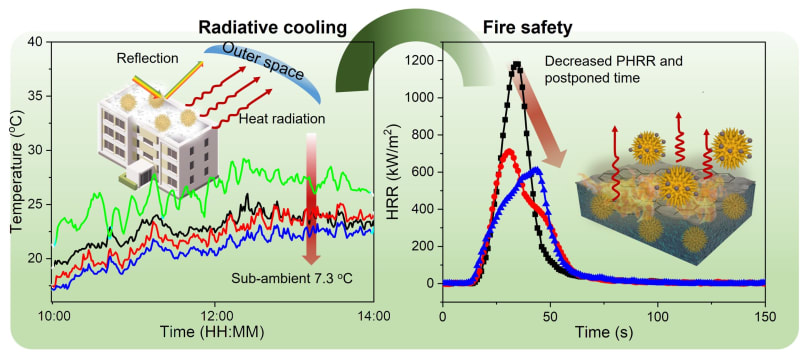
That's exactly what an international research team just developed. Their new coating reduces building surface temperatures by over 7 degrees Fahrenheit compared to surrounding air, all while cutting a fire's maximum intensity nearly in half.
The secret lies in tiny particles shaped like tree branches. These microscopic structures, made from the same silicon dioxide found in sand and glass, work double duty for buildings.
During the day, the tree-like particles reflect 95.5% of incoming sunlight. At night, they release trapped heat as infrared radiation that escapes through the atmosphere. The result? Surfaces actually become cooler than the air around them, naturally lowering indoor temperatures without electricity.
Dr. Wei Cai, a researcher at IMDEA Materials Institute, explains that the branching structure creates more surfaces to bounce light away. "Both experimental and simulation results show that the reflectivity of dendritic SiO₂ is much higher than those of solid, hollow or mesoporous SiO₂," he says.
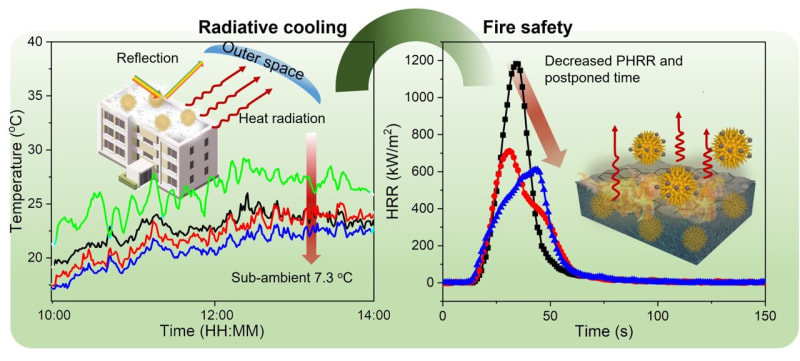
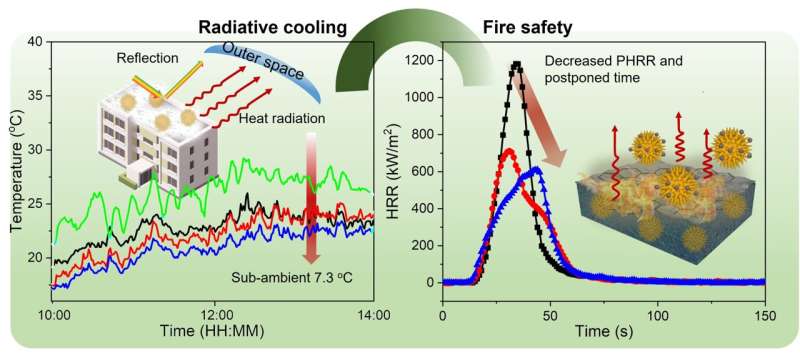
Testing showed the coating dropped temperatures by 2 degrees compared to existing products. More impressively, coated surfaces measured 7.3 degrees cooler than bare materials in the same environment.
But the team discovered an unexpected bonus. When they tested fire safety, the coating reduced peak heat release by 48.4%.
The engineered particles thicken as they heat up, trapping flammable gases and forming a protective barrier. In a real fire, this could slow flame spread and give people more time to evacuate safely.
This dual benefit solves a problem that's plagued building materials for years. Cool roof coatings typically ignore fire safety, while fire-resistant materials often trap heat.
The Ripple Effect
Urban areas face mounting challenges from both extreme heat and fire risk. Cities create heat islands where concrete and asphalt absorb sunlight, raising temperatures well above surrounding areas. Meanwhile, dense buildings increase fire danger.
This coating addresses both threats at once. Buildings could stay cooler naturally, cutting air conditioning costs and carbon emissions. Simultaneously, they'd offer better protection if fires break out.
The technology works as a simple paint-like application on roofs and building facades. No complex installation or power source required.
The research team believes their coating is particularly valuable for hot cities where overheating and fire risk converge. They've published their findings in Nano Materials Science, providing a roadmap for manufacturers to produce the coating at scale.
Buildings that keep us cool and safe? That's the kind of simple solution that could change millions of lives.
More Images

Based on reporting by Phys.org - Technology
This story was written by BrightWire based on verified news reports.
Spread the positivity!
Share this good news with someone who needs it