New Framework Connects Local Actions to Global Sustainability
Scientists from 13 institutions just published a roadmap showing how cities and countries can work together to achieve the UN's 2030 sustainability goals. The framework reveals how progress in one place can accelerate or undermine success everywhere else.
When a city changes how it uses land or a country shifts its trade policies, those decisions ripple across the planet in ways we're only beginning to understand.
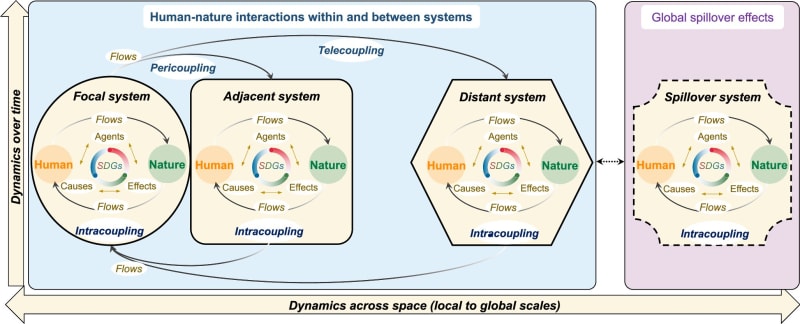
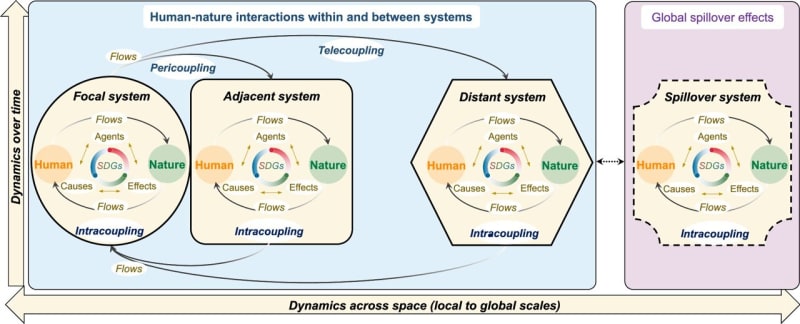
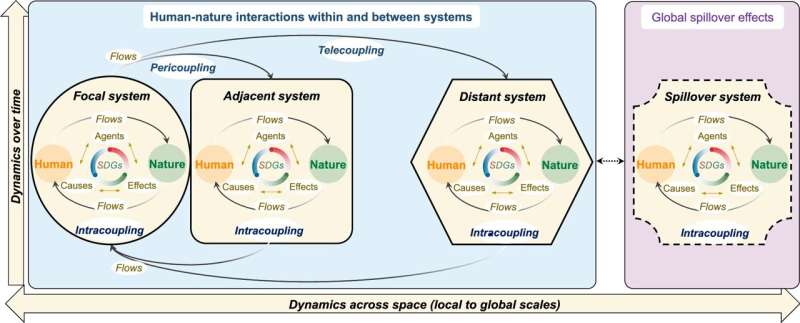
Now, 19 researchers across three continents have mapped out exactly how those connections work. Their new framework, published in Nature Communications, shows how local actions create global impacts through what they call the "metacoupled Anthropocene," an era where human and natural systems link through trade, migration, energy, tourism, information, and technology.
"In today's interconnected world, achieving sustainability is no longer a local or national challenge," said Jianguo "Jack" Liu, director of Michigan State University's Center for Systems Integration and Sustainability. "Actions taken by one city or country can ripple across the world."
The team identified three types of connections that shape our progress toward the United Nations' Sustainable Development Goals. Within countries, local development and land use changes affect communities directly. Between neighbors like Canada and the United States, shared resources create regional impacts. And across vast distances, trade between Brazil and China influences sustainability outcomes on both sides of the Pacific.
Recent global events prove how powerful these connections are. The COVID-19 pandemic and Russia-Ukraine war didn't just affect health and food security in conflict zones. They triggered biodiversity loss, cropland expansion, and inequality in distant regions that seemed unrelated.
The researchers tested their framework in Asia's Guangdong-Hong Kong-Macao Greater Bay Area. They demonstrated how regional development, global trade, and international collaboration interact to shape sustainability outcomes both locally and worldwide.
The Ripple Effect
The framework addresses a critical blind spot in current sustainability efforts. When we ignore spillover effects, wealthy regions can improve their own performance while shifting environmental and social costs to poorer areas. That undermines the core UN principle of "leave no one behind."
By tracking these cross-system effects, the new approach lets us measure progress as a shared global outcome rather than isolated national achievements. Cities designing climate action plans can now see how their choices affect distant communities. Countries negotiating trade deals can account for sustainability impacts beyond their borders.
The timing matters. With the 2030 deadline for UN sustainability goals approaching, the framework offers practical steps to accelerate progress by connecting the dots across systems, scales, and borders.
"True progress requires coordinated action across systems," Liu said. "Only by recognizing these connections can we design sustainable development pathways that are effective, fair, and resilient."
This research builds on years of pioneering work published in Science, Nature, and other leading journals, all pointing toward the same conclusion: we need integrated approaches, not isolated fixes. The path to 2030 and beyond runs through collaboration that honors how deeply our world is connected.
More Images


Based on reporting by Phys.org - Earth
This story was written by BrightWire based on verified news reports.
Spread the positivity!
Share this good news with someone who needs it