New Reactor Turns Nuclear Waste Into Clean Energy
Scientists just solved one of nuclear power's biggest problems: what to do with radioactive waste. A new reactor design can turn dangerous nuclear waste into electricity while making it safe in just 300 years instead of 100,000.
📺 Watch the full story above
Imagine taking something deadly and turning it into something useful. That's exactly what scientists have achieved with a revolutionary reactor that eats nuclear waste for fuel.
Back in the early 1990s, CERN director Carlo Rubbia assembled a team with an ambitious goal. Design a reactor that could generate electricity from radioactive materials without creating more nuclear waste or anything that could become a weapon.
The result was the Accelerator Driven System, or ADS. Instead of the dangerous chain reactions in traditional nuclear plants, this reactor uses a particle accelerator to carefully control the breakdown of radioactive atoms.
Here's how it works. The reactor holds 7,000 tons of melted lead with radioactive materials dissolved inside. A particle accelerator shoots protons at high speed into the liquid, creating a cascade of neutrons that breaks apart radioactive atoms and releases energy.
The beauty of this system is what it can consume. The reactor can run on thorium, unenriched uranium, or even spent nuclear fuel that's currently sitting in storage across the country.
Traditional nuclear plants only use about 2 to 3 percent of their fuel. The remaining 97 percent becomes radioactive waste that needs guarding for 100,000 years. But an ADS reactor could use that leftover fuel to generate electricity for centuries.
One calculation based on Vermont's now-closed nuclear plant suggests its spent fuel alone could power an equivalent reactor for over 500 years. Instead of a toxic burden, nuclear waste becomes an energy resource.
Why This Inspires
What makes this breakthrough particularly exciting is the waste it produces. Most of the spent material from an ADS reactor becomes lead-207, which isn't radioactive at all.
The remaining waste reaches safe radiation levels in just 300 years. That's still a long time, but it's 300 times shorter than the 100,000 years required for current nuclear waste.
For decades, one obstacle held back this technology: building a powerful enough particle accelerator at a reasonable cost. Scientists knew circular accelerators could work, but they'd be too expensive. Straight accelerators seemed better, but nobody had built one powerful enough.
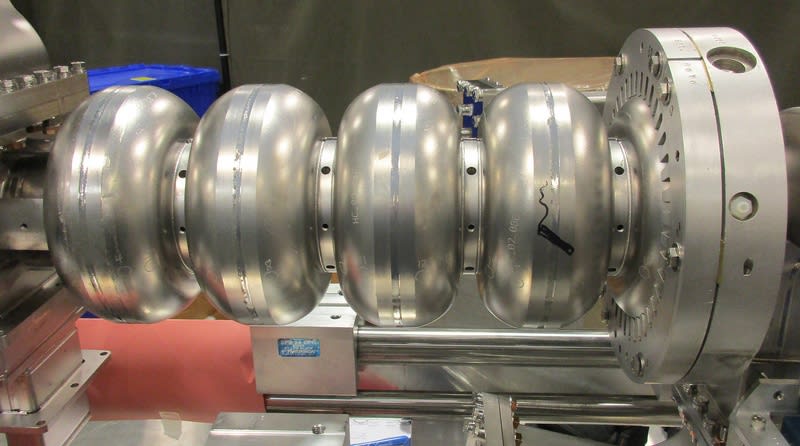
That final piece just fell into place. Jefferson Lab, a Department of Energy facility in Virginia, recently announced it developed a particle accelerator specifically designed for ADS reactors. The team is now testing niobium-tin cavities to make the system even more efficient.
This isn't just theoretical anymore. The technology exists to turn one of humanity's most dangerous problems into a solution.
The implications go beyond just dealing with existing waste. These reactors could potentially make traditional nuclear power plants obsolete, offering a safer path forward for nuclear energy.
The Ripple Effect
Countries around the world are sitting on mountains of nuclear waste with no good solution. The United States alone has over 80,000 metric tons of spent nuclear fuel in temporary storage.
An ADS reactor doesn't just solve the waste problem for one location. The technology could be deployed wherever nuclear waste exists, turning a global environmental threat into distributed clean energy production.
The timing couldn't be better as the world searches for clean energy sources to combat climate change.
After more than 30 years of development, the technology that seemed impossible is finally ready to become real.
Based on reporting by CleanTechnica
This story was written by BrightWire based on verified news reports.
Spread the positivity!
Share this good news with someone who needs it