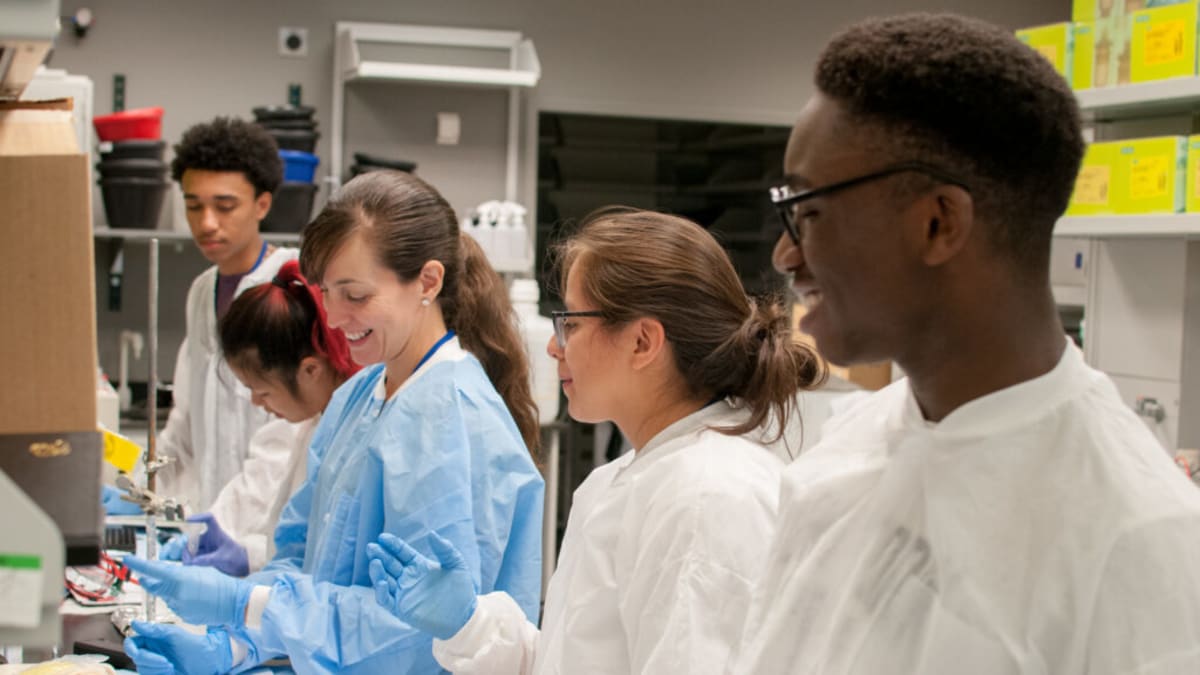
NIH Programs Doubled PhD Rates for Undergrad Researchers
A 20-year study reveals that two mentorship programs helped twice as many students earn PhDs by providing research opportunities and professional support. The findings prove what educators have long believed: the right guidance at the right time can change career trajectories.
After two decades of careful research, scientists finally have proof that mentorship programs work better than anyone imagined.
A new study published in Science Advances tracked hundreds of undergraduate students over 20 years and found something remarkable. Students in two National Institutes of Health diversity programs were twice as likely to earn a PhD compared to equally qualified peers who didn't participate.
The Research Initiative for Scientific Enhancement and Minority Access to Research Careers programs didn't just accept any interested students. Faculty handpicked undergraduates they believed had potential, then provided mentoring, research opportunities, and professional training to help them succeed in science careers.
Finding the right students to compare was tricky. Researchers needed to match program participants with students who had similar grades, motivation, and career goals but didn't get into the programs. They carefully matched 608 program students with 135 comparison students across 11 different variables.
The results were clear. Among RISE students, 20% earned PhDs compared to just 10% of their matched peers. MARC students did even better, with 34% earning PhDs versus 15% in the comparison group.
"I believe in mentoring, and I believe it works," said Donna Ginther, an economist who studies research funding gaps. "I think it's very important to underscore it in this environment."
Anna Woodcock, a social psychologist on the research team, explained why the study took such care. "We have to find these students' twins, students who looked exactly like them in terms of motivation, preparation, and intentions, but didn't have an opportunity to begin a RISE or MARC program."
The programs started in response to a 1993 law calling for more diverse voices in biomedical research. Clif Poodry, who directed workforce development at the National Institute of General Medical Sciences, wanted to know if the investment was working. "As scientist administrators, we wanted to know, 'Do the programs work?' but also importantly, 'How do they work?'"
The Bright Side: This research proves what mentors have known in their hearts. When students receive targeted support, professional training, and belief in their potential, they don't just survive in challenging fields. They thrive. An estimated 9,000 students participated in just one of these programs between 1986 and 2013, with many now in academic positions, research roles, and teaching careers where they can mentor the next generation.
The study demonstrates that investing in student potential creates measurable, lasting impact on scientific careers and diversity in research.
More Images



Based on reporting by STAT News
This story was written by BrightWire based on verified news reports.
Spread the positivity!
Share this good news with someone who needs it