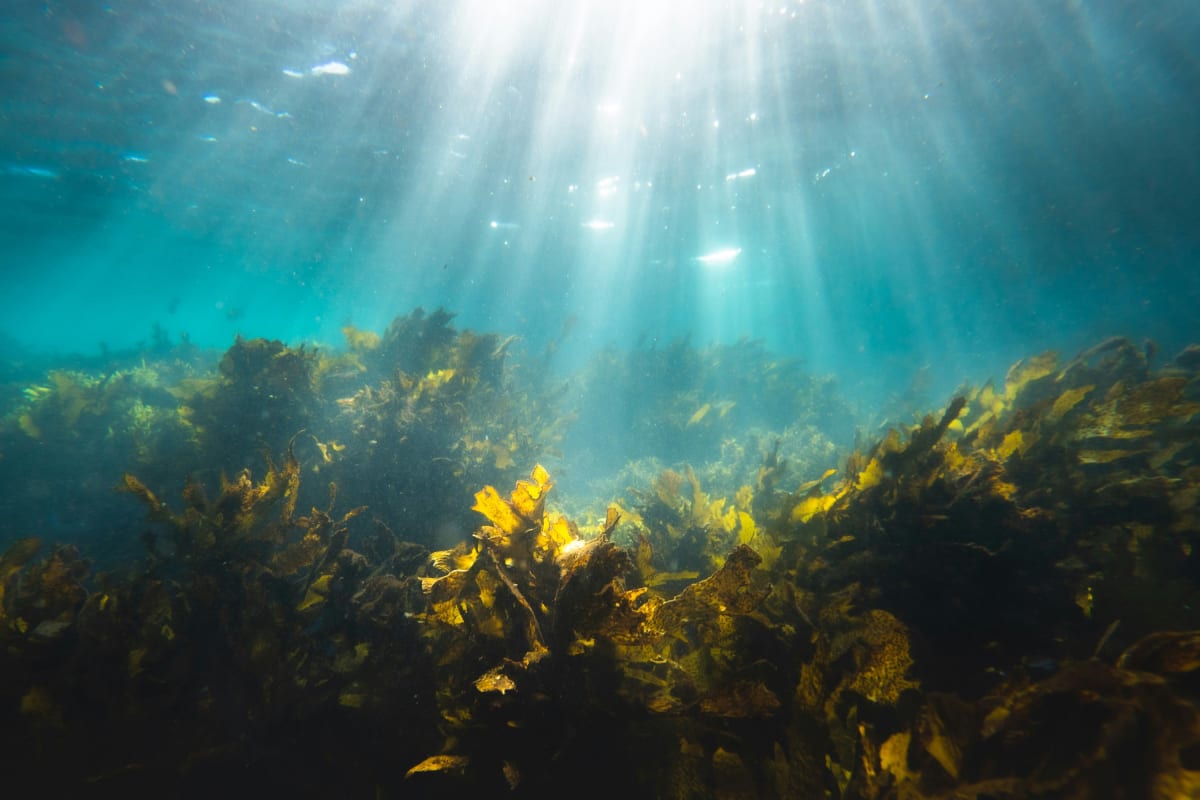
Ocean Bacteria Team Up to Store Carbon Long-Term
MIT scientists discovered that ocean bacteria work in teams to break down tough algae molecules, revealing a surprising key to how oceans store carbon for centuries. The finding could help us predict and enhance natural carbon storage in our seas.
Scientists just cracked the code on how the ocean locks away carbon for the long haul, and the answer is beautiful teamwork happening at the smallest scale imaginable.
Researchers at MIT discovered that communities of ocean bacteria work together like specialized crews to break down fucoidan, one of the toughest carbon-storing molecules in the sea. This molecule, produced by brown algae and diatoms, is so complex that no single microbe can digest it alone.
The team, led by Andreas Sichert and Professor Otto Cordero, found more than 453 different genes spread across eight bacterial strains, each playing a unique role in the breakdown process. Some bacteria specialize in dismantling the molecule's tough backbone, while others focus on removing its tricky side branches.
Here's where it gets exciting: when these bacterial specialists team up, they don't just work faster. They create a synergistic effect that exceeds what any combination of solo efforts could achieve. The more complementary their skills, the stronger the teamwork becomes.
The researchers developed a simple model that could predict how well these bacterial communities would perform, even when facing nine completely different types of fucoidan from various algae species. What looked impossibly complex turned out to follow elegant, predictable patterns.
Why This Inspires
This discovery matters far beyond the laboratory. When bacteria lack the right mix of teammates, fucoidan molecules can sink deep into the ocean carrying carbon with them, storing it away from the atmosphere for extended periods. Understanding this "diversity-limited degradation" helps explain one of nature's most important carbon storage systems.
The finding also flips conventional thinking about biotechnology on its head. Instead of engineering one super-microbe to tackle tough materials, the smarter approach might be assembling dream teams of specialists who already know their jobs.
The researchers found evidence that these complementary bacteria naturally cluster together in ocean samples, suggesting this teamwork isn't just a lab phenomenon. It's happening right now in seas around the world, quietly helping regulate our planet's carbon cycle.
The broader promise extends to other biological systems scientists don't yet fully understand. If hundreds of mysterious enzymes can be simplified into two measurable traits, the same approach could unlock predictions about how microbial communities handle other complex materials throughout nature.
This research transforms our understanding from cataloging individual parts to recognizing powerful partnerships, showing us that sometimes the most complex problems have surprisingly elegant solutions hiding in plain sight.
Based on reporting by MIT News
This story was written by BrightWire based on verified news reports.
Spread the positivity!
Share this good news with someone who needs it

