One Asteroid Strike Solved Two Mysteries on Mars Moon
Scientists discovered that a single ancient asteroid collision may have reshaped nearly the entire surface of Deimos, Mars' mysterious smaller moon. New computer simulations and spacecraft images reveal how one impact created both the moon's giant southern crater and its strangely smooth, dusty surface.
Scientists just solved a cosmic puzzle that's been floating around Mars for billions of years.
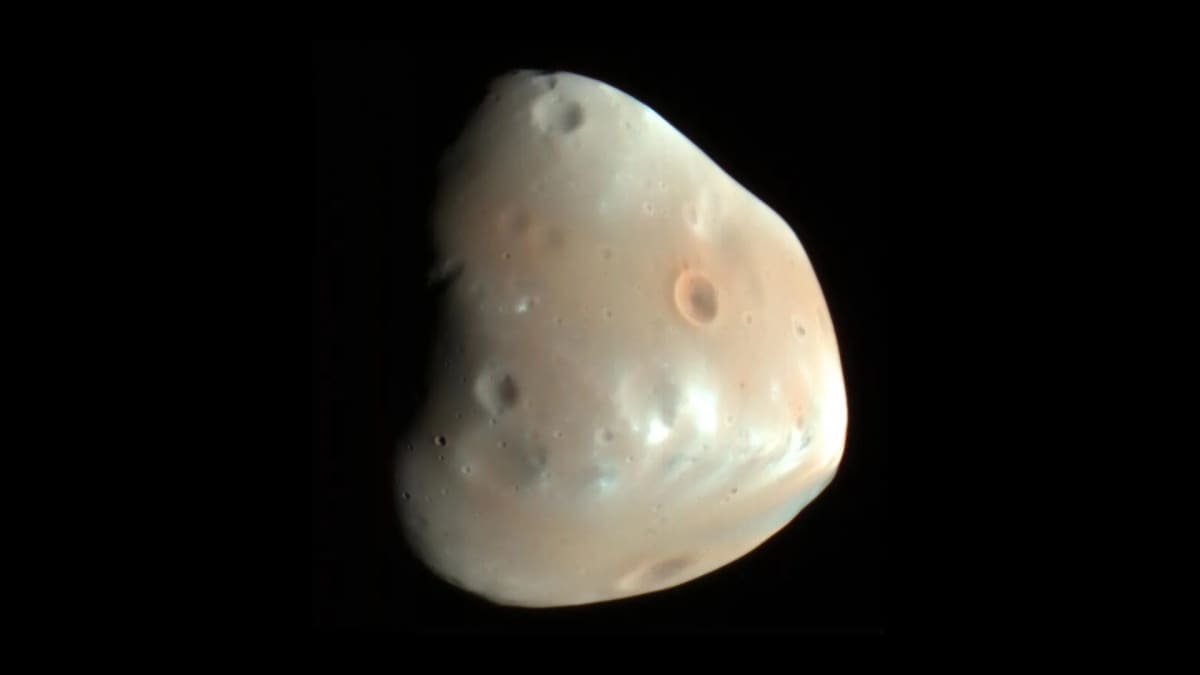
Researchers at the University of Bern discovered that one massive asteroid strike likely explains two of the biggest mysteries about Deimos, the smaller of Mars' two moons. While its neighbor Phobos looks heavily cratered and beaten up, Deimos appears strangely smooth and dusty, with a giant depression near its south pole that nobody could fully explain.
Dr. Sabina Raducan led an international team that ran about 100 detailed computer simulations to recreate what might have happened. Each simulation took roughly a week to complete on powerful university computers. The researchers tested different asteroid sizes, speeds, and impact angles until they found a scenario that matched what we see today.
The winning scenario involves an asteroid about 320 meters across striking Deimos at a 45-degree angle. The collision was powerful enough to carve out the southern depression but not strong enough to shatter the moon completely. The impact threw enormous amounts of debris across the entire surface, burying older craters under a blanket of dust and rocks that reaches over 200 meters deep in some places.
The team used observations from ESA's Hera spacecraft, which flew past Deimos in March 2025 while heading toward its main destination, the asteroid moon Dimorphos. This research marks the first scientific study to incorporate data from that historic flyby. The images supported what the simulations predicted and revealed something surprising: Deimos is much more porous and fragile than scientists previously thought.
The same computer code used in this research previously helped simulate NASA's DART mission, where a spacecraft deliberately crashed into an asteroid to test planetary defense strategies. The University of Bern has spent roughly two decades developing this software, which represents colliding objects as millions of individual particles to see exactly how impacts unfold.
Why This Inspires
This breakthrough shows how creative thinking and powerful technology can solve mysteries that have puzzled astronomers for decades. Instead of needing separate explanations for Deimos' smooth surface and its southern depression, one elegant answer ties everything together.
The findings will help guide Japan's upcoming Martian Moons eXploration mission, which plans to study both Deimos and Phobos up close. Understanding how these moons formed and evolved helps us piece together the early history of Mars and our entire solar system.
Sometimes the simplest explanation really is the right one, even when that explanation involves a cosmic collision powerful enough to reshape an entire world.
Based on reporting by Science Daily
This story was written by BrightWire based on verified news reports.
Spread the positivity!
Share this good news with someone who needs it