%2Fhttps%3A%2F%2Ftf-cmsv2-smithsonianmag-media.s3.amazonaws.com%2Ffiler_public%2Ff4%2F4f%2Ff44ff302-6a20-43aa-a93a-f1f3f31b0ea6%2Fscreenshot_2026-04-28_at_123916.png)
Orangutan Crosses First Rope Bridge Over Sumatra Road
For the first time ever, a critically endangered Sumatran orangutan was filmed using a rope bridge built over a busy road in North Sumatra. The simple solution proves wildlife and human development can coexist.
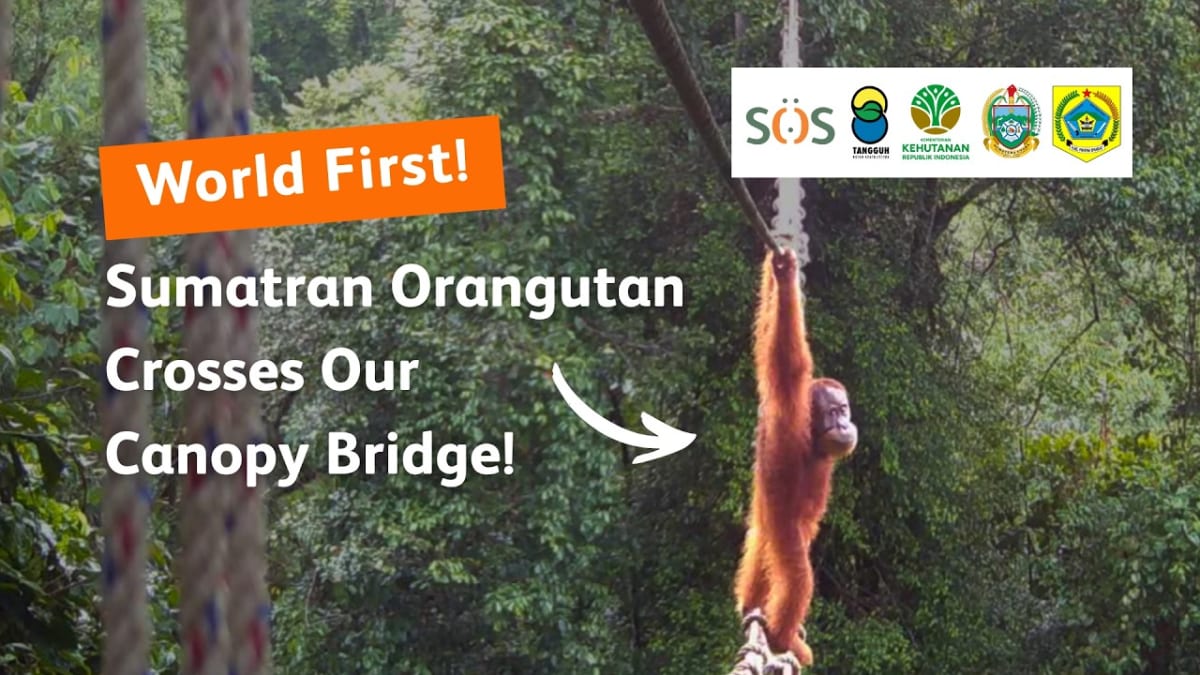
After two years of watching and waiting, conservationists in Indonesia captured a moment that made their team cry out with delight: a wild orangutan swinging across a rope bridge high above a public road.
The young male Sumatran orangutan paused halfway across the treetop overpass, glanced back at the camera, then continued his journey. His crossing proved that the world's largest tree-dwelling mammals will use human-made structures to navigate their fragmented forest home.
The bridge stretches across the Lagan-Pagindar road in North Sumatra's Pakpak Bharat district, which cuts through habitat supporting about 350 wild orangutans. The road separates two protected forest areas and provides isolated villages with access to healthcare, schools, and government services.
When road upgrades in 2024 widened the gap in the forest canopy, orangutans faced a serious problem. Development was necessary for people, but without intervention, it would have trapped orangutans on either side and made crossing impossible for tree-dwelling wildlife.
Conservation groups worked with government agencies to build five rope bridges connecting trees on both sides of the road. They studied orangutan nests, tracked animal movements, and surveyed forest cover to find the perfect spots. Camera traps installed on each bridge captured gibbons, langurs, and macaques using the structures, but everyone was waiting for an orangutan.
Sumatran orangutans spend nearly their entire lives in the trees. Females rarely touch the ground, and males only occasionally travel on the forest floor.
With fewer than 14,000 individuals remaining and their population declining, these critically endangered primates face habitat fragmentation as one of their biggest threats. Females can weigh up to 120 pounds and males up to 220 pounds, making them remarkably heavy for animals that spend their lives swinging through branches.
The Ripple Effect
The success of these simple rope bridges demonstrates a powerful principle: human progress and wildlife protection don't have to conflict. Sometimes the most effective conservation solutions are also the simplest ones.
Five bridges now span the road, creating multiple pathways that prevent inbreeding and allow genetic diversity to flourish across previously separated populations. The approach tackles what experts call "one of the greatest challenges in contemporary conservation" with materials that cost a fraction of more complex interventions.
These canopy corridors prove that thoughtful planning can help development and nature thrive together.
More Images
%2Fhttps%3A%2F%2Ftf-cmsv2-smithsonianmag-media.s3.amazonaws.com%2Ffiler_public%2Ff4%2F4f%2Ff44ff302-6a20-43aa-a93a-f1f3f31b0ea6%2Fscreenshot_2026-04-28_at_123916.png)
%3Afocal(929x717%3A930x718)%2Fhttps%3A%2F%2Ftf-cmsv2-smithsonianmag-media.s3.amazonaws.com%2Ffiler_public%2Ff4%2F4f%2Ff44ff302-6a20-43aa-a93a-f1f3f31b0ea6%2Fscreenshot_2026-04-28_at_123916.png)
%2Fhttps%3A%2F%2Ftf-cmsv2-smithsonianmag-media.s3.amazonaws.com%2Faccounts%2Fheadshot%2FMargherita_Bassi.png)
Based on reporting by Smithsonian
This story was written by BrightWire based on verified news reports.
Spread the positivity!
Share this good news with someone who needs it