Osaka Scientists Fit 'Hundreds' of Qubits on Single Chip
Japanese researchers just cracked a major puzzle blocking practical quantum computers, using clever light-beam patterns that look like tapestries. Their breakthrough could finally make quantum computing useful for solving real-world problems.
Scientists at The University of Osaka just solved one of quantum computing's most frustrating problems: how to get hundreds of laser beams into a space smaller than your fingernail.
Think of it like trying to route hundreds of highways through a single city block without any traffic jams. Until now, that physical limitation kept quantum computers stuck in the lab, too clumsy and complex to scale up.
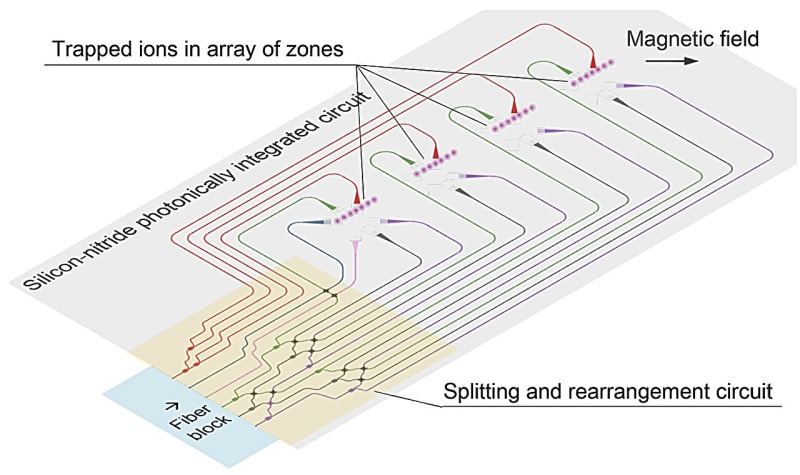
Quantum computers work by trapping individual charged atoms (called ions) and hitting them with precisely aimed laser beams at different wavelengths. Each ion becomes a "qubit," the building block that makes quantum computers potentially thousands of times faster than regular computers at certain tasks. But delivering dozens of different laser beams to the right spots without them interfering with each other? That's been the sticking point.
The Osaka team, led by researcher Alto Osada, created intricate patterns of waveguides (think fiber-optic highways for light) that weave over and under each other like a complex tapestry. Their designs deliver six different laser wavelengths exactly where they need to go, with switches to turn each beam on and off independently.
The results, published in APL Quantum, show these patterns could support several hundred qubits on a single chip. That's a massive leap from current systems.
The researchers developed two pattern approaches called "bubble sort" and "blockwise duplication." Each has strengths depending on how many beams you need and how much light you can afford to lose along the way.
Why This Inspires
This isn't just an incremental improvement. It's the kind of foundational breakthrough that transforms lab experiments into real technology. For years, quantum computing has lived in the realm of "someday maybe." This research brings that someday much closer.
The same waveguide patterns could revolutionize other optical systems beyond quantum computers, from advanced sensors to communications technology. When scientists solve one hard problem elegantly, the solution often unlocks doors nobody even knew were there.
Quantum computers promise to tackle challenges regular computers can't touch: designing new medicines, optimizing complex systems, cracking climate models. This breakthrough removes a major roadblock standing between promise and reality.
More Images



Based on reporting by Phys.org
This story was written by BrightWire based on verified news reports.
Spread the positivity!
Share this good news with someone who needs it