Oxford Engineers World's First Quantum-Enabled Proteins
Scientists at Oxford University have successfully engineered proteins that harness quantum mechanics, marking the first time these mysterious physics effects have been deliberately designed into biological molecules for practical use. The breakthrough could revolutionize medical imaging and drug delivery.
Scientists just crossed a threshold that seemed impossible a decade ago: they've engineered proteins that work using quantum mechanics, the strange physics that governs the tiniest particles in our universe.
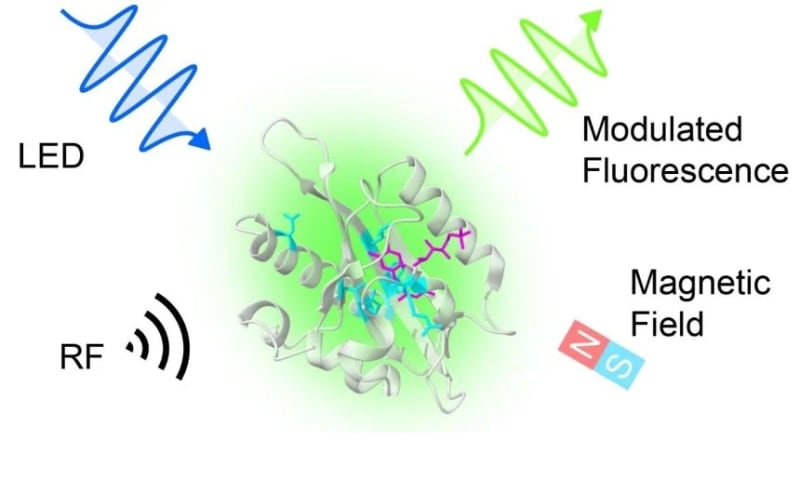
Researchers at the University of Oxford created what they call magneto-sensitive fluorescent proteins, or MFPs. These specially designed molecules respond to magnetic fields and radio waves through quantum interactions triggered by light.
The team published their findings in Nature, one of the world's most prestigious scientific journals. Lead researcher Gabriel Abrahams, a doctoral student in Oxford's Department of Engineering Science, said the breakthrough came from an unexpected source: evolution itself.
Instead of designing these quantum proteins from scratch, the researchers let nature do the heavy lifting. They used a technique called directed evolution, introducing random mutations into protein DNA and selecting the best performers over multiple rounds. Over time, the proteins became dramatically better at sensing magnetic fields.
The inspiration came from an unusual place: birds. Scientists have long suspected that birds navigate using quantum effects in their bodies to sense Earth's magnetic field. The Oxford team took that natural phenomenon and engineered it into laboratory proteins.
Why This Inspires
The real magic lies in what these proteins can do for medicine. The team built a prototype imaging device that works like a highly targeted MRI scanner, but instead of imaging entire body parts, it can track specific molecules or watch genes turn on and off inside living tissue.
Imagine doctors delivering cancer drugs that light up only when they reach a tumor, or monitoring genetic changes inside cancer cells without invasive biopsies. That's the potential locked inside these quantum-enabled proteins.
Senior researcher Harrison Steel noted how unpredictable scientific progress can be. The quantum understanding came from decades of bird navigation research, while the starting proteins originated in the common oat plant growing in fields.
The project united three cutting-edge fields: engineering biology, quantum science, and artificial intelligence. All three happen to be priority areas in the United Kingdom's national innovation strategy, showing how fundamental research aligns with real-world needs.
The research involved collaborators from institutions across four continents, including universities in Denmark, Australia, South Korea, and a US life sciences company. It's part of a larger effort at Oxford to explore quantum effects in biological systems.
The team is already expanding their work into new applications, pushing further into territory where quantum physics meets living cells. What seemed like science fiction just years ago is becoming laboratory reality, one engineered protein at a time.
Based on reporting by Google News - Tech Breakthrough
This story was written by BrightWire based on verified news reports.
Spread the positivity!
Share this good news with someone who needs it