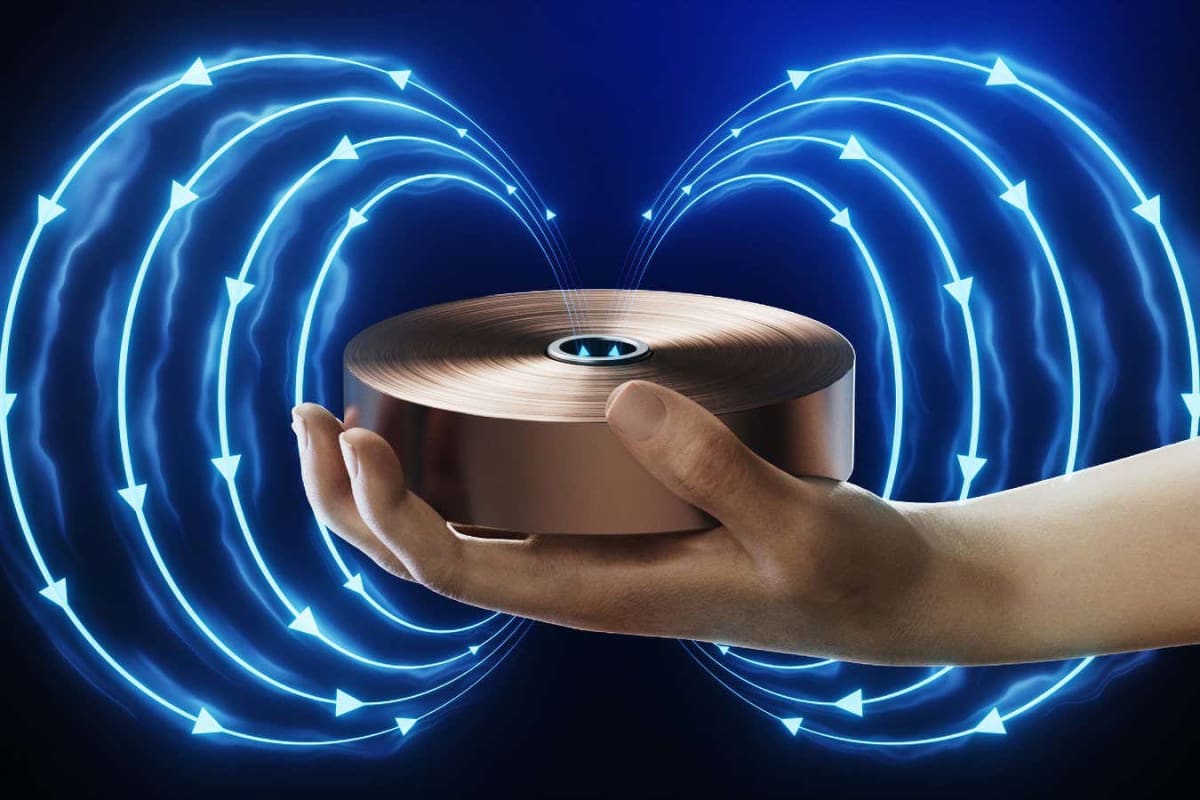
Palm-Sized Magnet Rivals Building-Sized Powerhouses
Scientists built a magnet smaller than your hand that matches the strength of two-story building magnets, using 30,000 times less power. This tiny breakthrough could make advanced medical testing affordable for labs everywhere.
Scientists just shrunk one of the world's most powerful magnets down to the size of a cherry tomato, and it could transform how we discover new medicines.
Researchers at ETH Zurich in Switzerland built a superconducting magnet measuring just 3.1 millimeters across that produces magnetic fields as strong as some of the world's most powerful magnets. Those traditional magnets weigh several tons, stand as tall as a two-story building, and guzzle 30 megawatts of power.
The new palm-sized version needs less than 1 watt of power to work.
Alexander Barnes and his team tested over 150 different designs before landing on their winner. They used thin tape made from a ceramic material called REBCO, which becomes a superconductor at extremely cold temperatures, allowing electricity to flow with almost perfect efficiency.
The team coiled this special tape into pancake shapes, creating versions with either two or four coils. The four-coil design produced a magnetic field strength of 42 Tesla, close to the 45 Tesla record held by building-sized magnets. For perspective, your average fridge magnet clocks in at less than 0.01 Tesla.
The Ripple Effect
This miniature powerhouse could democratize nuclear magnetic resonance (NMR) testing, a technique scientists use to figure out the molecular structure of new drugs and industrial materials. Right now, only well-funded laboratories can afford the massive, expensive magnets required for this work.
Making NMR accessible to more chemists means faster discovery of life-saving medicines and better materials for everything from batteries to building supplies. Barnes and his team are already testing their tiny magnet in an NMR setup.
Mark Ainslie at King's College London says achieving field strengths above 40 Tesla in such a compact device is significant. He notes that extremely high-field magnets could become available to a much wider range of laboratories soon.
The team still needs to fine-tune how uniform the magnetic field stays and how to better control the electromagnetic behavior of the coils. But the hardest part is done: proving that small magnets can pack a building-sized punch.
Sometimes the biggest breakthroughs come in the smallest packages.
More Images



Based on reporting by New Scientist
This story was written by BrightWire based on verified news reports.
Spread the positivity!
Share this good news with someone who needs it