Palm-Sized Magnet Rivals Power of a 22-Foot Lab Device
Swiss scientists just shrunk a building-sized superconducting magnet down to the size of your hand without losing its incredible power. This breakthrough could bring advanced medical imaging and fusion energy research to labs everywhere.
Scientists at ETH Zurich just created a magnet small enough to hold in your palm that rivals the strength of machines weighing 35 tons and standing 22 feet tall.
The two tiny powerhouses, each smaller than 2.5 inches across, generated magnetic fields of 38 and 42 tesla. That's nearly as strong as the world-record holder at Florida's National High Magnetic Field Laboratory, which produces 45 tesla but needs $15 million worth of equipment, 33 megawatts of power, 4,000 gallons of water per minute, and 2,800 liters of liquid helium just to run.
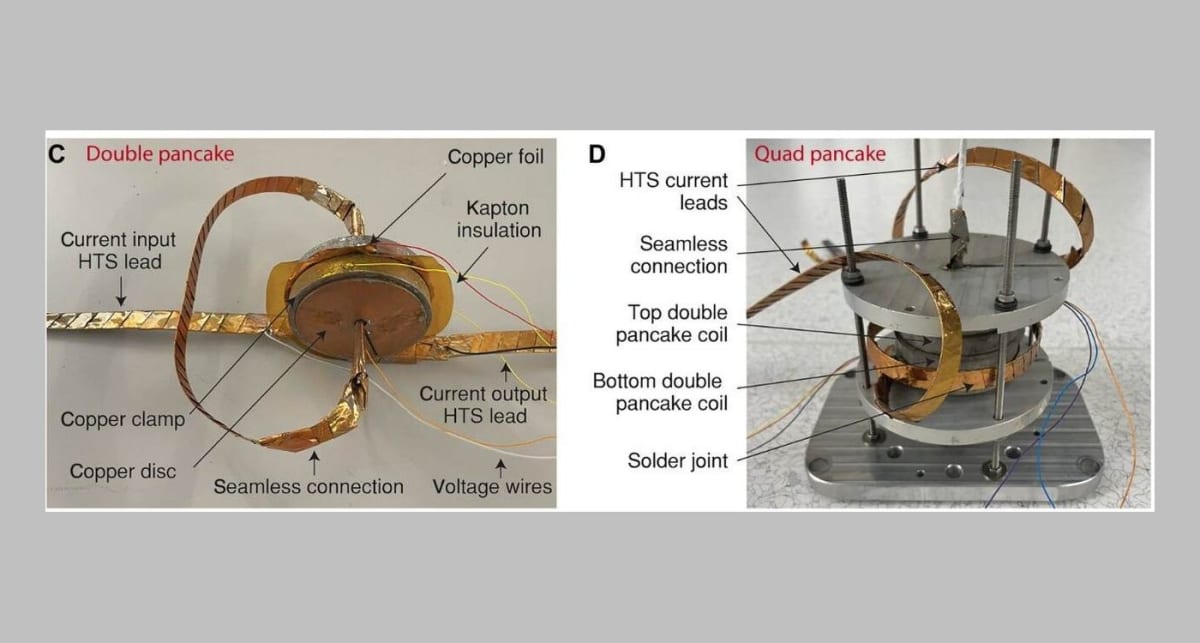
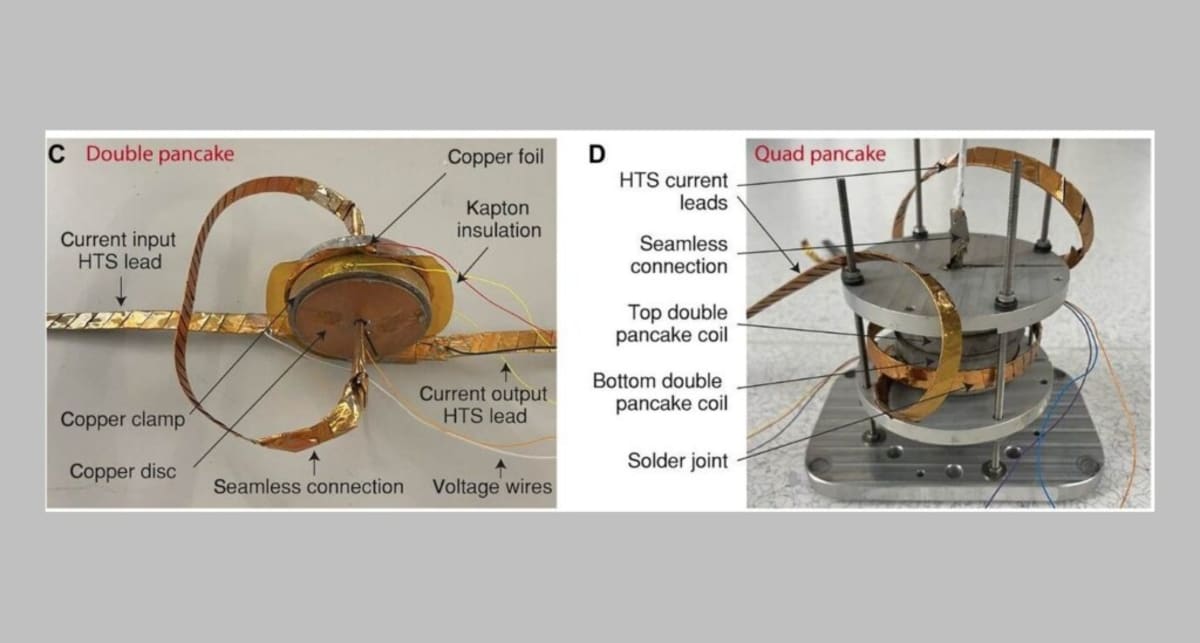
The Swiss team's secret lies in how they wound special superconducting tape called REBCO (rare earth barium copper oxide) into tiny disk-shaped coils they call pancakes. By stacking these pancakes together, they concentrated immense magnetic power into a small space using much less material than traditional designs.
The smaller size actually makes the magnets more efficient. Without joints, breaks, or insulation between the coils, electricity flows through without any loss of conductivity, which means no extra power or cooling needed.
When researchers ran 1,000-amp currents through these compact coils, they successfully performed nuclear magnetic resonance, a high-tech method for examining subatomic particles. This test proved the little magnets could handle real scientific work, not just look impressive on paper.
The Ripple Effect
This advance could democratize access to cutting-edge science around the world. Right now, only major research institutions with millions in funding and massive facilities can run high-field magnetic experiments.
Shrinking these tools down to tabletop size means smaller universities, hospitals, and labs could afford equipment that was previously out of reach. Medical facilities could offer more advanced diagnostic imaging without building entire wings to house the machinery.
The implications extend to nuclear fusion research too, where powerful magnetic fields are essential for containing the super-hot plasma needed to generate clean energy. Smaller, more efficient magnets could accelerate progress toward practical fusion power.
ETH Zurich, one of the world's top engineering schools, built their prototypes without the complexity and expense that held back previous attempts. The elegant simplicity of their stacked pancake design shows that sometimes the best innovations come from rethinking the basics rather than adding more complexity.
The research team published their findings in Science Advances, opening the door for other scientists to build on their work and push these mini-mega magnets even further.
What once required a small building now fits in your hand, bringing tomorrow's science within reach today.
More Images
Based on reporting by Good News Network
This story was written by BrightWire based on verified news reports.
Spread the positivity!
Share this good news with someone who needs it